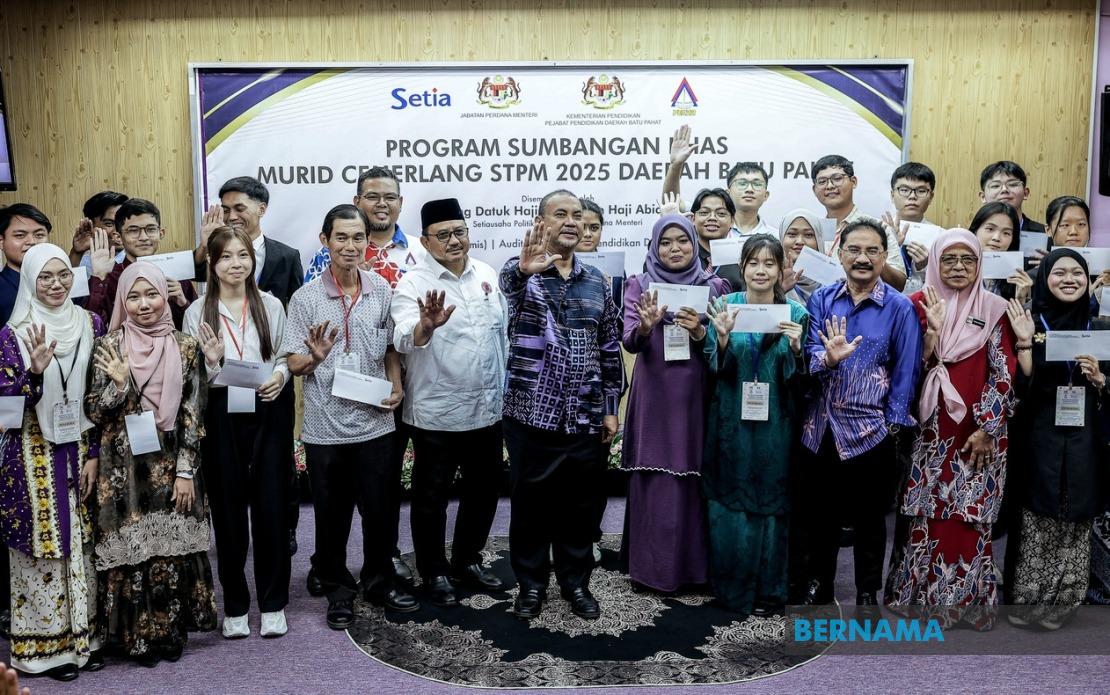
A group of 214 high-performing students who completed their 2025 Sijil Tinggi Persekolahan Malaysia (STPM) examinations in Batu Pahat have been recognized with special financial contributions from the Prime Minister's Office. The awards, distributed during a ceremony at the Batu Pahat District Education Office, represent a targeted initiative aimed at celebrating academic achievement while providing tangible support to students preparing for university life.
Datuk Azman Abidin, Political Secretary to the Prime Minister, oversaw the presentation of the contributions to the 214 recipients drawn from 16 secondary schools across the district. In remarks to the gathered audience and media representatives, Azman emphasized that the programme serves as both recognition and encouragement for the cohort to maintain their academic standards and serve as positive role models within their communities. The initiative reflects a broader government priority of investing in students who demonstrate exceptional performance during their final years of secondary education.
The underlying motivation for the contribution scheme centers on supporting Malaysia's most capable young people as they navigate the crucial transition from secondary school to tertiary institutions. By providing financial assistance to top achievers, the government aims to remove or reduce potential barriers related to the costs associated with university preparation and early studies. This approach acknowledges that financial constraints can sometimes prevent even accomplished students from pursuing their aspirations, particularly in families with limited disposable income. The contribution thus functions both as recognition and as practical support during a formative period.
Azman indicated that the programme has been designed with flexibility in mind, contingent upon available government funding. He expressed the government's intention to extend the initiative to other districts and localities beyond Batu Pahat, suggesting that successful implementation in the initial location may serve as a model for expansion. This phased approach allows policymakers to assess the programme's effectiveness and impact before committing to broader rollout, while also managing fiscal considerations. The statement signals commitment to rewarding academic excellence across different regions of Malaysia.
The contribution initiative also communicates a broader message about government priorities and values. By publicly recognizing and rewarding student achievements, authorities demonstrate institutional care for education and youth development. Such symbolic gestures, coupled with material support, can strengthen the perception that academic excellence is valued by the state and that pursuing studies seriously yields tangible recognition. For recipient students and their families, the contribution serves as official validation of their efforts and encouragement to continue pursuing higher learning.
One beneficiary of the programme, 20-year-old Afida Auni Airulnizam, a former student of Sekolah Menengah Kebangsaan Tun Sardon in Rengit, spoke about the personal significance of receiving the contribution. Beyond the financial value, she described the award as meaningful recognition of her academic journey, providing psychological reinforcement as she prepares for the next phase of her education. Her family structure, with an older brother already pursuing university studies, has created a supportive environment where advancing to tertiary education represents a shared family aspiration. She views the contribution as both validation of her own achievements and practical assistance in realizing her goal of studying sports science at the tertiary level.
Afida's trajectory illustrates the broader pattern among many Malaysian students where family members already engaged in higher education provide both inspiration and precedent for younger siblings. The availability of peer role models within the family unit can significantly influence educational aspirations and persistence, particularly when combined with parental encouragement and material support. Her intention to follow her brother's path into university education demonstrates how family dynamics and individual achievement interact to shape educational outcomes. The Prime Minister's contribution adds external validation to the educational values already embedded within her family context.
Another award recipient, Muhd Ammar Firdaus Mohd Fadzil, 20, a former student of Sekolah Menengah Kebangsaan Tun Ismail, welcomed the initiative with particular emphasis on its financial dimension. He noted that the contribution meaningfully addresses the practical costs associated with preparing for and entering tertiary institutions. For students from middle-income or lower-income family backgrounds, expenses related to university applications, entrance examinations, accommodation arrangements, and initial study materials can represent significant financial burdens. The government's contribution helps alleviate these pressures, allowing talented students to focus on their studies rather than worrying about financial constraints.
The programme's timing, occurring just as successful STPM candidates begin their transition toward university applications and enrollment, makes the contribution particularly valuable. Students at this stage face multiple expenses including university application fees, accommodation deposits, and initial semester costs. By providing recognition-based contributions during this critical window, the government removes certain financial obstacles that might otherwise force capable students to delay studies or choose educational pathways based primarily on affordability rather than aptitude and interest. This targeted support can therefore have outsized impact on educational outcomes and career trajectories.
The expansion plans referenced by Azman suggest that if sustained, this initiative could become a regular component of Malaysia's approach to supporting top-performing students. Should the programme expand to other districts and achieve continued funding, it could benefit thousands of high-achieving STPM students nationwide. The potential scope of such an expanded programme could reshape how the government recognizes and supports academic excellence, moving beyond symbolic recognition toward material investment in the students most likely to contribute significantly to the nation's development. The initiative thus represents not merely a one-time distribution but potentially a structural change in how Malaysia invests in its most accomplished youth.
For students and families in Batu Pahat and beyond, the programme signals that academic excellence receives tangible recognition from national leadership. This messaging carries particular weight in Malaysian society where education has historically served as a pathway to upward mobility and professional advancement. When the highest levels of government publicly reward academic achievement with financial contributions, it reinforces cultural values emphasizing study and intellectual development. For younger students still in secondary school, witnessing their predecessors receive official recognition and support may serve as motivation to aspire toward similar achievements. The programme thus operates simultaneously as recognition, support, and incentive across different student cohorts.

