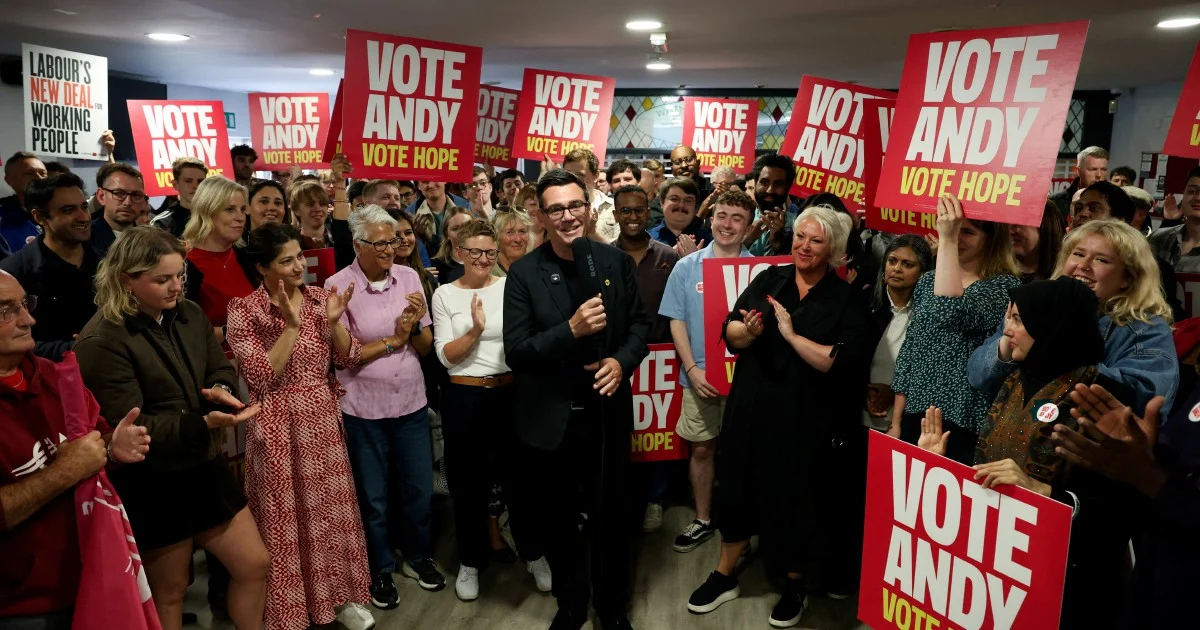
Andy Burnham's ambitions to eventually challenge Keir Starmer's position as Britain's Prime Minister have been significantly strengthened by an unexpected political development: the widening rift between two populist parties on the right side of the political spectrum. As voters prepare to cast ballots in Thursday's election for the Makerfield seat, the fractious relationship between competing conservative factions threatens to dilute their collective electoral strength, potentially benefiting Burnham's Labour campaign more through their mutual antagonism than through any particular advantage of his own political stature.
The dynamics playing out in Makerfield represent a broader phenomenon reshaping British electoral politics. When opposition parties fracture along ideological lines without consolidating behind a single alternative to the governing party, the governing party often gains unexpected advantages. Rather than voters uniting around one conservative standard-bearer, the presence of two competing right-wing movements effectively splits the anti-Labour vote. This mathematical quirk of Britain's first-past-the-post electoral system means that candidates can sometimes secure victory with substantially lower overall vote shares simply because their opponents carve up the remaining electorate between themselves.
Burnham's position as a senior Labour figure seeking to maintain and expand his party's dominance in this constituency depends significantly on this fragmentation. Without the organisational coherence and unified messaging that might characterise a single opposition bloc, the competing parties on the right spend considerable energy attacking each other rather than mounting a coordinated assault on Labour's hold on Makerfield. This mutual hostility and competition for votes among right-wing voters fundamentally weakens their collective ability to challenge the incumbent Labour representative.
The implications for Southeast Asian observers watching British politics are worth noting, particularly for those monitoring how populist movements operate within developed democracies. Britain's experience suggests that fractionalised anti-establishment movements, despite their apparent strength in capturing voter dissatisfaction, can inadvertently strengthen the very establishments they seek to overturn. When multiple populist parties emerge without a clear merger or alliance, they often cannibalise each other's support while allowing centrist or centre-left parties to consolidate power through plurality rather than majority appeal.
Burnham himself represents a particular strain of Labour politics that blends traditional working-class representation with more contemporary progressive politics. His Makerfield constituency provides a testing ground for Labour's ability to hold traditionally working-class heartland seats amid the fragmented opposition landscape. The seat's characteristics as a former mining and manufacturing area make it symbolically important to Labour's claims of representing Britain's post-industrial communities, even as those communities increasingly fragment along multiple political dimensions.
The feuding right-wing parties pursuing victory in Makerfield highlight how personality-driven politics and competing visions for conservative governance can undermine broader political objectives. Rather than settling on a single champion who might consolidate conservative voters, the competing populist movements each insist on their own distinct identity and leadership. This stubbornness, while reflecting genuine ideological and personality-based differences, ultimately works against their collective electoral prospects. For voters seeking a real alternative to Labour, the multiplication of right-wing choices paradoxically reduces their effective power to achieve that alternative.
Starmer's government benefit from this opposition disarray at a critical moment. As new administrations typically face public scrutiny and pressure regardless of their policies, having a splintered opposition means Labour can govern with less organised pressure from a unified alternative. The absence of a credible single opposition bloc allows Starmer more political space to implement his agenda and define the political narrative without facing a cohesive counter-narrative from the right.
Burnham's personal trajectory matters here as well. As the Mayor of Greater Manchester, he has developed a regional power base independent of central Westminster politics. His Makerfield bid signals his intention to maintain a traditional parliamentary seat while potentially advancing higher. The weakness of his right-wing opposition in this seat essentially gifts him the electoral infrastructure and incumbent advantages he needs to build his national political platform. Without serious organised competition, even a politician with limited personal magnetism can secure victory.
The broader strategic question facing British conservatism concerns whether this fractionalisation will eventually resolve through merger, alliance, or continued fragmentation. Historical precedent suggests that divided opposition movements eventually consolidate, though that consolidation often requires years and significant internal negotiation. Until such resolution occurs, candidates like Burnham benefit from the temporary political advantage that comes from competing against divided adversaries rather than unified alternatives.
Looking ahead to Thursday's ballot, Burnham's position reflects less a personal political mandate than the structural advantage created by his opponents' inability to cooperate. This distinction matters because it shapes what kind of mandate he can claim and how effectively he might later advance claims to higher office. A victory built on opposition fragmentation rather than genuine personal support proves more fragile than one built on positive voter endorsement. As British voters weigh their choices across multiple parties, the consequences of that political fragmentation will reverberate well beyond Makerfield, shaping the competitive landscape for years to come.