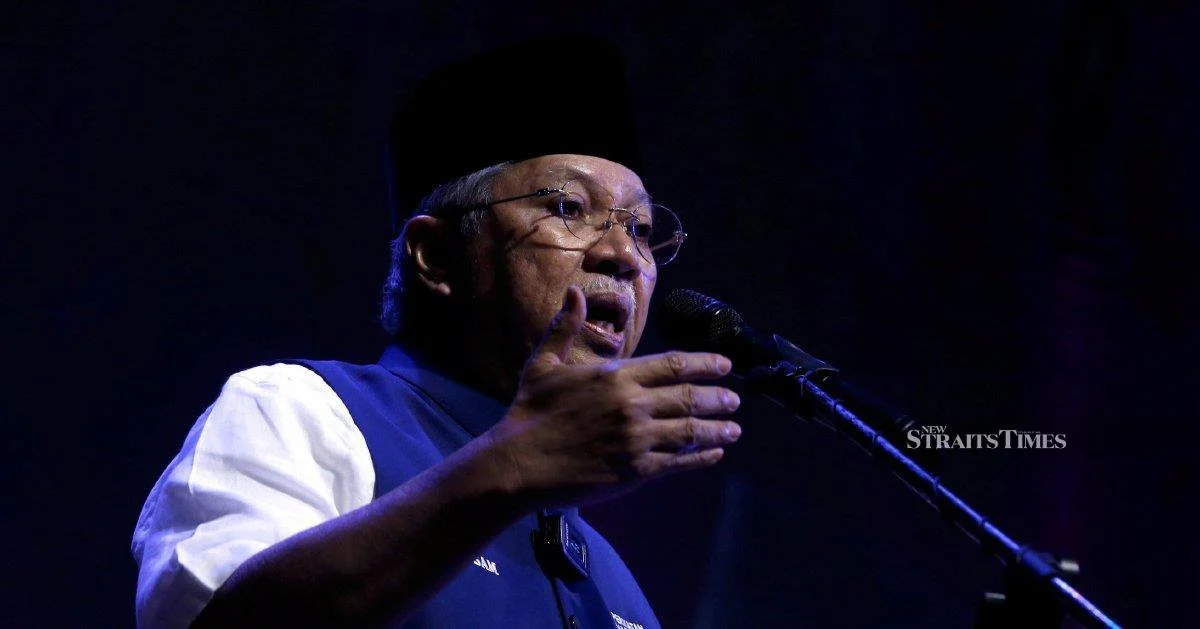
Finance Minister Annuar Musa has issued a carefully-worded plea for Bersatu to maintain composure and resist the urge to issue hasty public statements as Perikatan Nasional navigates a period of notable internal friction. The counsel reflects growing concern within leadership circles that inflammatory rhetoric or premature positioning could destabilize the opposition coalition further, undermining its credibility at a time when unity messaging appears increasingly fragile.
Annuar's intervention signals that senior figures across the coalition recognize the delicate equilibrium required to hold together Perikatan Nasional's disparate factions. The call for restraint represents an implicit acknowledgment that various component parties harbour different strategic interests and interpretations of coalition direction. Bersatu, as the largest party within PN and a potent political force in its own right, commands particular attention; its public statements carry outsized weight in shaping market sentiment and broader perceptions of coalition viability.
The timing of Annuar's remarks underscores mounting pressure from multiple quarters. Coalition tensions have periodically erupted into public disputes that damage the opposition's standing and invite criticism from government supporters who characterize PN as unstable and unfit for governance. Each public quarrel provides ammunition for Barisan Nasional and government narratives questioning whether the coalition possesses the discipline and maturity required for executive responsibility. The request for measured responses reflects awareness that every statement becomes weaponized in ongoing political contests.
For Malaysian observers, Bersatu's position within Perikatan Nasional carries particular significance given its recent trajectory and evolving electoral calculations. The party confronts pressure from multiple directions: maintaining coherence with coalition partners, preserving internal party unity, and advancing its own political positioning ahead of future electoral contests. These competing imperatives sometimes pull in divergent directions, creating the friction evident in recent coalition dynamics.
The broader PN coalition encompasses ideologically diverse partners with distinct power bases, constituencies, and policy preferences. Islamic party PAS maintains formidable rural machinery and grassroots mobilization capacity, while Bersatu brings urban middle-class appeal and administrative experience from government service. Smaller components contribute specialized regional strengths or niche constituencies. This heterogeneity generates resilience but also creates fault lines susceptible to friction under pressure.
Contextualizing Annuar's intervention requires understanding the coalition's recent trajectory. Perikatan Nasional has sought to present itself as a credible alternative government framework, challenging Barisan Nasional and ambitious Pakatan Harapan. Yet internal discord repeatedly undermines this messaging, allowing opponents to characterize PN as fractious and unreliable. Public disagreements between component parties contradict unified governance narratives and invite unflattering media coverage questioning coalition durability.
The injunction against premature statements reflects sophisticated awareness that coalition management in contemporary Malaysian politics demands careful calibration. Public positions become immediately subject to interpretation, media analysis, and strategic deployment by competing factions. Hasty commentary risks hardening positions, limiting negotiating flexibility, and creating rhetorical commitments that complicate subsequent compromise. Measured silence often serves coalition interests better than reactive public posturing, particularly when underlying issues remain under negotiation or when positions have not achieved full internal alignment.
For Bersatu specifically, Annuar's counsel carries practical implications regarding party discipline and internal communication protocols. Senior leaders must balance responsiveness to party grassroots expectations against broader coalition imperatives. Party members and supporters naturally expect timely public responses to developments affecting party interests; managing these expectations while maintaining coalition discipline requires sophisticated political communication. The tension between party advocacy and coalition loyalty creates recurring management challenges for Bersatu's leadership.
Regional implications merit consideration as well. Southeast Asia's opposition movements frequently struggle with coalition cohesion, organizational discipline, and sustained strategic coordination. Malaysian political observers watch Perikatan Nasional's management of internal tensions partly because the coalition's success or failure offers lessons about opposition viability across the region. Coalition breakdowns or dysfunction reinforce narratives about ruling party superiority and government sustainability—dynamics relevant across Southeast Asia where alternating power remains contested.
Annuar's position as Finance Minister adds institutional weight to his intervention. His role in government suggests he commands broader political standing beyond narrow party constituency, enabling him to speak with perceived authority on matters affecting national governance. The Finance Ministry portfolio carries particular salience in coalition politics because budget allocation, fiscal policy, and economic management intersect with party interests and coalition negotiations. Annuar's perspective reflects experience managing these intersections from government perspective.
Moving forward, the sustainability of Perikatan Nasional likely depends significantly on whether component parties successfully internalize and operationalize the restraint that Annuar advocates. Coalition members must develop mutual trust sufficient to withstand inevitable disagreements without immediately weaponizing disputes through media channels. This requires evolved political maturity, sophisticated communication protocols, and shared commitment to coalition longevity that transcends short-term tactical advantages.
The broader question confronting Malaysian politics remains whether opposition coalitions can achieve sufficient internal discipline and coherence to function effectively as alternative governments. Perikatan Nasional's response to current tensions may illuminate answers to this fundamental question, with implications extending well beyond immediate coalition dynamics into the broader trajectory of Malaysian democratic contestation and governance alternatives.