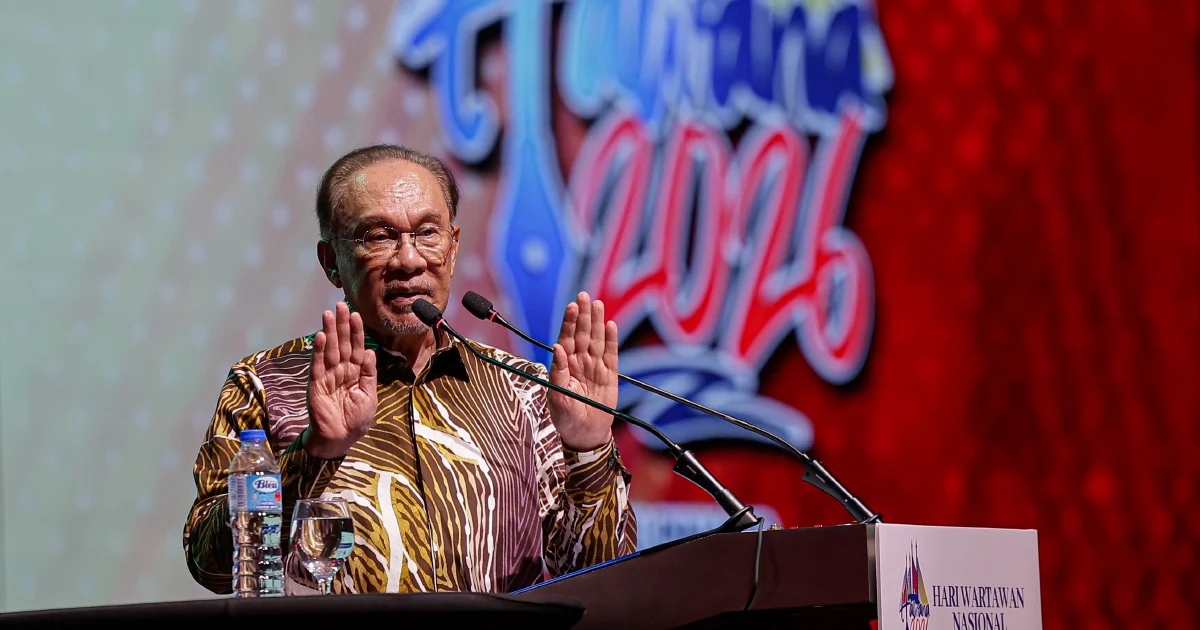
Prime Minister Datuk Seri Anwar Ibrahim has expressed confidence that the appointment of retired Federal Court judge Tan Sri Nallini Pathmanathan as the new chairman of the Malaysian Media Council (MMC) will substantially strengthen the institution's standing with the Malaysian public. Anwar made these remarks during an appearance in Butterworth, signalling the government's backing for the leadership transition at the media regulatory body. His public endorsement underscores the significance attached to the appointment, which comes as the MMC navigates evolving challenges in media governance and public accountability.
The recruitment of Nallini, whose distinguished judicial career spanned the Federal Court, represents a strategic move to elevate the council's profile and position it as a more credible arbiter of media standards. Her appointment carries particular weight given her background in constitutional and administrative law, areas directly relevant to media regulation and freedom of expression. By placing a jurist of her standing at the helm, the government appears intent on signalling that the MMC operates with independence and professional rigour. Anwar's vocal support suggests this selection reflects broader cabinet consensus regarding the need to rebuild institutional trust.
Mediation between press freedom and regulatory authority remains a delicate balance in Malaysia, where media dynamics have shifted markedly in recent years. The rise of digital platforms and social media has fractured the traditional media landscape, challenging the MMC's established mechanisms for oversight and accountability. Traditional print and broadcast outlets now compete with online news portals and user-generated content, creating regulatory gaps and enforcement complications. Against this backdrop, the appointment of a figure with deep legal expertise and judicial demeanour could help the MMC navigate these technical and philosophical complexities more effectively.
The timing of Nallini's appointment carries broader implications for Malaysian governance. The MMC has faced intermittent scrutiny over its effectiveness, with critics questioning whether its codes of ethics command sufficient compliance from major media outlets. Industry observers have noted that public confidence in the council's adjudication processes has been variable, with some stakeholders perceiving decisions as inconsistent or insufficiently transparent. Nallini's juridical background and her track record on the Federal Court bench suggest she may bring increased rigour to adjudication procedures and clearer articulation of reasoning behind regulatory decisions. This could address longstanding complaints about procedural opacity.
For Southeast Asian context, Malaysia's media regulatory framework operates within a regional spectrum of oversight approaches. While some neighbouring countries maintain state broadcaster dominance or more prescriptive control mechanisms, Malaysia has endeavoured to develop a self-regulatory system centred on the MMC. This model sits between libertarian approaches and authoritarian control, attempting to balance legitimate public interest protection with media independence. The success of such hybrid arrangements depends heavily on the perceived legitimacy and competence of regulatory institutions. Anwar's confidence in Nallini's appointment reflects recognition that institutional credibility directly determines whether self-regulation functions effectively or becomes contested.
Nallini's judicial experience on the Federal Court provides several relevant foundations for her new role. Federal Court judges engage routinely with constitutional law, fundamental liberties, and administrative justice—domains that intersect significantly with media freedom questions. Her exposure to constitutional principles governing expression and information rights, along with her understanding of administrative law concerning government action review, positions her to understand both the rights framework and the practical governance context within which media regulation operates. This combined knowledge base addresses a perceived gap in prior MMC leadership selections.
The appointment also signals potential shifts in how the council approaches its stakeholder engagement. Judges typically emphasize procedural transparency, reasoned decision-making, and separation between adjudication and policy advocacy. Should Nallini extend these values to the MMC's operations, the council might implement more systematic approaches to explaining decisions, clearer complaint procedures, and enhanced accountability mechanisms. These operational refinements could gradually rebuild institutional legitimacy among both media practitioners and the broader public, who have historically received limited visibility into the council's internal processes.
For Malaysian journalists and media operators, Nallini's appointment carries mixed significance. Industry figures supportive of robust self-regulation may welcome her judicial credentials as enhancing the MMC's independence from political interference. Conversely, those suspicious of media regulation generally might view her background in formal legal and institutional frameworks as potentially restrictive. Her inaugural period will likely involve extensive stakeholder consultation to establish her credibility across these divergent constituencies. Building trust with media practitioners represents an immediate challenge, as their cooperation remains essential for effective regulation.
Public trust restoration requires tangible operational changes beyond leadership appointments alone. The MMC will need to demonstrate enhanced transparency in complaint handling, publish detailed reasoning for adjudications, and explain how the council balances competing principles of media freedom and public protection. Nallini's experience navigating complex legal disputes could translate into clearer public communications about how the council reaches difficult decisions involving expression rights and social responsibility. If she implements systematic communication strategies explaining regulatory judgments in accessible language, public understanding of the MMC's legitimacy and authority could improve meaningfully.
The institutional challenges facing the MMC extend beyond perception management to substantive regulatory questions. Digital media convergence means that content increasingly blurs boundaries between news reporting, commentary, entertainment, and advertising. Traditional codes developed for distinct print and broadcast sectors apply awkwardly to integrated digital platforms. Nallini's appointment suggests the government recognizes that addressing these substantive evolution questions requires judicial-quality thinking about regulatory principles and their contemporary application. Her background suggests capacity to undertake this conceptual work systematically.
Anwar's explicit articulation of confidence in Nallini also carries implicit political messaging. By publicly endorsing the appointment and emphasizing its legitimacy-building potential, the Prime Minister positions the government as committed to institutional strengthening rather than instrumentalizing regulation for political advantage. This framing matters particularly given Malaysia's historical concerns about media governance being captured for partisan purposes. Demonstrating that major regulatory appointments proceed on merits rather than political loyalty helps stabilize democratic institutions more broadly.
Looking forward, Nallini's tenure at the MMC will be measured against whether public confidence in the council's judgments and processes demonstrably increases. This requires consistent, principled decision-making that media practitioners, academics, civil society observers, and the general public can collectively recognize as fair-minded and independent. Her judicial background provides initial credibility, but only sustained performance delivering transparent and well-reasoned oversight will substantively strengthen the public trust that Anwar predicts her appointment will generate.

