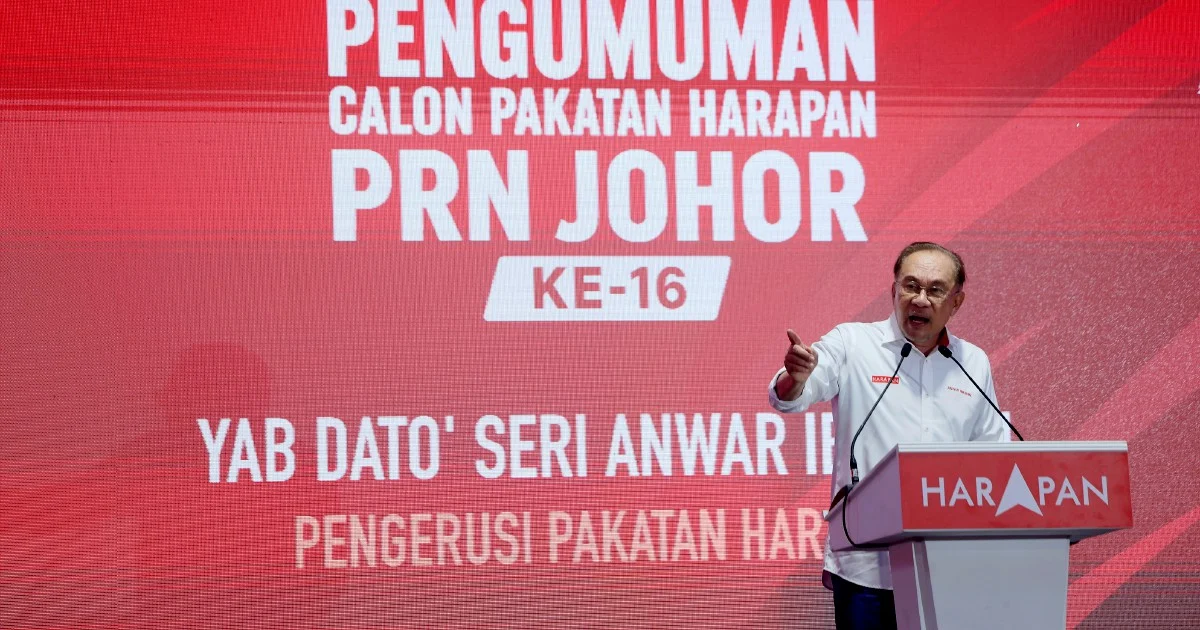
Prime Minister Datuk Seri Anwar Ibrahim has called on the Johor executive council to take a more assertive stance in questioning previous federal administrations about how much revenue the state has rightfully received. Speaking in Tangkak, Anwar suggested that the Johor state government should press both the earlier Barisan Nasional and more recent Perikatan Nasional-led federal governments to justify their revenue distribution decisions, raising questions that appear to have been overlooked in past years.
The Prime Minister's remarks represent a significant moment in Malaysia's evolving federal-state relations, particularly as they touch on how resource allocation between Putrajaya and the states has been managed. Johor, as the nation's southernmost peninsular state and a critical economic hub with major ports, manufacturing sectors, and tourism infrastructure, has long occupied an important position in Malaysia's fiscal landscape. The implication in Anwar's statement is that Johor may not have benefited proportionally from federal revenue streams relative to its economic contributions and development needs.
This intervention by the federal leader underscores growing scrutiny of how previous administrations distributed resources to the states. Both Barisan Nasional, which governed Malaysia for decades before 2018, and Perikatan Nasional, which took power in 2020 following the political upheaval after Pakatan Harapan's election victory, face questions about the transparency and equity of their revenue-sharing arrangements. By publicly encouraging Johor to demand accountability, Anwar appears to be signalling that such accountability matters—and that current federal leadership, under his premiership since November 2022, is open to revisiting these calculations.
The timing of these remarks is noteworthy given the current political landscape in Johor. The state remains strategically important for the government's political standing, and ensuring that its leadership feels adequately supported by the federal administration is vital. Johor's relationship with Putrajaya can influence both state-level policy implementation and broader political dynamics in the southern region. By encouraging closer scrutiny of past arrangements, Anwar may be attempting to demonstrate that his government is more responsive to state concerns than its predecessors.
The question of fair revenue distribution between federal and state governments has long been contentious in Malaysian politics. States depend on federal allocations through the system of grants and development funding, creating an inherent power imbalance. Smaller or less economically developed states often require substantial federal support, while wealthier states like Johor may argue they contribute more in taxes and economic output than they receive in return. Understanding these dynamics is crucial for Malaysian readers, as revenue distribution affects everything from healthcare and education infrastructure to road development and social services at the state level.
Anwar's call for transparency suggests potential areas of concern that have not been fully addressed. Whether Johor genuinely faced disadvantageous treatment under previous administrations requires careful examination of budget documents, allocation formulas, and comparative spending across states. The Prime Minister's statement invites such scrutiny without definitively claiming that wrongdoing occurred, allowing room for investigation while placing pressure on past governments to defend their decisions.
For Southeast Asian observers, this situation reflects broader governance challenges across the region. Many countries struggle with balancing centralised federal authority against the legitimate expectations of states and provinces for equitable resource distribution. Malaysia's federal system, inherited from colonial arrangements and adapted since independence, continues to evolve in response to political pressures and changing economic realities. How successfully Anwar's government addresses these concerns could set precedents for federal-state cooperation under his leadership.
The executive council in Johor will now face pressure to act on Anwar's suggestion. Whether they will formally investigate past revenue decisions, request comprehensive audits, or formally petition the federal government for clarification remains to be seen. The state's response will indicate how seriously it takes these concerns and whether it is willing to challenge previous administrations' records—a politically sensitive undertaking if former leaders remain influential within local politics.
This development also reflects broader questions about historical accountability in Malaysian governance. As different administrations succeed each other, questions inevitably arise about decisions made by predecessors. Anwar's encouragement of scrutiny suggests openness to revisiting past arrangements, though translating this into concrete policy changes or compensatory measures would represent a more substantial commitment. The message to state governments appears to be that the current federal administration invites questions and dialogue about previous arrangements.
Looking forward, Anwar's remarks may signal the beginning of a process to recalibrate federal-state relations more broadly. If Johor pursues the line of inquiry the Prime Minister suggested, it could lead to broader discussions about revenue allocation across all Malaysian states. This could ultimately benefit states that feel they have been shortchanged while also requiring the federal government to justify and potentially restructure how it distributes resources. For Malaysian readers, understanding these dynamics matters because improved federal-state cooperation can translate into better-funded and more responsive governance at the state and local levels.

