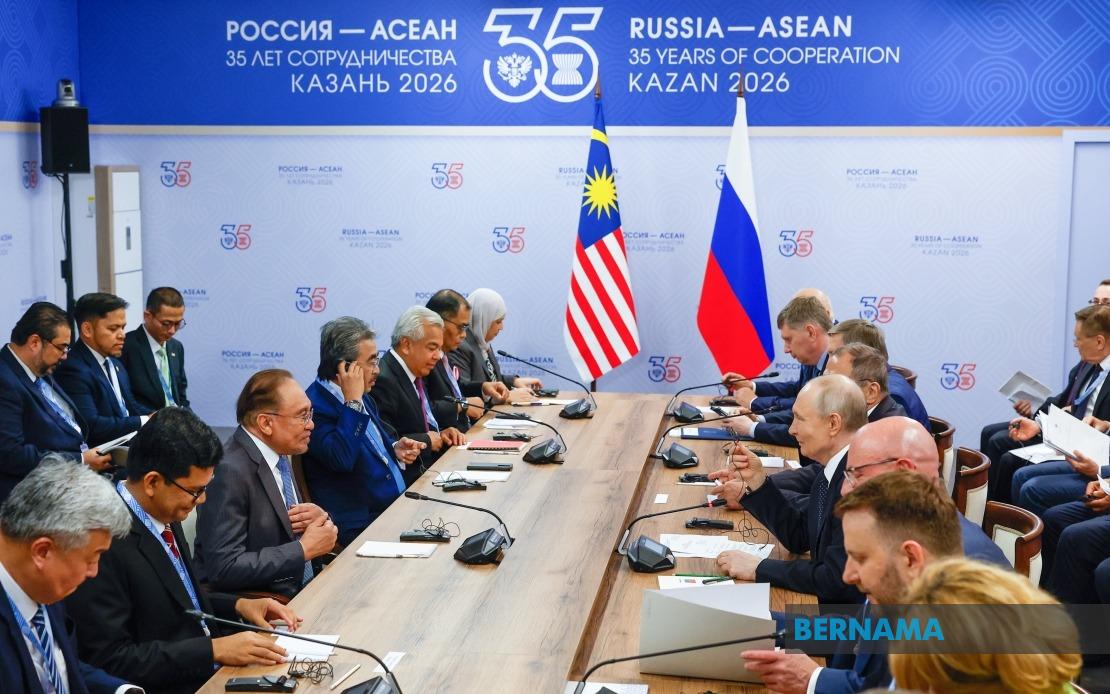
Prime Minister Datuk Seri Anwar Ibrahim has publicly commended Russian President Vladimir Putin and Chinese President Xi Jinping for their advocacy of peace and their denunciation of atrocities targeting civilians across West Asia, particularly in Gaza, Iran and Lebanon. The remarks were made during an exclusive interview with Russian state television network RT while Anwar was in Kazan for an official visit to commemorate the 35th anniversary of ASEAN-Russia relations, underlining Malaysia's diplomatic engagement with major powers on one of the most contentious geopolitical issues of our time.
Malaysia's position on Middle Eastern conflicts has been consistently principled and independent, Anwar stressed, emphasizing that his government has maintained a strong stance against military operations by Israel while declining to subordinate its foreign policy to any superpower or ideological bloc. This stance reflects decades of Malaysian diplomatic tradition but has taken on renewed significance in the context of recent escalations in the region. The Prime Minister pointed to Parliament's bipartisan decisions on the matter as evidence of the domestic consensus underpinning Malaysia's international positions, suggesting that this approach carries legitimacy beyond executive prerogative.
The Prime Minister's decision to highlight Putin and Xi's positions carries geopolitical weight for Malaysia and the broader Southeast Asian region. By publicly thanking these leaders, Anwar is signalling that Malaysia views their diplomatic stances as constructive contributions to regional stability, even as Western nations maintain different positions. This represents a deliberate choice to align Malaysia's messaging with non-Western perspectives on conflict resolution, reflecting the country's historical commitment to a multipolar approach to international relations rather than deference to Western-led consensus.
Crucially, Anwar distinguished between what Malaysia terms "centrality" and the concept of "neutrality," a semantic distinction that carries profound implications for how ASEAN nations understand their role in global affairs. The principle of centrality, as articulated by the Prime Minister, means that Malaysia will not remain passive or silent when confronted with what it characterizes as human rights violations, whether perpetrated against Gazans, Iranians, Lebanese civilians or any other population. This formulation allows Malaysia to take robust positions on specific issues while maintaining independence from broader superpower alignments, a balancing act that reflects the complexities of contemporary Southeast Asian diplomacy.
Anwar's diplomatic engagement on these issues has been comprehensive, encompassing interactions with leaders from the Gulf states, Pakistan, Turkey and Iran as part of a sustained effort to broker understanding and pursue equitable solutions. This multilateral approach demonstrates Malaysia's self-perception as a bridge-builder and honest broker in regional conflicts, leveraging its relationships across both Western and non-Western spheres to encourage dialogue. The Prime Minister expressed cautious optimism that these engagement efforts would contribute to more just outcomes, though he acknowledged the inherent difficulty in navigating such complex geopolitical terrain without compromising principles.
The Prime Minister levelled sharp criticism at what he characterized as Western hypocrisy in its treatment of Israeli military actions compared to similar conduct by other nations. Anwar questioned how the international community could simultaneously condemn aggression by some nations while endorsing or overlooking identical conduct when perpetrated by allies, particularly Israel with United States backing. This critique strikes at the heart of a broader debate within the Global South regarding the perceived double standards in international relations, where major Western powers appear to apply different moral standards depending on geopolitical interests.
Anwar specifically highlighted the inconsistency in international responses to Iranian actions, arguing that while some quarters criticize Iran's responses to perceived threats, there exists near-total silence regarding what he termed aggression and atrocities against Iran itself. This observation resonates strongly with many non-aligned nations that perceive structural bias in how Western media and governments frame Middle Eastern conflicts. The Prime Minister framed this contradiction not merely as inconsistency but as hypocrisy that undermines the credibility of international norms and institutions purporting to be universally applicable.
The economic dimensions of ongoing conflicts in West Asia, while acknowledged by Anwar, were presented as secondary to the fundamental principles at stake. The Prime Minister emphasized that the core issue transcends concerns about trade disruptions, supply chain disruptions, or energy prices, instead focusing on whether the international community will permit fundamental violations of sovereignty and human rights to persist unchallenged. This framing elevates the discussion beyond pragmatic calculations to matters of principle and institutional integrity, suggesting that Malaysia views these conflicts through a lens of long-term international order rather than short-term material interests.
The timing of these comments during an official visit to Russia carries symbolic significance, effectively positioning Malaysia as willing to engage substantively with nations that take independent stances on Middle Eastern questions. While Malaysia maintains relations with Western nations and remains strategically engaged with the United States and its allies, the decision to make these particular remarks in Kazan signals Malaysia's confidence in pursuing a genuinely independent foreign policy. This reflects a broader pattern across Southeast Asia of nations seeking to maximize their diplomatic flexibility and avoid being drawn into great power competition in ways that compromise their autonomy.
For Malaysia specifically and ASEAN more broadly, the articulation of a "centrality" doctrine represents an attempt to carve out policy space in an increasingly polarized international environment. Rather than accepting that nations must choose alignment with either Western or non-Western blocs, this approach posits that principled engagement with both spheres while maintaining independent judgment represents both possible and desirable. The success of this balancing act will likely depend on Malaysia's ability to sustain credible relationships across ideological divides while avoiding the appearance of pure opportunism or fence-sitting.
The Prime Minister's public commendation of Russian and Chinese positions should be understood within this broader strategic context. By publicly validating their diplomatic stances, Anwar strengthens Malaysia's credentials as an independent actor while simultaneously demonstrating to these powers that Malaysia recognizes and appreciates their contributions to regional diplomacy. This creates reciprocal incentives for continued engagement and suggests Malaysia's confidence that cooperation with Russia and China on specific issues need not preclude parallel relationships with Western nations on other matters.
Looking forward, Malaysia's articulation of these positions will likely influence broader ASEAN discourse on Middle Eastern conflicts and international norms more generally. As a significant voice within the organization and a respected diplomatic actor in Asia-Pacific affairs, Malaysia's framework of "centrality" versus "neutrality" may provide template language that other ASEAN members can adopt to reconcile their own commitments to principles with the practical necessities of engaging multiple great powers. This could gradually reshape how Southeast Asian nations collectively approach questions of international justice and humanitarian concern.

