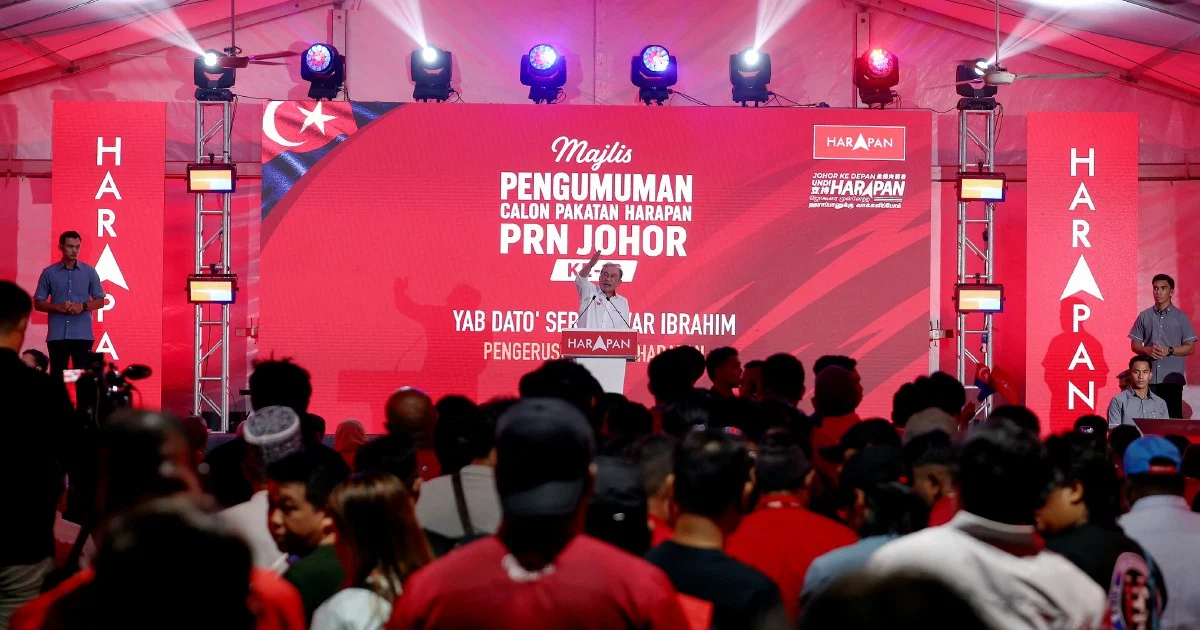
Prime Minister Anwar Ibrahim has drawn a clear line between electoral politics and the monarchy, urging that the forthcoming Johor state election be conducted as a political competition without the involvement of Malay Rulers' institutions. Speaking in Tangkak, the PH chairman emphasised the importance of maintaining this separation, reflecting broader concerns about the boundaries between Malaysia's constitutional monarchy and competitive democratic processes.
Anwar's statement carries particular weight in the Malaysian political context, where the role of Malay Rulers intersects with state governance in ways that can blur conventional democratic boundaries. The Johor sultanate wields considerable influence in state affairs, and tensions have periodically emerged regarding the extent to which royal institutions should engage with electoral politics. By explicitly advocating for a purely political battlefield, Anwar is signalling that PH believes the election should be determined by campaigning, popular support, and policy platforms rather than by any royal or institutional factors beyond the standard constitutional framework.
The timing of these remarks is significant given Johor's status as one of Malaysia's most politically contested states. The southern state has been a traditional stronghold for Umno and has witnessed intense competition between BN and opposition parties in recent electoral cycles. Johor's political fortunes carry implications for national stability, and the Prime Minister's intervention underscores PH's commitment to ensuring the contest unfolds according to democratic principles that have become increasingly important to urban and younger Malaysian voters.
Anwar's position also reflects the internal dynamics within the ruling coalition. Pakatan Harapan, which governs at federal level, comprises parties with diverse bases and ideologies. Some component parties maintain stronger ties to traditional institutions than others, and any perception that royal bodies were favouring particular candidates could exacerbate tensions within the coalition or undermine its campaign narrative. By staking out this position publicly, Anwar is reinforcing PH's modernising credentials and appeal to voters who prefer secular, transparent electoral processes.
The separation of electoral competition from royal involvement also touches on broader governance questions relevant to Southeast Asian democracies. Malaysia's constitutional monarchy provides checks and balances in the political system, but the extent to which royal institutions should be visibly partisan or engaged in electoral outcomes remains contested among constitutional scholars, political scientists, and civil society observers. Anwar's statement acknowledges this tension and comes down squarely on the side of traditional democratic norms.
For the Johor electorate, particularly middle-class and urban voters in cities like Johor Bahru, such assurances carry weight. These constituencies increasingly expect elections to be decided through conventional mechanisms: party platforms, candidate quality, manifestos, and debates rather than institutional endorsements that might appear to circumvent popular will. Anwar's framing taps into these expectations and positions PH as the party defending democratic integrity against any hint of institutional interference.
The opposition camp will likely scrutinise whether all political actors, including BN components, adhere to this principle throughout the campaign. Any appearance of royal bodies favouring one side could feed narratives of institutional bias, particularly if leveraged by incumbent coalitions facing electoral challenges. Anwar's preemptive statement thus functions partly as a warning to other political players that such actions would be noticed and criticised.
Moreover, Anwar's comments must be contextualised within the broader regional pattern where constitutional monarchies face pressure to clarify their role in competitive politics. Thailand's experience, where the monarchy has become entangled in political conflicts with destabilising consequences, serves as a cautionary tale for Malaysian observers who value stability. By advocating for clear separation between royal institutions and electoral competition, Anwar is implicitly drawing on lessons about institutional health and democratic longevity.
The statement also reflects calculations about PH's electoral prospects in Johor. If internal polling suggests the coalition is competitive or ahead, maintaining a clean political campaign without institutional complications benefits the party. Conversely, any suggestion of royal preference flowing toward BN could undermine PH's momentum and credibility. By establishing this expectation early, the coalition seeks to frame the electoral landscape in its favour and preempt accusations of unfairness if results disappoint.
For civil society groups monitoring electoral integrity in Malaysia, Anwar's position provides reference points against which to measure campaign conduct. Election observers and independent monitors can point to the Prime Minister's own statement when assessing whether all participants respected the principle he articulated. This creates accountability beyond party rhetoric.
Looking ahead, the Johor election will test whether Malaysian politics can accommodate genuine competition within the bounds of institutional respect. The ultimate proof of commitment to Anwar's principle will lie not in statements but in conduct—whether all parties, the ruling coalition and opposition alike, genuinely contest on political merits while honouring the separateness of electoral and royal domains.

