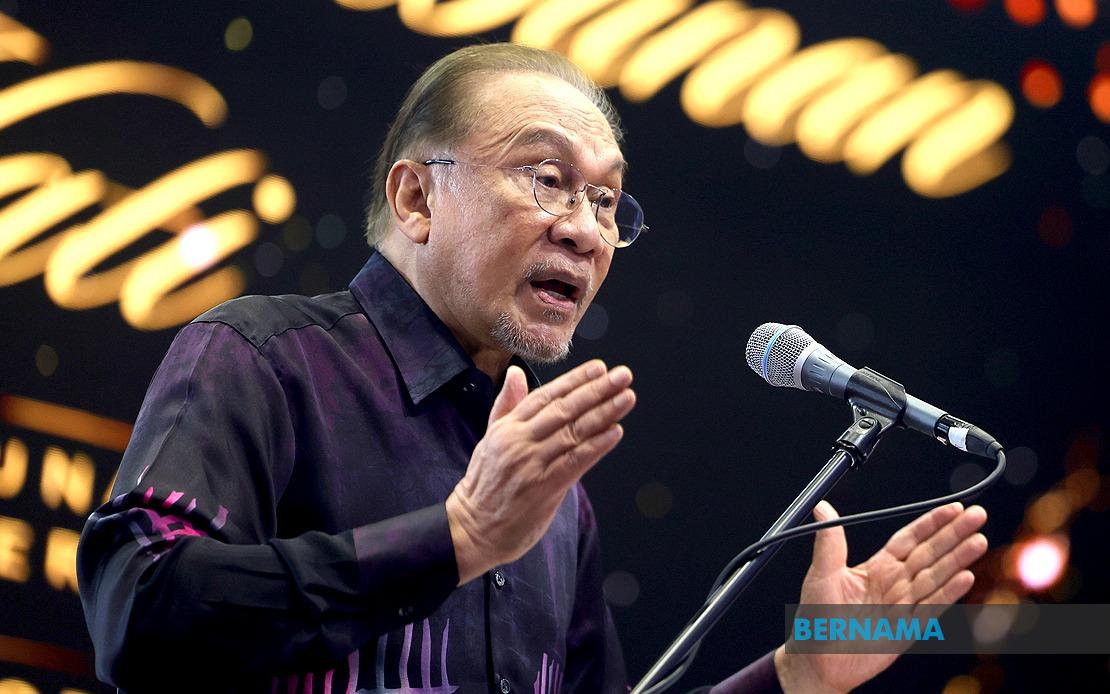
Prime Minister Datuk Seri Anwar Ibrahim has issued a direct appeal to Malaysians across all ethnic communities to stand firm against divisive rhetoric and preserve the country's foundational unity, warning that deliberate attempts to sow discord between racial groups threaten the nation's cohesion. Speaking at a gathering in Seremban attended by over 1,000 members of Pertubuhan Lima Generasi Malaysia, Anwar characterised efforts by some leaders to manufacture conflict between Malays, Chinese, Indians and other communities as fundamentally corrosive to Malaysia's interests.
The prime minister's remarks come at a time when Malaysia continues to grapple with periodic outbursts of inflammatory language and communal tension from various political quarters. By explicitly calling out leaders who deliberately peddle inter-ethnic animosity, Anwar sought to reinforce the government's position that national stability depends on citizens refusing to be drawn into manufactured grievances. His intervention suggests the administration views the protection of multicultural harmony as a priority that transcends partisan politics.
Anwar framed Malaysia's ethnic plurality not as a liability to be managed defensively, but as a genuine strategic asset that distinguishes the country in the region. This framing represents a deliberate contrast to zero-sum narratives that treat inter-communal relations as inherently competitive. According to the prime minister, the nation's strength flows from the degree to which its diverse populations actively reinforce mutual understanding and engage in substantive cooperation across ethnic lines, rather than merely coexisting.
The specific language Anwar deployed—invoking the notion that "some leaders want us to hate one another"—acknowledges an ongoing problem without necessarily pointing fingers at particular individuals or parties. This measured approach allows him to address the phenomenon of divisive rhetoric while avoiding the kind of targeted accusations that might invite retaliation or deepen partisan polarisation. Yet the clarity of his message leaves little doubt about his intended audience: political actors who calculate that stoking resentment serves their electoral or ideological purposes.
Regionally, Malaysia's trajectory regarding communal relations carries implications for Southeast Asia's broader stability. The ASEAN region encompasses numerous states wrestling with similar dynamics of ethnic and religious diversity, making Malaysia's experience—whether as a cautionary tale or a model—relevant to neighbouring governments. Leaders across the region watch closely how Malaysia manages these pressures, particularly given the country's historical record of negotiating plural societies without the kind of large-scale violence that has marked other multi-ethnic nations.
The event itself, held in Negeri Sembilan and attended by the state's Menteri Besar Datuk Seri Aminuddin Harun, carried symbolic weight. By positioning this message at a community-focused gathering rather than through a direct policy announcement, Anwar emphasised that the call for unity operates at the grassroots and civic level, not merely as government diktat. The presence of over 1,000 ordinary Malaysians served as both audience and, potentially, as multipliers who might carry the message into their own networks.
The challenge Anwar faces, however, extends beyond exhortation. While leaders can set the tone through rhetoric and by modelling inclusive behaviour, sustaining multicultural commitment requires institutional mechanisms, equitable governance, and economic policies that prevent any community from feeling systematically disadvantaged. Statements advocating unity ring hollow if accompanied by exclusionary practices or if material inequalities generate genuine grievances that political entrepreneurs can exploit.
Malaysia's experience over recent decades suggests that interlocking factors maintain communal stability: a constitutional settlement that provides autonomy and protections to different groups, a relatively intact civil service and judiciary that command cross-community respect, and an economy large enough to generate opportunities that reduce zero-sum competition. When any of these elements weaken, inflammatory rhetoric finds more receptive audiences. Anwar's intervention implicitly acknowledges this reality by grounding his appeal in the mutual benefit of cooperation rather than merely in abstract constitutional principles.
The Prime Minister's invocation of "Malays, Chinese, Indians, Kadazans and others... united and working together as one strong force" also reflects a deliberate rhetorical choice. By naming multiple communities and using inclusive language that extends beyond the conventional "Bumiputera" versus "non-Bumiputera" dichotomy, he attempted to counter narratives that reduce Malaysian diversity to a binary competition. This framing potentially opens conceptual space for coalitional politics that cross traditional fault lines.
Looking forward, the sustainability of Anwar's message will depend substantially on political developments in the coming months. If other significant leaders endorse or amplify his call, momentum builds. Conversely, if rival factions or parties respond with counter-narratives emphasising community particularism or grievance, the effect of his statement may dissipate. The coming months will test whether this represents a genuine reorientation of political discourse or a temporary articulation quickly overwhelmed by more parochial pressures.
For Malaysian citizens and observers, Anwar's address serves as a reminder that political leaders retain agency in setting the tone for intercommunal relations. By explicitly rejecting divisive framing and appealing directly to shared national interest, he has staked out a position that, if consistently maintained and supported by policy, could help insulate Malaysia from the kind of communal polarisation that has damaged neighbouring countries. Whether that potential translates into sustained practice remains an open question.

