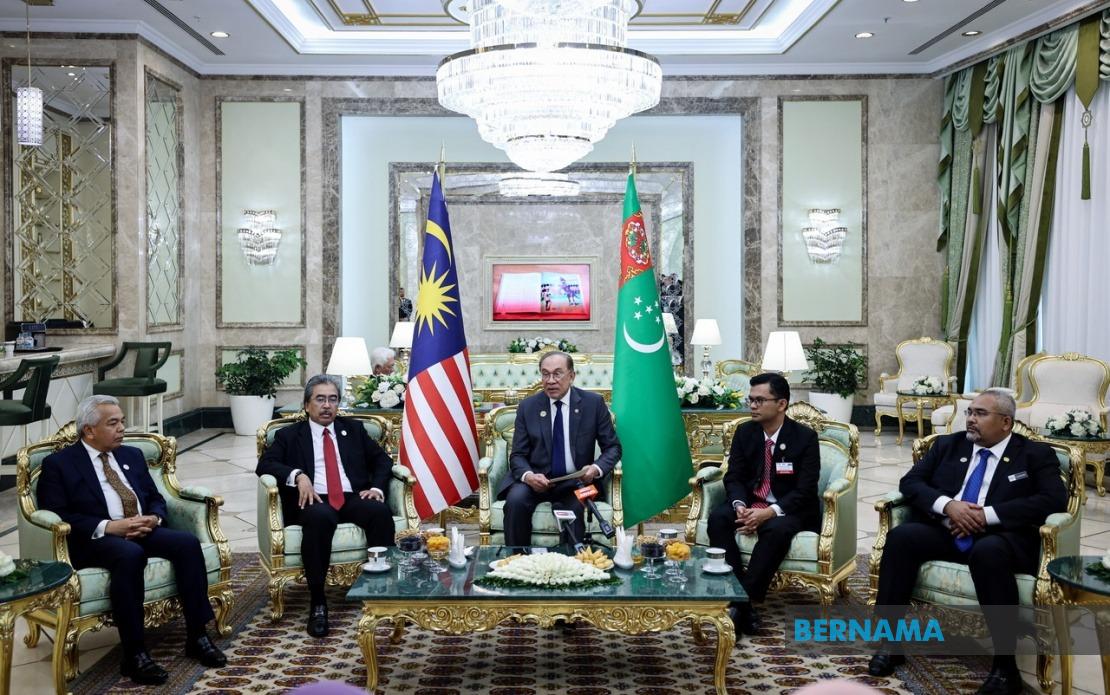
Prime Minister Datuk Seri Anwar Ibrahim has characterized his official working visit to Turkmenistan as a productive engagement that has successfully advanced Malaysia's strategic positioning in Central Asia whilst bolstering the framework for deeper bilateral cooperation. Speaking from Kuala Lumpur following the two-day mission that commenced on June 18, Anwar emphasized that the visit fulfilled its core diplomatic objectives and represents a meaningful expansion of friendly relations between Kuala Lumpur and Ashgabat at a time when Malaysia is actively diversifying its international partnerships across emerging markets.
Central to Anwar's assessment is the identification of the energy sector as a cornerstone for future collaboration, a finding that carries significant implications for Malaysia's long-term resource security and economic strategy. Turkmenistan, positioned as Central Asia's dominant natural gas producer with vast hydrocarbon reserves, presents a compelling opportunity for Malaysian interests, particularly through PETRONAS, which has historically sought to expand its upstream operations and trading portfolios beyond conventional Southeast Asian markets. The visit appears to have established preliminary groundwork for exploring avenues through which Malaysian companies might participate in Turkmenistan's energy infrastructure, a sector where the Central Asian nation continues to seek international capital and technical expertise to enhance production and export capabilities.
This inaugural official visit since Anwar assumed office as Malaysia's 10th Prime Minister in November 2022 reflects a deliberate diplomatic strategy to expand Malaysia's footprint beyond its traditional regional focus. The timing and composition of the delegation underscore the government's commitment to this engagement, with Anwar accompanied by heavyweight ministerial figures including Minister of Investment, Trade and Industry Datuk Seri Johari Abdul Ghani and Minister of Economy Akmal Nasrullah Mohd Nasir, alongside senior officials from the Prime Minister's Office and the Foreign Ministry. This high-level representation signals to Turkmenistan's leadership that Malaysia views the relationship as meriting sustained attention at the highest levels of government.
President Serdar Berdimuhamedov's extension of a formal invitation to Anwar and the reported warm reception accorded to the Malaysian delegation indicates mutual interest in fostering closer ties during a period when both nations are reassessing their strategic partnerships. For Turkmenistan, engagement with Southeast Asian nations offers opportunities to diversify its diplomatic and economic relationships beyond Russia and China, whilst simultaneously exploring new markets for its energy exports and investment linkages. Malaysia, conversely, gains from cultivating relationships with Central Asian states as part of a broader pivot toward deepening ties with nations along traditional Silk Road corridors.
The emphasis placed on energy cooperation specifically reflects pragmatic recognition of where genuine mutual interests intersect. Malaysia's reliance on energy imports and PETRONAS's global exploration mandate align closely with Turkmenistan's need to maximize revenue from its hydrocarbon endowments. The potential for Malaysian investors to participate in infrastructure development, downstream processing, or energy trading arrangements could yield mutual benefits, though concrete details of any agreements or frameworks established during the visit remain limited in the public domain. Such collaborations would require careful navigation of geopolitical complexities, given Turkmenistan's historical positioning within the Russian sphere of influence and the broader regional strategic competition between major powers.
Anwar's public acknowledgment of the various stakeholders who contributed to the visit's success demonstrates awareness of the institutional ecosystem required to execute meaningful diplomatic missions. The Malaysian Embassy in Ashgabat, PETRONAS representatives, security personnel, and media contingents all played essential roles in ensuring the delegation's visit proceeded smoothly and generated appropriate diplomatic messaging. This attention to operational detail reflects the professionalization of Malaysia's diplomatic apparatus and the coordination required between government, state-linked enterprises, and supporting institutions to advance national interests abroad.
The visit occurs within a broader context of Malaysia seeking to strengthen its engagement with non-aligned and emerging market nations, particularly those positioned along strategic trade and energy routes. Turkmenistan's location at the crossroads of Central Asia, coupled with its vast natural gas reserves and strategic proximity to multiple regional powers, makes it a valuable interlocutor for Malaysia. Building relationships with such nations provides Malaysia with additional leverage in international forums, diversified economic partnerships, and alternative sources of critical commodities.
From a regional Southeast Asian perspective, Malaysia's proactive engagement with Central Asian partners signals that the nation continues to punch above its weight diplomatically despite its relatively modest economic scale. The willingness of Malaysian leadership to invest time and diplomatic capital in building relationships with distant partners demonstrates commitment to the principle of independent foreign policy and non-alignment, principles that have historically defined Malaysian statecraft. This approach also provides opportunities for Malaysian enterprises to identify and capitalize on economic opportunities in emerging markets before competitors from larger and wealthier nations establish dominant positions.
While the immediate outcomes of the Turkmenistan visit remain largely ceremonial in nature, the foundation laid through this high-level engagement could yield tangible dividends in energy trade, infrastructure partnerships, and investment flows over the medium term. The successful completion of this inaugural official visit suggests that Anwar's government is committed to executing an active foreign policy agenda that extends beyond ASEAN and traditional Southeast Asian partnerships. For Malaysian stakeholders monitoring developments in energy markets and international business opportunities, the Turkmenistan visit represents a potential opening for deeper commercial engagement in Central Asia, provided appropriate follow-up mechanisms and institutional arrangements are established to translate diplomatic goodwill into concrete business cooperation.

