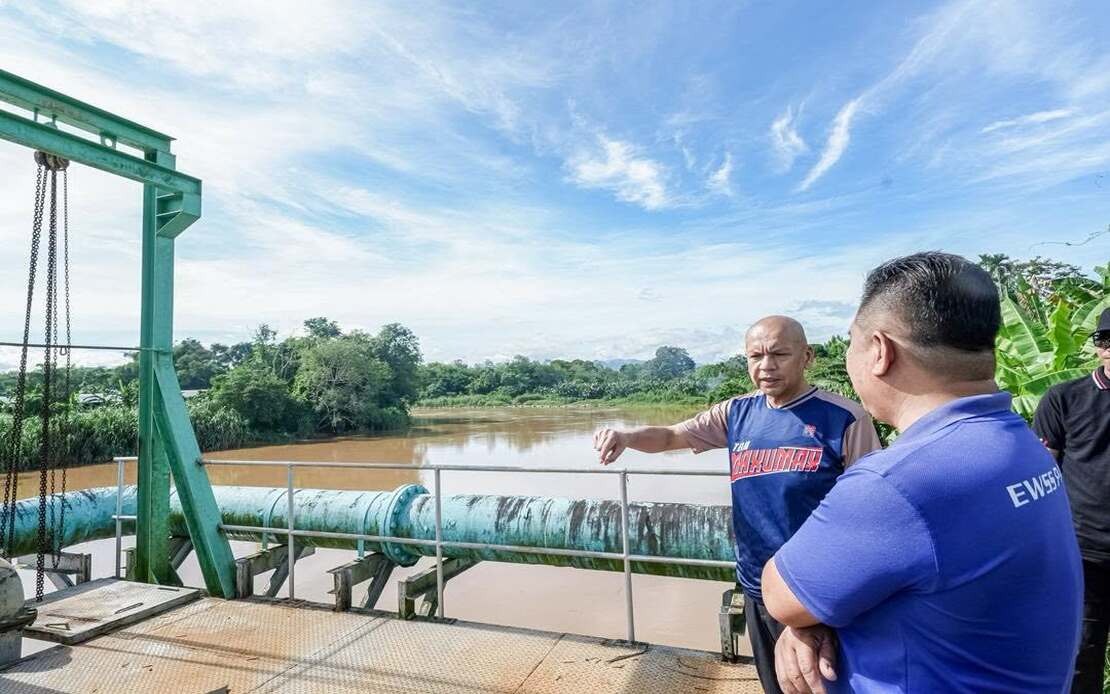
Papar's water infrastructure faces a critical expansion phase as Domestic Trade and Cost of Living Minister Datuk Armizan Mohd Ali conducted a comprehensive inspection of stabilisation projects designed to meet escalating local demand. The visit, undertaken by the Member of Parliament for Papar on June 19, followed discussions held four days earlier to assess implementation progress and ensure these initiatives deliver tangible improvements to residents experiencing chronic supply constraints.
Two cornerstone projects are advancing to substantially increase the district's water treatment capabilities. The Kogopon Water Treatment Plant is undergoing a significant capacity upgrade from its current 40 million litres per day to double that output at 80 million litres per day, addressing fundamental supply bottlenecks. Simultaneously, infrastructure improvements at the Kampung Kabang intake point are being executed to enhance the raw water sourcing infrastructure that feeds the treatment network. These complementary initiatives represent a coordinated strategy to strengthen both treatment capacity and source reliability across Papar's water system.
The expansion reflects growing recognition that Papar's existing infrastructure has struggled to keep pace with population growth and increasing per-capita consumption patterns typical of developing Malaysian districts. The doubling of the Kogopon plant's capacity indicates authorities have assessed demand trajectories over the medium term and determined current infrastructure can no longer sustain consumer needs during peak periods or under stress conditions. This proactive approach contrasts with reactive responses to supply crises and suggests integrated planning is guiding the broader rehabilitation effort.
However, the minister's visit also highlighted immediate operational challenges threatening current service reliability. The EWSS Plant and JETAMA Limbahau Plant both experienced temporary closures during the preceding week due to elevated turbidity levels in raw water sources entering their facilities. Turbidity—measured in nephelometric turbidity units (NTU)—indicates suspended particulates and sediment that compromise water quality and can damage treatment equipment if concentrations exceed operational thresholds. These disruptions forced both plants to suspend operations until incoming raw water quality improved sufficiently for safe processing.
Raw water turbidity problems underscore vulnerability in Papar's source water quality management and suggest seasonal or episodic events—possibly heavy rainfall, upstream agricultural runoff, or land disturbance—can rapidly degrade water entering treatment systems. The temporary nature of these disruptions indicates reactive rather than preventive management, where plants respond to crisis conditions rather than maintaining consistent source water quality through upstream interventions. This pattern is common in Malaysian water systems where source protection and watershed management sometimes lag behind treatment plant investments.
Armizan emphasized the importance of ground-level monitoring to accurately diagnose infrastructure challenges and design proportionate solutions. His statement that direct field observation was essential to understand obstacles facing water authorities reflects a broader principle that on-site assessment often reveals constraints and opportunities obscured in office-based planning. For water utilities managing complex networks across geographically dispersed treatment plants and distribution zones, systematic field monitoring by leadership creates accountability and enables evidence-based decision-making rather than reliance on secondhand reports.
The Papar situation carries implications beyond this single district, as similar infrastructure constraints affect numerous Malaysian municipalities. Many treatment plants nationwide operate near or above design capacity, leaving minimal buffer for demand surges, maintenance shutdowns, or raw water quality deterioration. The strategic approach of systematically upgrading core facilities like Kogopon, while simultaneously improving source infrastructure like the Kampung Kabang intake, offers a model for other regions facing comparable pressures.
For Malaysian consumers, particularly those in expanding districts like Papar, these infrastructure projects represent the difference between reliable daily water access and the intermittent supply that forces households to maintain storage tanks and endure uncertainty. The stabilisation initiatives signal intent to transition from crisis management to sustainable service delivery, though their success depends on timely completion and effective operation once commissioned. Construction delays or post-implementation operational issues could further frustrate residents already experiencing supply volatility.
The intersection of increasing demand and raw water quality challenges also highlights the interdependence between water infrastructure investment and environmental stewardship. Papar's turbidity problems suggest that upstream land use decisions—deforestation, agricultural expansion, construction activity—directly impact downstream treatment plant operations and ultimately consumer service. Comprehensive water security therefore requires coordinating treatment infrastructure with watershed protection and source water quality management, an integration that remains inconsistently achieved across Malaysian jurisdictions.
Moving forward, the success of Papar's stabilisation programme will be gauged not merely by project completion but by sustained improvement in service reliability for residents. Whether the Kogopon expansion and Kampung Kabang upgrades resolve chronic supply constraints, and how effectively authorities manage seasonal raw water quality fluctuations, will determine whether current investments translate into genuine service transformation. The minister's hands-on review suggests political commitment to oversight, yet water system reliability ultimately depends on sustained operational excellence by technical teams managing treatment and distribution networks day-to-day.

