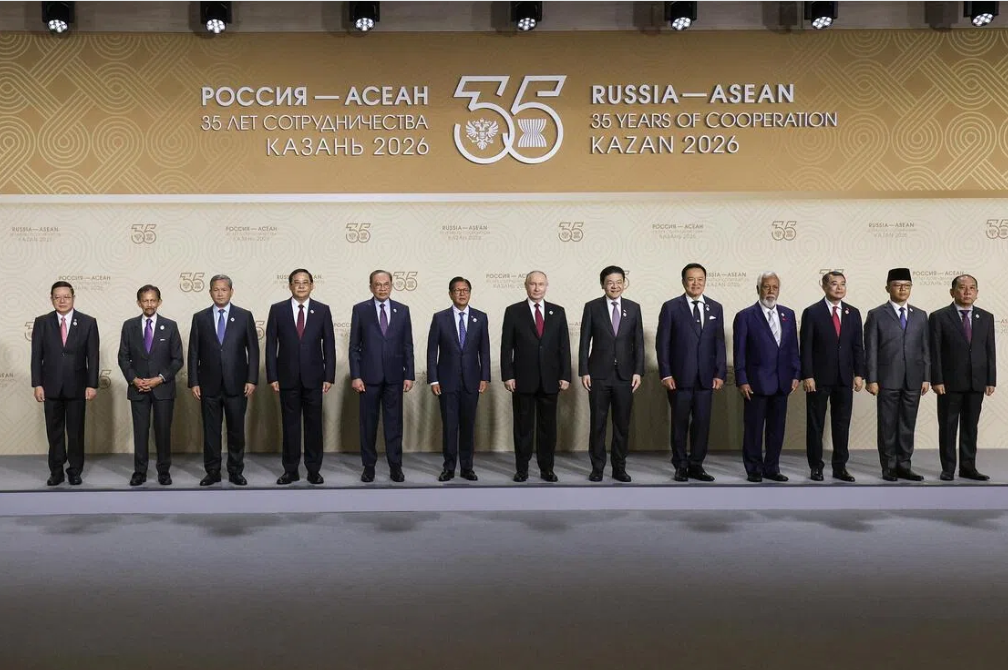
The Asean-Russia Commemorative Summit held in Kazan in mid-June represented a significant milestone in relations between the ten-nation bloc and Moscow, with both sides adopting multiple frameworks to guide cooperation over the coming years. The gathering, hosted by Russian President Vladimir Putin, marked the 35th anniversary of formal diplomatic relations and the 30th year since the two sides established their dialogue partnership—a relatively mature relationship that has weathered considerable international turbulence in recent times.
Three major documents emerged from the summit, each designed to strengthen practical engagement on multiple fronts. The Kazan Declaration serves as the overarching vision statement, reviewing three and a half decades of bilateral relations while laying out priorities for the next phase of partnership. Alongside this, delegations adopted a Joint Statement on Cultural Cooperation that emphasizes expanding people-to-people exchanges, and the Asean-Russia Comprehensive Plan of Action covering 2026 to 2030, which translates broader strategic commitments into specific operational initiatives over the next five years.
The scope of cooperation outlined in these documents is notably expansive, covering traditional security and economic domains as well as softer areas of engagement. Maritime cooperation takes prominence given the shared interest in ensuring stable sea lanes throughout the Asia-Pacific region. Trade and investment partnerships feature prominently, reflecting mutual economic interests despite geopolitical divisions. Energy cooperation remains strategically significant, particularly for Asean nations seeking diverse sources of supply. Connectivity initiatives—encompassing both physical and digital infrastructure—underscore recognition that regional prosperity depends on seamless integration. Educational and cultural exchanges are positioned as essential for building understanding and trust between societies with quite different historical experiences and political systems.
Singapore's Prime Minister Lawrence Wong, speaking on behalf of the bloc, struck a carefully calibrated tone that acknowledged both the potential for cooperation and the broader context of global uncertainty. His remarks emphasized the principle of Asean Centrality—the long-standing diplomatic doctrine that the ten-nation grouping should remain the central driving force shaping regional affairs—and welcomed Russia's historical support for this positioning. Wong noted that Russia has been an active participant in Asean-led mechanisms, particularly the Asean Regional Forum and the East Asia Summit, and expressed hope for Russia's continued engagement as regional tensions and great-power competition intensify.
The timing of the summit carried particular significance given Singapore's forthcoming assumption of the Asean rotating chairmanship in 2027. Wong used the occasion to signal continuity in Asean's diplomatic approach while setting expectations for deepened Russian involvement in regional institutions during Singapore's tenure. The reference to hosting the East Asia Summit and Asean Regional Forum in the Philippines later in 2024 underscored Asean's commitment to maintaining inclusive dialogue platforms at a moment when the region faces pressures to align with competing strategic blocs.
Wong identified several concrete areas where Asean and Russia could expand practical collaboration. Disaster management cooperation has particular relevance for Southeast Asia, where typhoons, flooding, and other natural hazards regularly threaten populations and infrastructure. The fight against drug trafficking represents another shared priority, with Russia facing significant challenges from narcotics flowing from neighboring regions while Southeast Asian nations struggle with both production and consumption issues within their borders. These less politicized domains of cooperation offer opportunities to build institutional capacity and trust without navigating the minefield of geopolitical disagreements.
However, Wong's broader remarks made clear that Asean's approach to Russia is framed by fundamental principles regarding international law and the rules-based global order. He reiterated Singapore's consistent position that all nations must respect sovereignty and territorial integrity—comments that carried unmistakable reference to Russia's 2022 invasion of Ukraine, which Singapore had condemned and responded to with sanctions that remain in effect. This statement was significant precisely because it was delivered while Singapore was deepening engagement with Moscow, demonstrating Asean's effort to maintain principled positions while preserving diplomatic channels.
The remarks on maritime freedom of navigation proved particularly revealing about Asean's strategic concerns. Wong emphasized the importance of unimpeded transit through key international waterways in accordance with the United Nations Convention on the Law of the Sea, a direct reference to anxieties about potential disruptions to chokepoints like the Strait of Malacca and South China Sea shipping lanes. This has obvious relevance to both Asean economic interests and to Russia's broader geopolitical posture, making it an area where cooperation on upholding established maritime norms could align interests.
Wong's comments on developments in the Middle East, including references to a peace agreement between the United States and Iran and hopes for reopening the Strait of Hormuz, reflected Asean's broader interest in reducing friction across multiple global flashpoints. The reasoning is straightforward: conflict anywhere that disrupts energy supplies or shipping routes has direct consequences for Southeast Asian economies highly dependent on energy imports and global trade. Russia, as a major energy supplier and geopolitical player in Middle Eastern affairs, shares some interest in regional stability even if its specific strategic objectives may differ from Asean's.
The bilateral meeting between Wong and Putin, conducted at the Russian president's request, provided an opportunity for direct dialogue on both bilateral matters and broader regional and international developments. Wong's subsequent social media post emphasized that the discussion underscored the value of engagement even between countries that disagree fundamentally on certain issues. This messaging is important for understanding how Asean conceives of its diplomatic role: not as an arbitrator or alliance-maker, but as a persistent advocate for dialogue and a platform through which divergent powers can maintain communication.
Wong also met with Rustam Minnikhanov, the head of the Republic of Tatarstan, reflecting Singapore's cultivation of relationships with Russian federal entities. The connection traces back to a 2007 visit by then-Minister Mentor Lee Kuan Yew to Tatarstan, demonstrating the long-term nature of Singapore's Russia engagement. Discussions with Minnikhanov covered cultural, educational, and people-to-people cooperation—the soft-power dimensions that build sustained connections between societies.
The Asean-Russia summit ultimately reflects a fundamental reality of contemporary Southeast Asian diplomacy: the region cannot afford to choose between great powers, nor does it want to. Instead, Asean members, and Singapore in particular, seek to maintain workable relationships with all major powers while anchoring themselves to principles of international law and peaceful dispute resolution. With Russia increasingly isolated from Western institutions and seeking partnerships in Asia, and Asean navigating an increasingly multipolar strategic environment, both sides have incentives to deepen engagement. The challenge lies in doing so without compromising on fundamental principles—a balancing act that the Kazan Summit attempted to embody.

