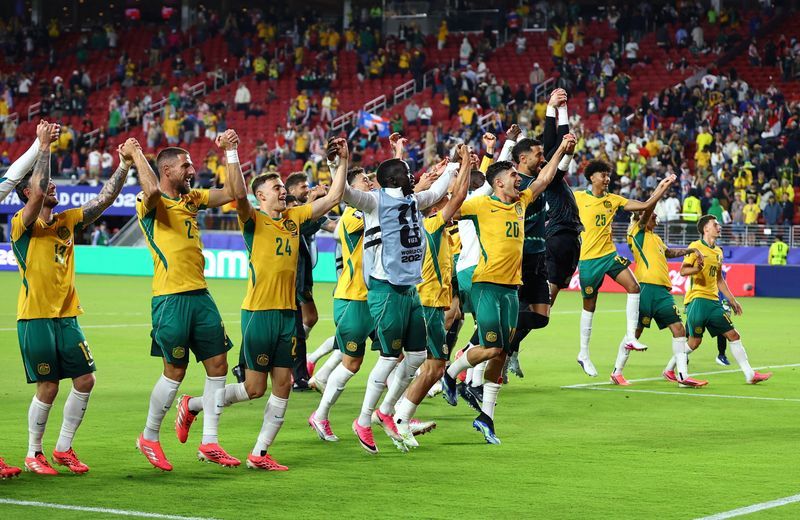
Australia secured a place in the FIFA World Cup's knockout round on Thursday evening with a hard-fought goalless stalemate against Paraguay in California, a result that eliminates any remaining jeopardy from their campaign despite the lack of goals. The encounter at San Francisco Bay Area Stadium proved a scrappy and physically demanding affair, with the Socceroos ultimately demonstrating sufficient control to claim the point required for progression. For the South American nation, the outcome leaves their tournament fate hanging in the balance, dependent on other group results to determine whether they squeak through as one of the competition's strongest third-placed finishers.
Under coach Tony Popovic's direction, the Australian squad clinched second position in Group D, automatically qualifying them for the next stage where they will face the runner-up from Group G. That particular grouping remains wide open as the final round of matches looms, with Egypt and Iran set to play while Belgium prepares to take on New Zealand on Friday. The third World Cup knockout appearance for Australia comes precisely four years on from their last Round of 16 venture in Qatar, suggesting an encouraging trajectory for the national program across consecutive tournaments.
Popovic implemented a notably aggressive tactical rotation, bringing six fresh faces into his starting lineup to signal attacking ambitions against their opponents. Nestory Irankunda's reintroduction to the forward line demonstrated this intent, as did the inclusion of Cristian Volpato, whose creative abilities were central to Australia's approach. The adjustment reflected confidence in the squad's depth and Popovic's willingness to press for victory rather than settle defensively, a philosophy that nearly paid dividends on several occasions during the opening phases.
The early momentum belonged entirely to the Australians, who orchestrated several promising attacking sequences through systematic pressure down the right flank. Jordan Bos's positional shift from left to right fullback, necessitated by the injury absence of Jacob Italiano, actually proved a productive avenue for the hosts' offensive ambitions. Within minutes of kickoff, Volpato executed a precision delivery to Jackson Irvine at the penalty area's edge, yet Irvine's angled attempt thundered directly at goalkeeper Orlando Gill rather than troubling the target with genuine accuracy.
Australia continued accumulating chances as the first half progressed, with Bos and Volpato each drawing responses from Gill without truly stretching the shot-stopper's capabilities. The dominance was complete and undisputed, yet the crucial finishing element remained consistently frustrating. Paraguay offered minimal in attack during this period, registering just a solitary effort that failed to test the Australian goalkeeper, placing their coach Gustavo Alfaro under clear pressure to engineer a more balanced performance.
Alfaro's halftime introduction of Mauricio, a Brazilian-born attacker, immediately altered Paraguay's complexion after the resumption. The substitute created immediate activity around Australia's penalty area, unleashing a speculative long-range effort that predictably sailed wide within five minutes. More significantly, Julio Enciso began asserting himself as a disruptive force, his energetic running repeatedly creating instability within the Socceroos' defensive shape and generating genuine scoring opportunities for his teammates.
Paraguay's crescendo manifested in their most dangerous moment with eight minutes remaining when Enciso collected the ball in a promising position and struck a low drive that flashed dangerously across goal before passing well beyond the far post. The momentum had shifted markedly by this stage, with the South Americans mounting sustained pressure that forced Australia into a more reactive, defensive posture. The scoreline's precariousness became apparent as both teams sensed opportunity in the increasingly frenetic closing exchanges.
Bos nearly broke the deadlock in the 89th minute when he surged forward down the right flank, splitting opposing defenders before advancing into the penalty area and dispatching a shot that narrowly bypassed the far upright. The Socceroos' bench rose in anticipation only to witness the ball flash past rather than nestle in the net. Mauricio provided one final scare moments later, discovering a sliver of space on the area's perimeter, but his tepid attempt lacked the venom required to seriously trouble goalkeeper Thomas Beach and Australia secured the advancing position.
The manner of qualification—through pragmatism rather than sparkling performance—nonetheless represents solid progress for a nation still building credibility on the world stage. Australia's progression carries particular significance for the Asian confederation in a tournament co-hosted by the United States and Mexico, demonstrating that the region can compete effectively in major competitions. Meanwhile, Paraguay's uncertain status adds intrigue to the final group matchdays, with the traditional South American side potentially joining the illustrious group of third-placed qualifiers depending on other results.
From a Southeast Asian perspective, Australia's success reinforces the capability of the wider region's football programs to establish themselves in elite competition. The Socceroos' consistency in reaching the World Cup knockout stages—now achieved in consecutive tournaments—provides a benchmark for emerging football nations throughout Asia. As Australia looks ahead to face Group G's runner-up, their measured progression through group play demonstrates that tournament football rewards tactical discipline and composure as much as attacking flair, lessons particularly valuable for neighboring national programs aspiring toward future major tournament qualification.

