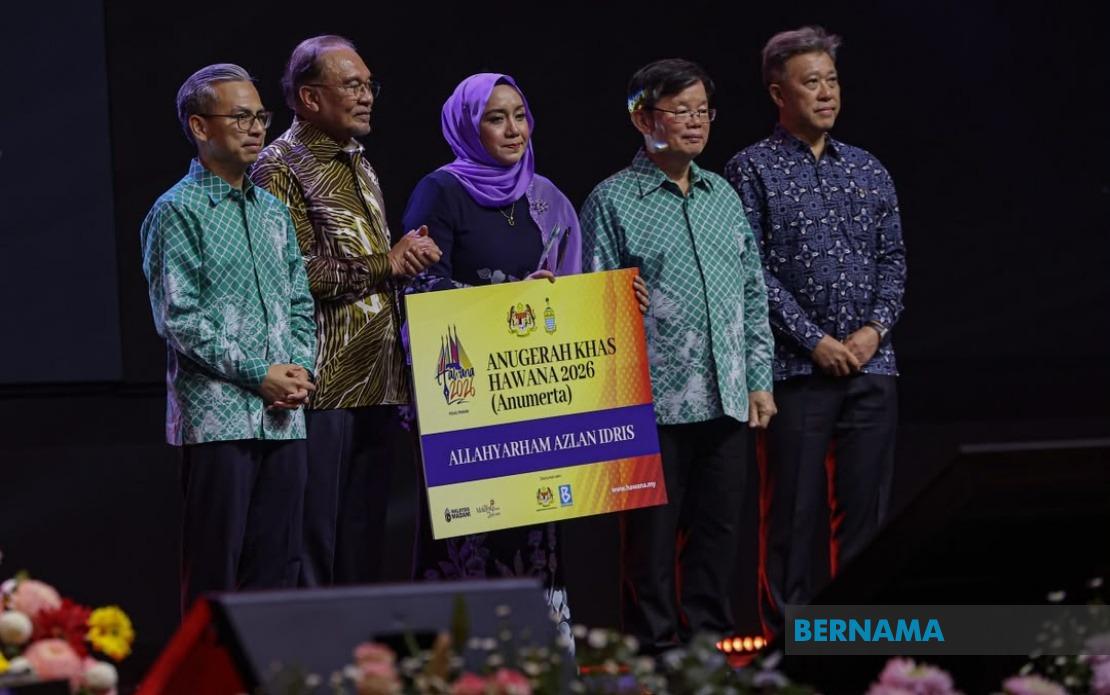
The Malaysian journalism fraternity paid tribute to a respected broadcasting pioneer on June 20 when the National Journalists' Day (HAWANA) 2026 Special Award was conferred posthumously on Azlan Idris at a ceremony in Butterworth. Prime Minister Datuk Seri Anwar Ibrahim presented the honour to Azlan's widow, Wan Syahrina Wan Abdul Rahman, during the main celebration held at the PICCA@Arena Butterworth Convention Centre, underscoring the national significance accorded to the recognition.
The gathering drew prominent figures from Malaysia's political and media establishment. Penang Chief Minister Chow Kon Yeow, Communications Minister Datuk Fahmi Fadzil, and Bernama chairman Datuk Seri Wong Chun Wai were among those witnessing the presentation. The attendance reflected the esteem in which Azlan was held across government and media circles, with senior representatives from local news organisations also present to acknowledge his legacy.
Azlan's career spanned multiple phases of Malaysian broadcasting, establishing him as a figure who bridged traditional and modern media platforms. Before his involvement with Bernama, he held positions at several prominent television networks including TV3, NTV7, and Channel 9, gaining extensive experience in commercial and public broadcasting environments. This diverse background shaped his approach to journalism and prepared him for his most significant role in building Bernama Radio following its establishment in 2007.
The founding and development of Bernama Radio represented a critical expansion of Malaysia's national news infrastructure, extending the Malaysian National News Agency's reach into the radio medium at a time when broadcast journalism was undergoing significant transformation. Azlan's leadership during this formative period established editorial standards and operational frameworks that would define the service's character for subsequent years. His work was instrumental in establishing Bernama Radio as a credible news source alongside the agency's traditional wire services and digital platforms.
Beyond his direct broadcasting responsibilities, Azlan demonstrated sustained commitment to the journalism profession through his organisational work within the industry. He chaired the main celebration committee for HAWANA on multiple occasions, beginning with the 2022 event held in Melaka and continuing through subsequent years. This leadership position placed him at the centre of national efforts to recognise and celebrate journalistic achievement across the country, positioning him as someone invested in the profession's institutional development and professional standards.
Azlan's death on January 15 at the age of 57 marked the loss of an experienced practitioner whose career had contributed substantively to Malaysian broadcasting's evolution. His passing removed a figure who had navigated the transition from analogue to digital news environments and helped shape how Malaysian news organisations adapted to technological change. The relatively early age of his death underscored the finality of that loss for colleagues and the industry.
The decision to award him the HAWANA 2026 Special Award reflected recognition that his contributions extended beyond operational success to encompass deeper impact on Malaysian journalism's institutional memory and values. Special awards of this nature typically acknowledge individuals whose work has influenced the profession beyond conventional measures of professional achievement. For Azlan, the recognition honoured not merely his tenure at Bernama Radio but his broader commitment to maintaining journalistic integrity and professional standards across multiple platforms and organisational contexts.
For Malaysian journalism, the honouring of Azlan carries implications regarding how the profession values its practitioners and their legacies. At a time when news organisations face significant challenges from changing consumption patterns and digital disruption, recognising figures who built lasting institutional frameworks becomes particularly meaningful. Azlan's career exemplified the kind of long-term institutional commitment that contemporary media environments sometimes struggle to sustain, making his recognition a statement about values the journalism profession wishes to preserve.
The ceremony also underscored the continuing role of government in supporting and recognising journalistic endeavour. Prime ministerial participation in presenting the award indicated official acknowledgment that independent journalism and national communications infrastructure strengthen each other. This relationship, while sometimes generating tension, reflects Malaysia's recognition that functional news systems require both professional independence and supportive institutional conditions.
Bernama's role as Malaysia's national news agency positions the organisation as custodian of particular standards and traditions in Malaysian journalism. Azlan's work at Bernama Radio therefore connected to broader questions about how national news infrastructure serves public information needs. His development of Bernama Radio represented investment in ensuring that Malaysian audiences could access reliable news through broadcast platforms, contributing to the informational diversity that supports democratic participation and public understanding.
The recognition extended to Azlan's family acknowledges the personal dimensions of professional commitment. Wan Syahrina Wan Abdul Rahman's receipt of the award on her late husband's behalf represented the family's role in supporting a career dedicated to public service through journalism. This element of the ceremony reflected understanding that professional achievement emerges within family contexts that often remain invisible in public recognition.
Looking forward, Azlan's posthumous honour may encourage reflection within Malaysian news organisations about succession planning and institutional memory. As broadcasting environments continue evolving rapidly, the knowledge and experience that practitioners like Azlan accumulated risk being lost without deliberate efforts to document and transmit that learning. His recognition can serve as prompt for such institutional attention within Malaysian media houses.

