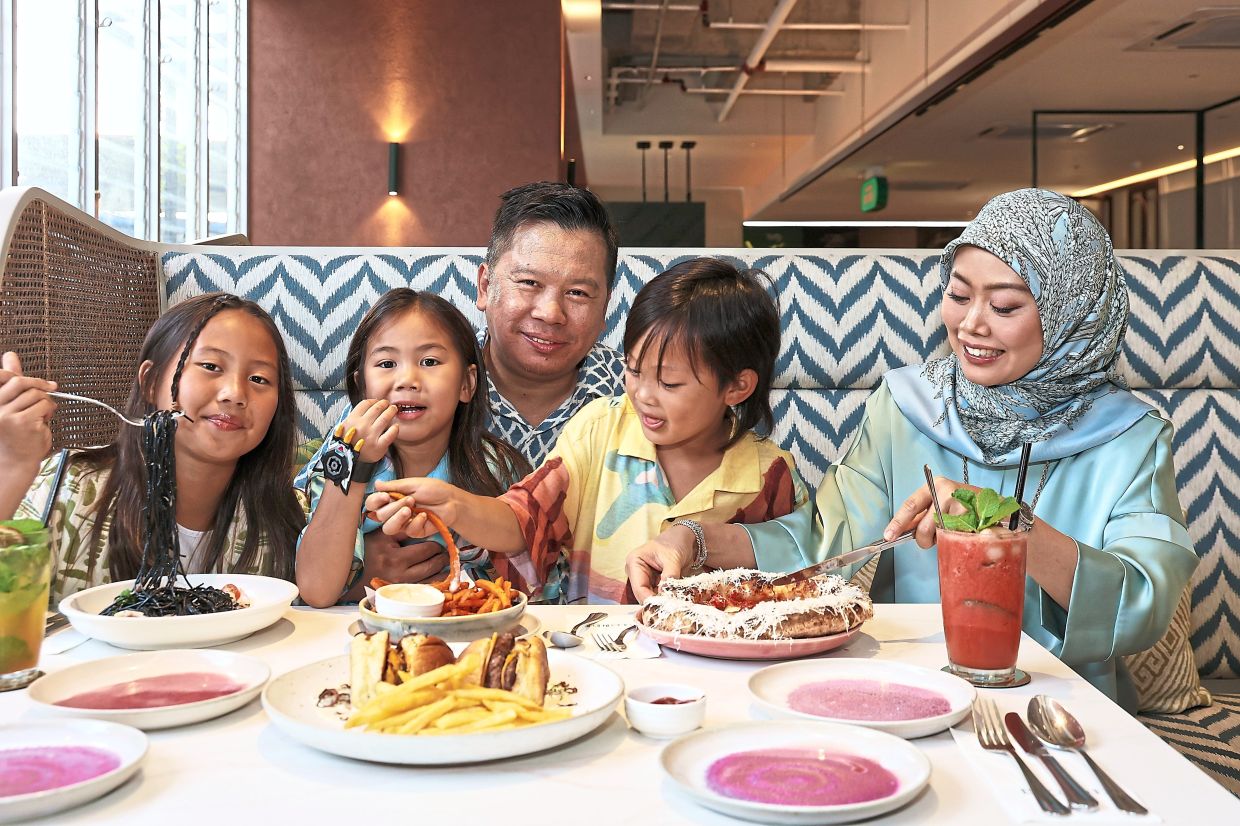
At the elegant Super Blonde restaurant within Kuala Lumpur's KLGCC Mall, the three children of Datuk Mohd Najib Abdul Hamid move about with the ease of seasoned proprietors. His eldest daughter Arya, just ten years old, navigates the adjoining Taffy gelato counter with practised confidence, while younger brothers Arman and Arif, aged eight and five respectively, find themselves equally at home among the dining room's banquettes and service staff. The scene captures something essential about the household—these children have never known a world separate from their parents' entrepreneurial ventures.
The restaurant empire their parents constructed spans two continents. Serai Group encompasses over thirty outlets staffed by more than a thousand employees, anchored by homegrown concepts such as Serai, Super Blonde, Jibby & Co, and Jibby Chow. The portfolio extends internationally through Meet Bros, a London-based steakhouse operated in partnership with Menate Steak Hub, with additional locations opening across the United Kingdom. This expansion represents a remarkable trajectory for Datuk Mohd Najib and his wife Datin Qistina Taff, both directors of the enterprise, yet the couple has deliberately woven their children into this growth story rather than compartmentalising family life away from business.
The roots of this philosophy run deep into both parents' childhoods. Qistina's mother, Rina Abdullah, established the original Serai Thai restaurant in 1990 within Shah Alam, Selangor, planting seeds that would eventually flourish into a regional dining institution. Datuk Mohd Najib's own upbringing in Sabah exposed him to different entrepreneurial rhythms—his father, a capable cook, initially tested the market by preparing dishes like nasi lemak and mee goreng at home, filling baskets that he would carry to government offices for sale. During school holidays, young Najib accompanied his father on these rounds, lifting heavy containers and observing firsthand how food could be transformed into commerce. This apprenticeship lasted roughly a year before his father formalised his operations into a proper restaurant, creating an indelible impression on his son about the relationship between family commitment and business building.
The couple's connection began in Melbourne, Australia, where both were present but only distantly acquainted. Qistina returned to Malaysia following graduation, and it was during one of Datuk Mohd Najib's visits home that a romantic spark ignited. They navigated years of long-distance courtship while he accumulated more than a decade of restaurant industry experience in Melbourne, regularly enduring sixteen-hour working days. When he finally relocated back to Malaysia in 2009, marriage followed in 2010, and the pair embarked on the ambitious project of reimagining Serai's presence throughout the Klang Valley.
The vision they articulated centred on evolution rather than abandonment. Recognising that the original Serai brand had operated for nearly four decades, they resolved to preserve the name while establishing an umbrella structure capable of nurturing multiple distinct restaurant concepts. What emerged as Serai 2.0 demanded extraordinary personal sacrifice during its formative years. Both proprietors handled virtually every operational detail themselves—waking before dawn to source ingredients from markets, then rushing to prepare the restaurant for service while Datuk Mohd Najib executed all cooking responsibilities and Datin Qistina managed cash operations. This period of unrelenting collaboration, spanning roughly five years, established the operational foundations and cultural DNA that would subsequently sustain expansion.
Their eldest child, Arya, arrived five years into the marriage and essentially grew up within the restaurant ecosystem. Rather than deploying childcare as a replacement for parental presence, she became a fixture in the dining rooms and kitchens, colouring books in hand while staff passed by, and even at age two, she mimicked management functions with such conviction that observers found it difficult to distinguish performance from genuine instruction. This immersion was neither accidental nor negligent—it reflected a deliberate choice to integrate family existence with professional ambition. When brothers Arman and Arif joined the household subsequently, they inherited this same environment, meaning that all three children possess an intuitive understanding of food, service standards, and restaurant operations that most adolescents would only encounter through formal hospitality education.
Datuk Mohd Najib's relationship with work threatened to follow the patterns established in his Melbourne years, where punishing schedules consumed most waking hours. However, the birth of his third child prompted philosophical recalibration. He recognised that maintaining the relentless pace that had characterised his younger years would forfeit irreplaceable moments in his children's development. Consequently, he restructured his commitments to ensure that despite Monday-through-Friday responsibilities remaining substantial, he personally escorts his children to school each morning and prioritises weekend engagement. When the family undertook the four-month relocation to London to oversee restaurant renovations and supplier negotiations several years ago, this deliberate choice to maintain proximity superseded the convenience that separation might have offered.
Datin Qistina emerged as the critical ballast enabling this balance. Described as exceptionally hands-on in maternal responsibilities, she prepares home-cooked meals for their children's school attendance and, despite employing childcare support, personally directed approximately ninety percent of early-childhood rearing. Datuk Mohd Najib acknowledges candidly that without a spouse operating within the same industry and therefore understanding the peculiar demands and temporal constraints of restaurant ownership, his household would likely have fractured under the competing pressures. This partnership—simultaneously romantic, professional, and parental—stands as the structural prerequisite for the family's apparent harmony.
Yet the couple has imposed deliberate guardrails against the profession's tendency to consume family time entirely. Each year, Datuk Mohd Najib ensures that the family dedicates at least two weeks to holidays during which work considerations receive minimal attention. This commitment emerged from a poignant observation made years earlier when he recalled a young daughter repeatedly attempting to reach her busy mother, the proprietor of the restaurant Naj and Belle, only to find herself unable to connect because of overwhelming operational demands. Witnessing his own daughter now seeking him with similar frequency—asking where he is and when he will return—crystallised the stakes. While restaurant operations demand constant attention, he resolved that no expansion target or operational milestone would justify missing the small but cumulative moments that constitute childhood.
The integration of children into the family business carries implications that extend beyond sentimentality or convenient narrative. In Southeast Asia, where family enterprises constitute the dominant business model, the challenge of succession planning and cultural transmission remains perpetually vexed. Datuk Mohd Najib's approach—allowing his children to develop organic familiarity with operations, food quality standards, and staff dynamics from their earliest years—creates a foundation for potential future involvement that differs markedly from the sudden imposition of responsibility that often characterises second-generation takeovers. Whether his children will ultimately choose to direct Serai Group remains uncertain, but they will do so from a position of genuine understanding rather than imposed obligation.
The broader significance of Datuk Mohd Najib's experience resonates particularly for Malaysian entrepreneurs navigating the tension between professional ambition and family integrity. The regional economy generates perpetual pressure to expand, optimise, and scale operations, yet the lived example he presents suggests that deliberate temporal allocation, spousal partnership, and resistance to the false binary between commercial success and parental presence remain achievable. His children's comfort within restaurant environments, their evident joy in parental accomplishment, and the couple's apparent stability in both their marriage and enterprise leadership challenge the assumption that building empires necessarily requires sacrificing family coherence. In an era when entrepreneurial culture frequently celebrates self-denial and total professional commitment, Datuk Mohd Najib's insistence on structured family time and his willingness to adjust business schedules for school drop-offs and weekend involvement offer a countervailing model grounded in his own childhood memories and the conviction that businesses ultimately derive meaning from the people they support.

