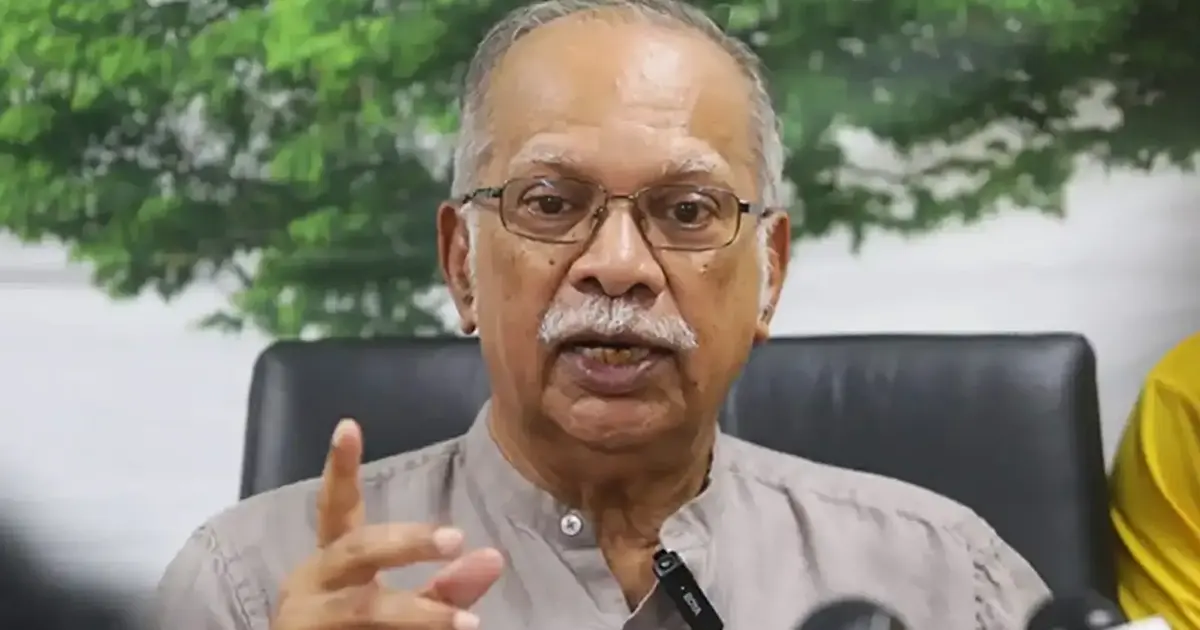
The Perikatan Nasional coalition faces deepening structural problems that remain unresolved despite an emergency meeting convened yesterday, according to Ramasamy, chairman of Urimai and a prominent voice in opposition politics. His critique points to a fundamental oversight: the coalition's reluctance to directly confront the question of Bersatu's future role, a matter that has assumed critical importance given the escalating tensions between the party and its coalition partner PAS.
The emergency gathering fell short of expectations in addressing the core dispute threatening the coalition's coherence, Ramasamy argued. Rather than using the opportunity to clarify Bersatu's standing and chart a path forward that accounts for its deteriorating relationship with PAS, participants reportedly skirted the issue entirely. This avoidance strategy, he suggested, only perpetuates uncertainty and leaves the coalition vulnerable to further fracturing as underlying grievances remain unattended.
Pegas between Bersatu and PAS have widened considerably, creating a rift that extends beyond mere political disagreement. The two parties occupy different ideological spaces within the Perikatan Nasional framework, and this philosophical divide has translated into practical disputes over strategy, positioning, and influence within the coalition structure. Without explicit discussion of how these differences can be managed or resolved, the coalition operates in a state of managed tension that threatens its viability.
Ramasamy's intervention underscores a critical problem in coalition politics: the tendency to delay difficult conversations in hopes that tensions will dissipate on their own. This approach rarely works in Malaysia's fractious political landscape, where party interests are fiercely protected and symbolic gestures carry substantial weight. The failure to address Bersatu's status directly suggests either a lack of consensus among coalition members about how to proceed, or an unwillingness to acknowledge problems that have become too visible to ignore.
The implications for Perikatan Nasional extend beyond internal management challenges. A coalition that cannot resolve its own organizational questions projects weakness to external observers and raises doubts about its capacity to function effectively as a credible political alternative. Voters and potential coalition partners consider stability and coherence when evaluating opposition groupings, and the current trajectory suggests neither is assured.
Bersatu's position within Perikatan Nasional has been precarious for some time, but recent developments have rendered the situation more acute. The party's relationship with PAS represents a fundamental compatibility problem that cannot be resolved through procedural mechanisms or strategic repositioning alone. At some point, coalition members must decide whether they can coexist productively or whether structural separation better serves all parties involved.
For Malaysian observers, this crisis reflects broader challenges inherent in opposition coalition-building. Multiple parties with distinct constituencies, ideologies, and ambitions must find sufficient common ground to function as a unified force, yet maintain enough independence to preserve their individual identities. Balancing these competing demands requires explicit agreements about power-sharing, strategic direction, and conflict resolution. When these conversations are avoided, coalitions deteriorate gradually until they implode suddenly.
The emergency meeting's apparent circumvention of Bersatu's status raises questions about leadership and decision-making within Perikatan Nasional. Who made the decision to exclude this critical question from the agenda? What negotiations occurred behind the scenes to sidestep a confrontation? These dynamics, typically invisible to public scrutiny, shape coalition durability far more than rhetorical declarations of unity.
Ramasamy's criticism also highlights the role that independent analysts and party figures outside the immediate coalition leadership play in maintaining political accountability. His public statement serves as a reality check, forcing acknowledgment that deliberate omissions from coalition agendas do not erase underlying problems—they merely defer resolution while allowing tensions to accumulate. This distinction between appearance and substance has become increasingly difficult for Malaysian political operators to maintain.
The path forward for Perikatan Nasional requires moving beyond yesterday's emergency meeting to undertake the more challenging work of structural realignment. Whether this involves Bersatu's continued membership on revised terms, its transition to a different political arrangement, or some other configuration remains uncertain. What is clear, however, is that avoiding the question will not resolve it—and may instead accelerate the coalition's fragmentation in ways that none of its constituent parties desire.

