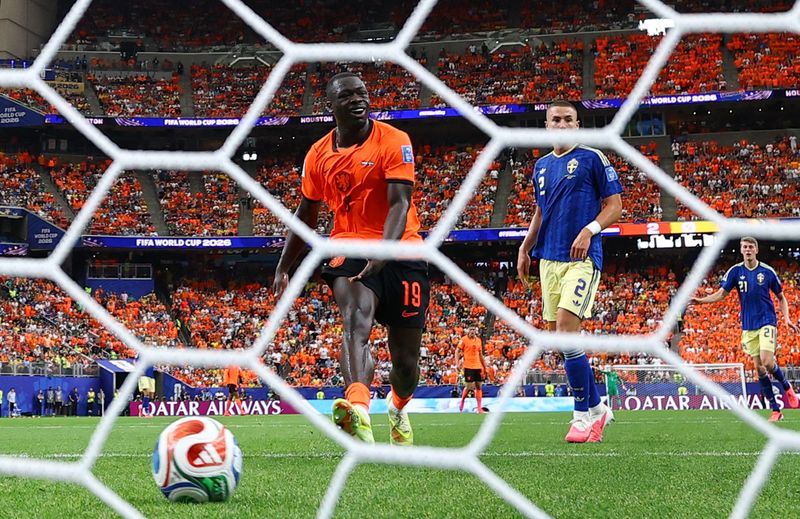
Ronald Koeman's tactical gamble has already proven vindication for the Netherlands coach, who faced considerable criticism after his uninspired substitutions during the Dutch side's opening World Cup encounter. Just days after that disappointing 2-2 draw with Japan, the Netherlands delivered a commanding 5-1 victory over Sweden, with the decision to deploy Brian Brobbey as the lead attacker emerging as the crucial turning point in transforming the team's fortunes and elevating them to the top of Group F.
The football environment rewards managers handsomely when their calculated decisions yield immediate results, and Koeman has already basked in that vindication following his choice to place Brobbey at the centre of the attack. The 24-year-old's performance was nothing short of exceptional, netting twice within the opening 17 minutes and effectively settling the contest before the halfway point. This explosive start against the Swedes demonstrated precisely the finishing quality and clinical efficiency that Koeman sought when making his selection, offering a sharp contrast to the laboured attacking display against the Japanese.
Brobbey's path to becoming the Netherlands' primary attacking option has been anything but straightforward. The striker found himself relegated to the periphery of national team planning during the qualifying campaign for the 2026 World Cup, overlooked repeatedly by the selection committee. His recall to the squad in March this year marked a significant rehabilitation of his status, ending what had been a year-long absence from international consideration. His critics had questioned whether he possessed the requisite pedigree and consistency to operate at the highest level, but Saturday's performance against Sweden has essentially silenced those doubters.
The transformation in Brobbey's game became evident during his stint in English football, where his season with Sunderland in the Premier League appears to have fundamentally elevated his capabilities as a complete striker. Speaking to reporters at the Dutch training camp earlier in the month, Brobbey articulated precisely how his development has progressed beyond the one-dimensional aspects of his play. He recognised that his effectiveness now extends well beyond the physical battle with opposition defenders, encompassing improved positioning, intelligent movement off the ball, and the spatial awareness required to operate in congested areas.
These technical refinements are crucial for succeeding in modern football, where the most efficient strikers combine intelligent running with predatory finishing. Brobbey's acknowledgment of his evolution as a player demonstrates a level of tactical maturity that suggests he has genuinely addressed weaknesses in his game rather than relying on natural attributes alone. The fact that he recognised the importance of dropping deeper and creating space through intelligent positioning indicates a player who has studied the demands of elite-level football and adapted accordingly.
The supporting cast around Brobbey at the World Cup is particularly well-suited to maximising his strengths as an attacking option. Cody Gakpo's creative presence on the left flank, combined with Denzel Dumfries' willingness to push forward aggressively from right-back, ensures consistent delivery of dangerous crosses and through balls. The addition of Crysencio Summerville to the attacking contingent has further enriched the Netherlands' offensive arsenal, creating multiple pathways to goal that should benefit whoever operates as the primary striker.
Brobbey's clinical finishing against Sweden will particularly resonate with Koeman, as it addresses what had been a nagging concern about the team's attacking prowess. Memphis Depay, the previous incumbent and the Netherlands' all-time leading goalscorer, has endured an extended injury layoff that has diminished his sharpness and match fitness. Depay's record and experience remain invaluable, but the reality of international football demands that countries identify and develop capable successors to their key players well in advance of the eventual transition.
The Netherlands had recognised for some time that finding a worthy heir to Depay represented a pressing challenge, one that could not be delayed indefinitely. With the 2026 World Cup qualifying cycle already underway and Depay no longer operating at peak capacity, the window for identifying and bedding in a replacement had become increasingly narrow. Brobbey's explosive emergence against Sweden has conveniently provided Koeman with a potential solution to that succession problem, at least in the immediate term.
For Malaysian and Southeast Asian observers of international football, Brobbey's trajectory offers an instructive lesson in player development and the importance of perseverance. His year-long absence from the national setup could have permanently derailed his career at the highest level, yet a disciplined approach to improving his game during that period proved transformative. The appetite among regional audiences in Asia for witnessing compelling narratives of redemption and resurgence ensures that Brobbey's story will resonate beyond purely Dutch or European contexts.
Looking ahead, Brobbey's continued performance at the tournament will determine whether his breakthrough against Sweden represents a sustainable shift in his status or merely a promising but isolated performance. Nevertheless, the foundation has undoubtedly been laid for him to stake a genuine claim on the Netherlands' lead striker position for the foreseeable future. Koeman's willingness to trust the young striker's development has been vindicated spectacularly, and that confidence appears warranted based on the evidence of Saturday's dominant display and Brobbey's demonstrated commitment to evolving as a complete centre-forward.

