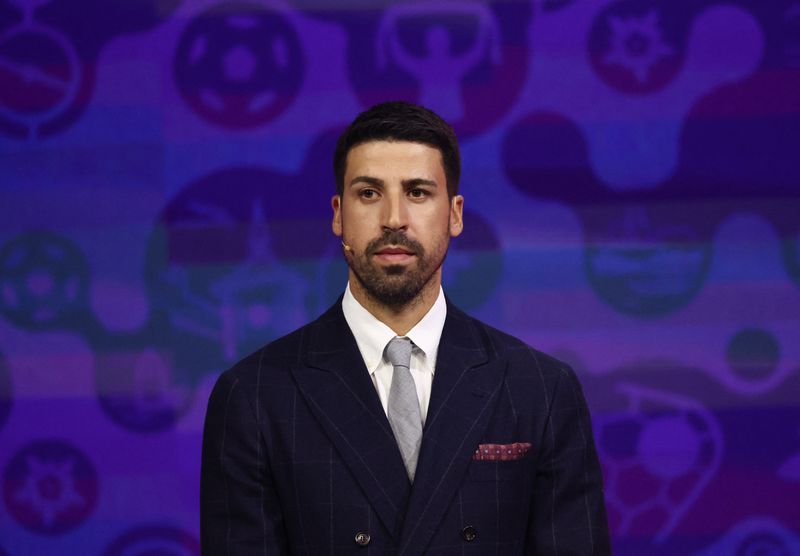
Sami Khedira, who helped Germany win the 2014 World Cup, has stepped into an increasingly common debate surrounding international football: whether brothers should be separated by national allegiances. Rather than viewing it as problematic, the former Real Madrid midfielder sees it as a powerful reflection of contemporary global society. With his own brother Rani representing Tunisia at the World Cup—honouring their father's heritage—Khedira told La Gazzetta dello Sport at the Home of Football museum in New York that the phenomenon carries no inherent conflict. Instead, he frames it as deeply human and wonderfully emblematic of our interconnected world.
The 2026 World Cup will feature eight sets of brothers competing across the tournament, with four pairs playing alongside each other and four representing different nations entirely. This growing trend highlights how migration, family history, and personal identity have reshaped football's landscape. Inaki and Nico Williams exemplify this split perfectly: the Athletic Bilbao teammates diverge at international level, with one pledging allegiance to Ghana and the other to Spain. Similarly, Guela and Desire Doue have chosen the Ivory Coast and France respectively, while Derrick Luckassen and Brian Brobbey, brothers through their mother but carrying their fathers' surnames, will wear the colours of Ghana and the Netherlands.
For Khedira, born and raised in Germany to a German mother and Tunisian father, this duality is not a source of tension but a fundamental part of his identity. He carries two cultures naturally, he explained, rather than viewing them as competing forces. Growing up, Khedira experienced the complexities of hyphenated identity firsthand. Some questioned his Germanness because of his name and appearance, while others in Tunisia perceived him as fundamentally German. His response to these contradictions was philosophically sound: both identities can coexist and complement each other without requiring compromise or hierarchy. For Khedira and his brother, Tunisia and Germany occupy equal space in their hearts and mentalities, making them distinctive rather than conflicted.
The emotional weight of such divisions became visceral for Khedira when he witnessed the Doue brothers singing both the French and Ivorian national anthems before a friendly match earlier this month. That moment crystallized football's capacity to transcend sport itself and communicate something profound about our contemporary world. Khedira described the scene as breathtakingly beautiful, a multicultural statement that reaches far beyond the 90 minutes on the pitch. In an era where nationalism and insularity often dominate discourse, football occasionally reminds us that multiple belongings and layered identities can coexist gracefully.
Khedira's perspective gains additional significance when considering the expanded format of the 2026 World Cup. The tournament's expansion to 48 teams has created unprecedented opportunities for nations like Cape Verde, Curacao, and Haiti to compete on football's grandest stage. This structural change has begun narrowing the traditional dominance of European and South American powers, as African and Asian federations increasingly close the gap. Better coaching infrastructure, improved educational systems for developing young talent, and enhanced investment in grassroots development have all contributed to this levelling of the playing field.
However, Khedira acknowledged that Europe bears a responsibility extending beyond merely benefiting from dual-nationality players. Wealthy European nations have long attracted talent from developing regions, but they must reciprocate by investing in football development at its source. This mutual obligation reflects football's global interdependence and prevents a system where richer nations simply harvest talent without supporting comprehensive advancement in poorer regions. The ethical dimension of modern football recruitment deserves serious consideration as dual-heritage players become increasingly common.
The most challenging aspect of this phenomenon, Khedira argues, falls upon young players themselves. Adolescents being courted by multiple national federations face immense pressure before they possess the maturity to fully comprehend the implications of their decisions. National football associations sometimes approach these players with agendas rooted in politics, heritage expectations, or strategic sporting needs, all of which can cloud the fundamental question: where does this young person's heart genuinely lie? Khedira was himself confronted with this choice at eighteen, still establishing his own identity while wrestling with a decision that would define his international career.
For Khedira, the correct answer cannot be manufactured through external pressure, ancestral claims, or federation demands. Instead, it emerges from something more instinctive and personal—what he describes simply as gut feeling. National origin matters less than inner conviction. The intensity of this emotional and psychological pressure on teenagers should not be underestimated; making such a weighty personal decision while simultaneously managing the expectations of nations, families, and sports bureaucracies is genuinely daunting.
When approached by Tunisia's football federation out of respect, Khedira recognized that these conversations with young dual-heritage players require sensitivity and understanding. His own experience taught him that choosing to represent a community is among the most consequential decisions a footballer can make. Yet he also acknowledged that it is fundamentally positive that young players retain agency in determining their international futures, even when that process proves emotionally taxing. The ability to make this choice freely, guided by authentic feeling rather than compulsion, represents a meaningful evolution in how football recognizes the complexity of modern identity.
Ultimately, Khedira's perspective offers a refreshing counterpoint to anxiety about brothers representing different nations. Rather than viewing it through a lens of division or disloyalty, he presents it as an authentic expression of contemporary humanity. Football, in his estimation, possesses remarkable power to celebrate multiculturalism and demonstrate that belonging to multiple communities is neither impossible nor inauthentic. The beautiful game's truly progressive moment arrives not when it forces monolithic identities but when it embraces the wonderfully complicated reality that many of its finest players carry multiple flags in their hearts.

