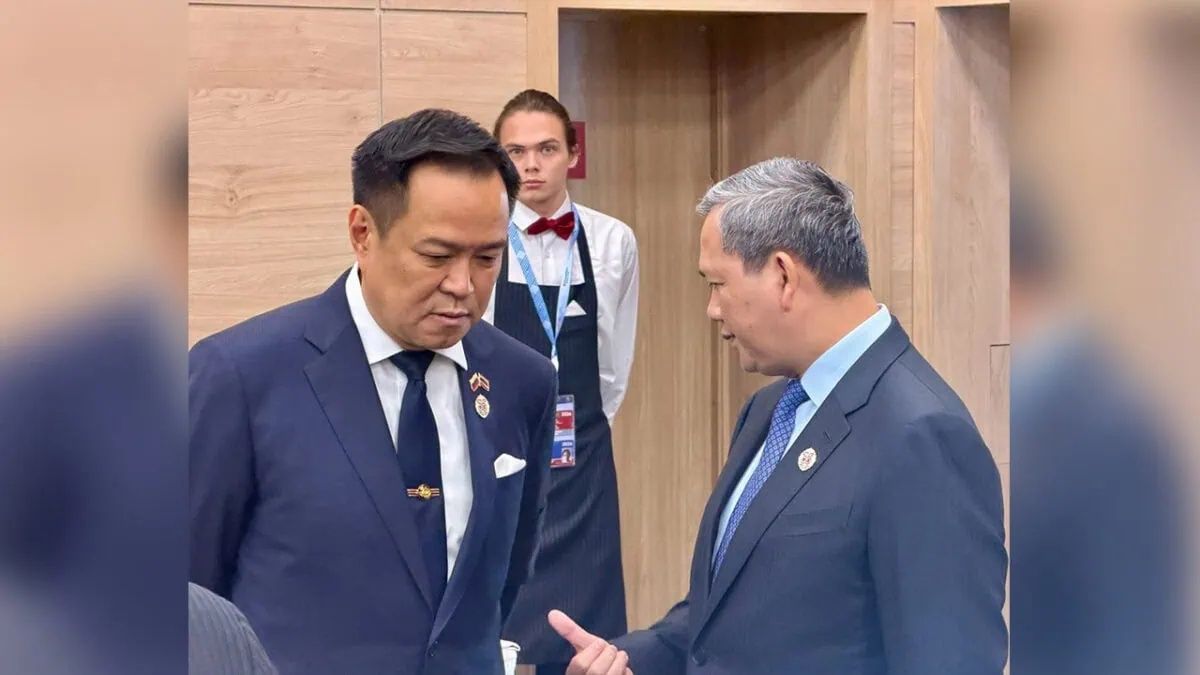
Cambodia's Prime Minister Hun Manet has pressed Thailand to move faster on appointing leadership for its Joint Boundary Commission and resuming critical border survey and demarcation operations, while both countries have reaffirmed their dedication to resolving territorial disagreements through lawful and peaceful means. The Cambodian leader conveyed this message during an impromptu encounter with Thai Prime Minister Anutin Charnvirakul at the margins of Asean-Russia engagement meetings in Kazan, Russia.
The informal diplomatic exchange, occurring on June 19, underscores the persistent challenge of managing one of Southeast Asia's most complex and sensitive territorial issues. Cambodia and Thailand share a border stretching hundreds of kilometres, with overlapping claims and demarcation difficulties that have periodically flared into public contention. The two nations have repeatedly sought to contain these disputes through multilateral frameworks, yet progress has remained sluggish, making Manet's direct appeal to accelerate work particularly significant.
In his statement released following the Kazan meeting, Manet emphasised that Cambodia remains wedded to bilateral mechanisms, specifically citing the Joint Boundary Commission as the preferred channel for resolving land boundary matters. He pointed to a joint statement signed on December 27, 2025, which he indicated should guide progress toward appointing Thailand's JBC chief and initiating joint survey and demarcation activities. The timing of such diplomatic messaging reflects Cambodia's strategy of maintaining pressure for tangible action whilst avoiding inflammatory rhetoric that could destabilise the relationship.
The Cambodian approach also involves a parallel strategy for maritime boundary questions. Both nations have engaged in compulsory conciliation proceedings under the United Nations Convention on the Law of the Sea, a separate legal track addressing disputes over offshore territorial claims. This two-pronged diplomatic architecture reflects the distinction between terrestrial and maritime boundary complexities, each requiring different legal and procedural frameworks.
Thailand's response, as conveyed through Prime Minister Anutin, matched Cambodia's measured tone. Anutin characterised the Kazan encounter as a fleeting conversation, describing it colloquially as leaders "pulling each other aside by the elbow" amid crowded margins of broader regional meetings. He confirmed that both premiers reiterated their opposition to conflict and discussed available dispute resolution mechanisms, including UNCLOS, the Joint Boundary Commission, and the General Border Committee. This echoing of non-confrontational messaging suggests Bangkok seeks to avoid escalation whilst maintaining flexibility on implementation.
An intriguing detail emerged when Anutin was asked whether border checkpoint reopenings had featured in discussions. He reportedly dismissed the question with humour, noting that raising such a topic would invite domestic political backlash in Thailand. This aside reveals the domestic political sensitivities surrounding border issues in both countries, where public opinion can constrain diplomatic flexibility. Thai constituencies have expressed concerns about cross-border issues, making officials cautious about appearing to concede on sovereignty or security matters.
The contrast between Manet's more detailed written statement and Anutin's more casual public comments reflects subtly different diplomatic positioning. Whereas Cambodia emphasised the need for Thailand to accelerate specific institutional steps—appointing a JBC chief and commencing fieldwork—Thailand stressed continuity of commitment to existing frameworks without committing to accelerated timelines. This distinction matters because it indicates Cambodia seeking momentum whilst Thailand signals stability without necessarily promising faster outcomes.
For the broader Southeast Asian context, the Cambodia-Thailand border situation remains important partly because unresolved disputes can occasionally draw in external actors or inflame regional tensions. Both nations are Asean members, and their ability to manage disagreements peacefully reinforces the association's credibility as a forum for collaborative problem-solving. The Kazan encounter, staged at an Asean-Russia engagement, illustrates how bilateral boundary issues coexist with wider regional and great-power diplomatic architecture.
The reliance on established legal and diplomatic mechanisms—UNCLOS, the JBC, and bilateral agreements—represents a maturation of the dispute management approach. Neither government currently signals interest in confrontation or escalation, and both reference international law as the appropriate framework. This contrasts with certain historical periods when border tensions prompted military posturing. The commitment to compulsory conciliation under UNCLOS, in particular, demonstrates willingness to subject disagreements to binding international processes, though conciliation itself is a non-binding procedure.
Mayet's insistence that discussions on reopening border crossings remain premature suggests Cambodia views institutional capacity-building—particularly appointing JBC leadership and conducting surveys—as preconditions for expanding people-to-people connectivity. This sequencing reflects awareness that border security and sovereignty concerns must be addressed through formal mechanisms before commercial or civilian infrastructure decisions can proceed.
The June 2025 exchange in Kazan also signals that regional diplomatic calendars remain crowded with bilateral engagement opportunities. Leaders continue to use multilateral gatherings to conduct side-channel discussions, allowing for direct communication on sensitive issues whilst maintaining broader diplomatic agendas. This pattern has characterised Asean diplomacy for decades and continues to provide crucial informal channels for resolving disagreements outside public scrutiny.
Looking forward, the outcome will likely depend on Thailand's willingness to allocate bureaucratic resources and political capital to accelerating JBC operations. Cambodia has signalled readiness to proceed, but progress requires reciprocal Thai commitment. The absence of announced timelines or specific deliverables in either leader's public remarks suggests that whilst both governments favour peaceful resolution, neither is imposing hard deadlines. This measured approach reduces pressure for quick fixes that might prove unsustainable, though it also perpetuates the long-standing delays that have characterised this border issue.

