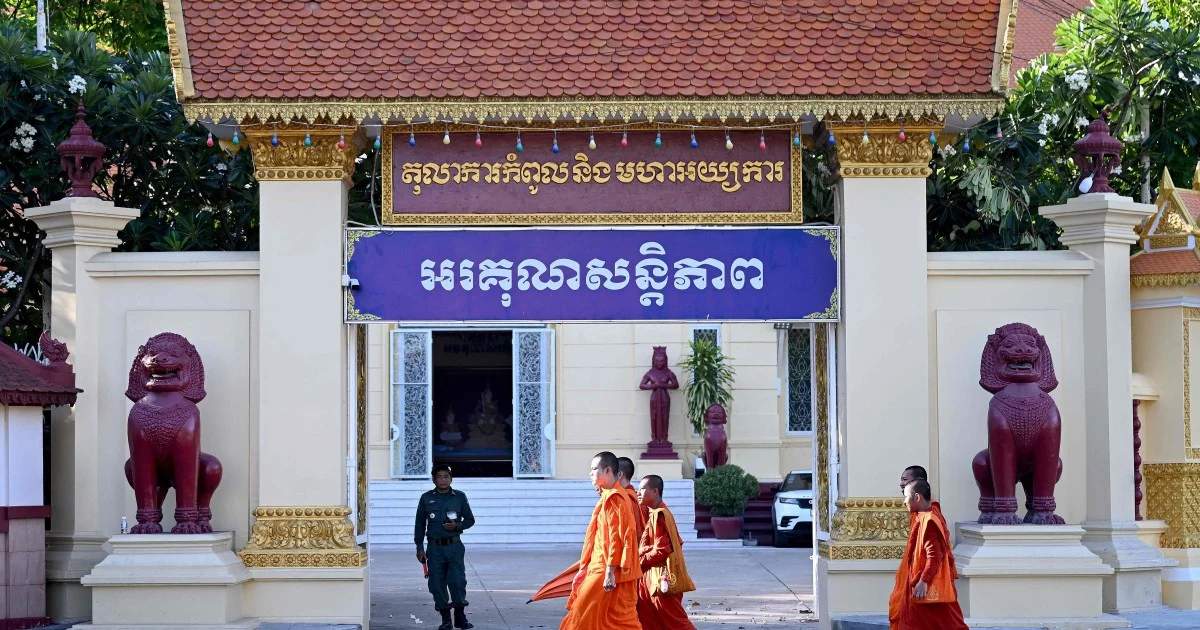
Cambodia's Supreme Court has rejected an appeal by two journalists facing lengthy prison sentences, cementing a controversial legal outcome that has drawn international scrutiny and raised fresh concerns about press freedom in the Southeast Asian nation. The court upheld 14-year prison terms against the reporters, who were convicted on treason charges stemming from their decision to publish a photograph taken within a military-restricted zone near the Thai border during a period of heightened cross-border tensions.
The judicial decision, confirmed by a Supreme Court judge in Phnom Penh on Thursday, marks a significant moment in Cambodia's ongoing struggle to balance national security interests with fundamental freedoms of expression. The original prosecution targeted the journalists for their coverage of an area explicitly designated as off-limits to civilians and journalists alike, with authorities arguing that the image compromised military strategic positioning and revealed sensitive information about Cambodian defence operations in the border region.
The case emerged from an environment of persistent friction between Cambodia and Thailand along their shared frontier, where territorial disputes and periodic military skirmishes have periodically flared into armed conflict. The specific border incidents that preceded the journalists' prosecution represented another chapter in decades of unresolved territorial questions and competing claims in the region. When the photograph was published, authorities moved swiftly to investigate the source and circumstances of its distribution, ultimately charging both reporters under Cambodia's treason statutes.
The conviction and subsequent rejection of their appeal represent a troubling pattern that media advocacy organisations have documented across Cambodia in recent years. International press freedom watchdogs have expressed alarm at what they characterise as the systematic use of national security and defamation laws to intimidate journalists and restrict reporting on sensitive government matters. The treason charge, historically reserved for the most egregious offences against the state, has increasingly become a prosecutorial tool deployed against reporters whose work touches on defence, border security, or other areas deemed strategically important by authorities.
The journalists' legal team has exhausted domestic avenues for appeal, with the Supreme Court's decision effectively ending their recourse within Cambodia's judicial system. The outcome has galvanised international human rights groups, which have characterised the sentences as disproportionate and contrary to the principles of freedom of expression enshrined in international human rights conventions to which Cambodia is a signatory. These organisations have called for clemency or a full pardon, arguing that the punishment far exceeds any legitimate state interest in protecting military information.
For the broader Southeast Asian media landscape, the Cambodian case carries troubling implications. Journalists across the region working in countries with similar geopolitical sensitivities face mounting pressure, with governments increasingly invoking national security as justification for restricting reporting. The example set by Cambodia's courts could potentially embolden authorities elsewhere in the region to adopt comparable approaches when journalists cover sensitive defence or border matters. The chilling effect on investigative reporting and international news agency operations is already becoming apparent, with some media organisations reconsidering their coverage strategies in Cambodia and neighbouring countries.
The treason convictions also highlight the vulnerability of journalists operating in environments where judicial independence remains contested and executive influence over courts remains a persistent concern. Defence lawyers argued that the charges were politically motivated and exaggerated the actual threat posed by publishing a single photograph, but these arguments failed to persuade the appellate tribunal. The speed and severity of the prosecution stood in sharp contrast to how other actors who have disclosed sensitive military information have been treated, raising questions about whether press outlets receive disproportionate scrutiny compared to other entities.
Cambodia's government has justified the sentences as necessary to protect national defence interests and maintain the integrity of its military operations in border areas. Officials have argued that designating regions as military-restricted zones serves legitimate security purposes and that journalists and civilians must respect these boundaries. This rationale, while perhaps defensible in principle, becomes problematic when the legal consequences are applied with such severity that they effectively deter all reporting on sensitive geographical areas, even when such reporting serves legitimate public interest purposes.
The imprisoned journalists have become symbols in Cambodia's larger debates about institutional accountability and democratic governance. Civil society organisations have highlighted their case alongside other examples of restricted space for independent media, warning that the climate for journalism continues to deteriorate. International diplomatic representations have been made on their behalf, though with limited apparent effect on Cambodia's judicial outcomes. The persistence of the sentences despite domestic and international pressure suggests limited willingness at present for reconciliation on press freedom issues.
Looking forward, the decision leaves Cambodia's two journalists facing years in custody unless higher authorities intervene with clemency. Their families and supporters have mounted awareness campaigns both domestically and internationally, attempting to sustain attention on their situation. The case serves as a cautionary reminder for journalists throughout Southeast Asia about the operational risks of covering border regions and defence-related matters, particularly in countries where national security justifications can override press freedom protections with limited judicial pushback.

