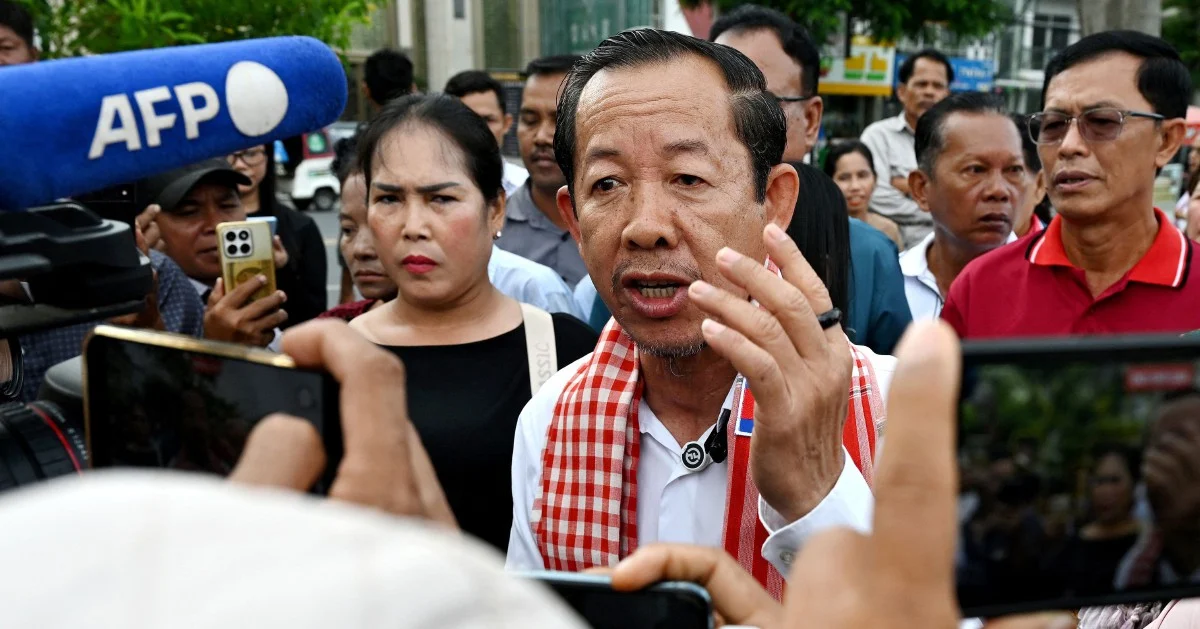
Cambodia's Supreme Court has delivered a mixed ruling on the case of opposition politician Rong Chhun, suspending his prison sentence while simultaneously reinforcing restrictions that bar him from seeking elective office. The decision, confirmed by his legal team on Friday, represents a nuanced outcome that grants reprieve from incarceration yet preserves the most consequential consequence of his earlier conviction—the permanent exclusion from electoral competition.
Rong Chhun, a prominent voice of dissent within Cambodia's fractious political landscape, had faced imprisonment stemming from charges that opponents of the government argue were politically motivated. The suspension of his custodial sentence signals potential softening within the judicial system, yet the court's refusal to rescind the election ban demonstrates the durability of restrictions imposed on opposition figures who challenge the established political order. This outcome reflects the precarious position occupied by Cambodia's opposition movements, where partial legal relief coexists with structural barriers to political participation.
The election prohibition carries profound implications for Cambodia's democratic trajectory and the viability of opposition challenges to the ruling establishment. By maintaining this prohibition while offering the reprieve from detention, the court has effectively neutralized Rong Chhun's capacity to mobilize supporters through electoral mechanisms without subjecting him to the politically costly symbolism of imprisonment. The maneuver suggests calculated governance—removing an obvious grievance that might galvanize international criticism while preserving the outcome that matters most to those in power: preventing a prominent oppositionist from contesting elections.
Cambodia's political environment has become increasingly constrained over the past decade. The country's dominant Cambodia People's Party has systematized approaches to limiting opposition effectiveness, employing legal mechanisms that operate within formal structures while undermining substantive political competition. Opposition leaders face a gauntlet of charges ranging from sedition to financial impropriety, frequently resulting in convictions that supporters characterize as lacking legitimate foundation. The Rong Chhun case exemplifies this pattern, where procedural outcomes that appear conciliatory mask the perpetuation of substantive political exclusion.
For Malaysian and wider Southeast Asian observers, Cambodia's approach to managing opposition challenges offers instructive parallels and contrasts. While Malaysia has experienced transitions of government and relatively more robust electoral contestation, both nations grapple with questions about the boundaries of permissible dissent and the weaponization of legal systems against political rivals. Cambodia's trajectory suggests risks when checks on executive power erode sufficiently that courts become instruments of political management rather than independent arbiters.
The suspension of Rong Chhun's prison term may also reflect international pressure and reputational calculations. Cambodia relies on foreign investment and development assistance, and the prolonged incarceration of high-profile opposition figures generates persistent international criticism. By suspending the sentence, the government can claim judicial evenhandedness and responsiveness to global concern while maintaining the election ban that accomplishes the primary political objective of preventing his candidacy. This approach allows Cambodian authorities to resist characterizations of themselves as simply imprisoning opponents.
Rong Chhun's status as a banned candidate removes him from formal electoral competition but does not necessarily eliminate his political influence. Opposition figures operating under such restrictions frequently maintain mobilization capacity through civil society organizations, religious institutions, and informal networks. The ban therefore represents not absolute political neutralization but rather a redirection of potential influence away from electoral channels—a restriction that fundamentally weakens opposition effectiveness while preserving nominal claims to legal process.
The broader implications extend to Cambodia's development of political institutions and the consolidation of a particular model of managed authoritarianism. Rather than outright prohibitions on opposition parties or blanket suppression of dissent, the system employs selective targeting of individual leaders through criminal convictions, election bans, and imprisonment threats. This approach maintains appearances of legality while accomplishing substantial restriction of political competition. For regional observers, the pattern suggests concerning trends in how Southeast Asian governments navigate tensions between retaining legitimacy and limiting accountability.
For the opposition movement in Cambodia, the ruling presents strategic complexity. The suspended sentence offers temporary relief from imprisonment without resolving the fundamental constraint of electoral exclusion. Opposition leaders must weigh whether accepting this partial outcome—avoiding detention while remaining barred from elections—represents progress or capitulation. Meanwhile, supporters face continued exclusion of a prominent voice from formal political channels, perpetuating the dominance of the ruling party in electoral competition.
The decision also carries implications for other opposition figures confronting similar legal jeopardy in Cambodia. If Rong Chhun's sentence suspension becomes precedent, other convicted politicians might anticipate similar outcomes. However, the maintenance of his election ban sends a contradictory signal—that while courts may show leniency on imprisonment, they will not dismantle the restrictions most consequential to opposition political viability. This asymmetry in mercy may establish a template for managing opposition challenges that appears responsive to concerns about authoritarianism while preserving core mechanisms of political control.
Looking forward, Rong Chhun's situation illuminates broader questions about Cambodia's democratic development. The Supreme Court's decision to suspend his prison term without rescinding the election ban represents a compromise that satisfies neither opponents of authoritarian restriction nor defenders of government prerogatives. It suggests an unstable equilibrium—a system attempting to balance international expectations of judicial independence with domestic imperatives of political control. Whether this balance proves durable, or whether Cambodia's political space continues either liberalizing or contracting more sharply, remains contingent on factors extending well beyond this individual court decision.

