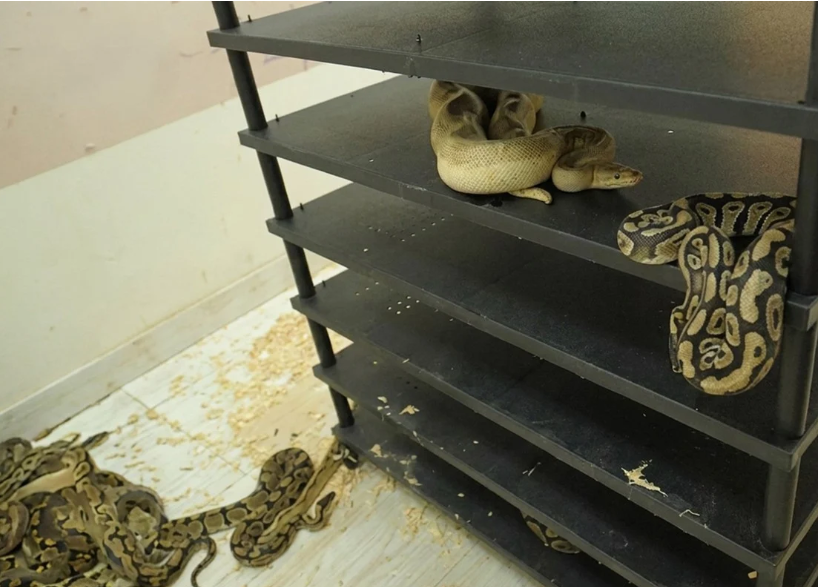
A resident of Taizhou in Zhejiang province has been handed a prison sentence following the discovery of an elaborate and illegal python breeding operation conducted entirely within his apartment. The case, which came to light in June through state broadcaster CCTV, highlights both the determination of Chinese law enforcement in protecting endangered species and the sophisticated methods used by wildlife traffickers to evade detection. The scale of the operation—involving 309 pythons seized from the suspect's home alone—demonstrates how modern technology and social media have enabled illegal breeding networks to flourish across the country.
The investigation began unexpectedly in March 2024 when a retired resident found a large tawny python near the base of a mountain in the region. The elderly man's decision to report his discovery to authorities rather than ignore it proved pivotal in unraveling a criminal enterprise that had been operating undetected for nearly a decade. Police initially theorised that the snake must have escaped from a breeder, as pythons are not native to the area and would ordinarily be dormant during the cold months. This reasoning became the foundation for what would become an intensive investigation combining both traditional detective work and modern forensic analysis.
The breakthrough came through an unconventional but logical line of inquiry. Investigators consulted with professional reptile specialists who explained that pythons require carefully controlled environments maintained between 20 and 30 degrees Celsius. Such precise climate control demands substantial and continuous electricity consumption, providing law enforcement with a quantifiable metric to identify potential illegal breeders. Officers systematically examined electricity usage patterns across households in the area surrounding the discovery site, eventually narrowing their focus to a solitary unmarried unemployed man surnamed Guo whose consumption rates were suspiciously elevated.
Once Guo became the primary suspect, undercover surveillance revealed a complex operation involving multiple accomplices. A man named Di was frequently observed collecting parcels from courier stations, packages that investigators traced back to online purchases of small white mice—a tell-tale indicator of reptile husbandry. The supply chain was straightforward: online retailers provided the mice specifically for feeding purposes, a detail confirmed when police contacted the sellers. Meanwhile, evidence from Guo's social media accounts showed photographs of snakes alongside vague references to sales, suggesting he was attempting to market his illegal inventory through digital channels.
Transaction records uncovered during the investigation revealed that the operation had generated significant revenue. Di had facilitated the sale of at least two pythons to a third party for 1,000 yuan, and subsequent analysis indicated that Guo and Di had successfully sold approximately 80 pythons since the breeding programme commenced. These sales likely occurred through private networks and online platforms, exploiting the challenge of tracking illicit wildlife transactions in the digital age. The financial value of the operation extended far beyond these documented transactions—the entire network of 436 pythons seized across multiple locations was eventually valued at over 30 million yuan, equivalent to approximately USD 4.4 million.
When police executed a search warrant at Guo's apartment, officers described being startled by the sight that confronted them. The living space had been entirely restructured to serve as a reptile facility, with Guo having consolidated his personal furniture into a single bedroom while converting the two remaining bedrooms and living room into breeding chambers. Hundreds of plastic containers were stacked throughout the space, each containing individual pythons maintained at the precise temperatures necessary for optimal breeding. The thoroughness of Guo's operation reflected both a methodical approach to the enterprise and a genuine obsession with reptile cultivation.
During interrogation, Guo displayed no remorse and expressed a genuine passion for his work that transcended mere profit motive. He explained that he had first acquired four pythons in 2014 and had spent the subsequent decade dedicated to mastering selective breeding techniques. According to statements attributed to him, Guo took considerable pride in his ability to cultivate pythons displaying diverse colour variations and patterns. His characterisation of himself as "a creature creator" revealed a mindset that viewed the illegal operation not simply as criminal enterprise but as a form of creative scientific endeavour, however misguided.
The investigation eventually extended beyond Guo to encompass his entire distribution network. A shop owner named Deng, who had been an early supplier of pythons to Guo, was also arrested and found to be maintaining 47 pythons in his own residence. The discovery indicated that the network operated through multiple interconnected nodes, with various individuals playing specialised roles in sourcing, breeding, selling, and distributing pythons throughout the region. This distributed structure likely provided some protection against detection, as no single location appeared suspiciously large until Guo's operation was specifically targeted.
The legal consequences for the three principal conspirators reflected the seriousness with which Chinese authorities regard violations of wildlife protection statutes. Under China's Criminal Law, unauthorised breeding and trafficking of Grade Two protected animals—a classification that includes pythons—can result in prison sentences of up to five years. The Taizhou court sentenced all three men to imprisonment, though specific sentence lengths were not disclosed in official reports. The sentencing represented a clear deterrent message, though observers note that enforcement remains inconsistent across China's vast territory.
For Southeast Asian readers, this case carries particular significance given the region's status as both a source and transit hub for illegal wildlife trafficking. Malaysia and neighbouring countries have experienced escalating pressures from wildlife trafficking networks that operate across borders using similar methods—exploiting digital platforms, maintaining private breeding facilities, and distributing specimens through informal channels. The techniques employed by Guo's operation—from leveraging electricity data to employing intermediaries for sales—mirror approaches documented across the region.
The seizure of over 400 pythons and their subsequent transfer to Zaizhou Zoo raises additional questions about wildlife rehabilitation and the long-term fate of illegally held animals. Chinese zoos and research institutions now house thousands of confiscated pythons, straining resources and creating permanent populations of non-native species that cannot be repatriated to natural habitats. This burden falls disproportionately on conservation facilities in countries where illegal breeding has become endemic, adding financial and operational strain to already stretched wildlife protection budgets.
The case also underscores the importance of public vigilance in wildlife protection efforts. The elderly citizen's decision to report an unusual snake rather than dismiss it as an anomaly set in motion an investigation that dismantled a sophisticated trafficking network. As illegal wildlife breeding becomes increasingly commercialised and technologically sophisticated, law enforcement agencies across the region are recognising that success depends on community awareness and cooperation. Educational campaigns emphasising the ecological and legal implications of purchasing illegally bred exotic animals may prove as valuable as traditional enforcement approaches in disrupting these networks.

