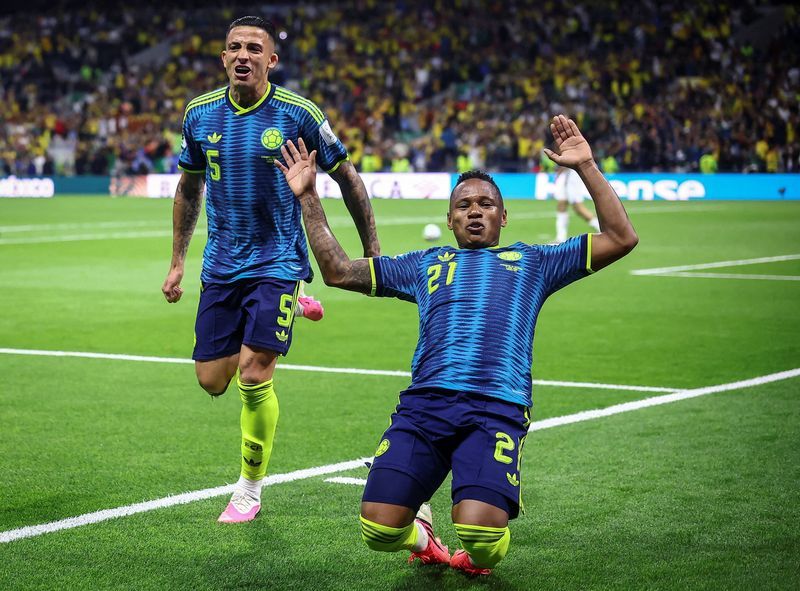
Colombia will attempt to extend their World Cup campaign momentum when they contest Tuesday's Group K fixture against DR Congo, a team that has already demonstrated its capacity to trouble tournament heavyweights. Nestor Lorenzo's squad began their campaign with a commanding 3-1 victory over Uzbekistan, yet the Argentine coach recognises that their Central African opponents represent a fundamentally different test, having earned an encouraging 1-1 draw against Portugal in their opening encounter.
The victory over Uzbekistan, while decisive on the scoreboard, exposed tactical vulnerabilities that Colombia must address to progress smoothly through the tournament. A second consecutive win would mathematically secure their passage to the knockout stages and could position them at the summit of their group, depending on the outcome of Portugal's simultaneous clash with Uzbekistan. However, the manner in which their previous opponents exposed gaps in Colombia's defensive structure suggests that complacency could prove costly against a side that has already earned respect in this competition.
DR Congo's emergence as a serious competitor comes after an absence of forty-eight years from the World Cup stage, having last featured in 1974 when the nation competed as Zaire. Their impressive showing against Portugal, a team widely regarded as tournament favourites, has injected genuine confidence into Sebastien Desabre's squad. Yoane Wissa's opening goal in that fixture marked a historic moment for Congolese football, and the manner in which his team maintained defensive discipline while launching dangerous counter-attacks suggests they possess a blueprint capable of unsettling Colombia's attacking ambitions.
Lorenzo has publicly acknowledged the tactical examination that awaits his players, indicating that DR Congo's style of play fundamentally differs from the possession-based approach of Uzbekistan. The Congolese favour a more direct methodology, transitioning rapidly from defence to attack through long passes and swift breaks that punish hesitation in the midfield. This approach, while less concerned with maintaining ball dominance, creates the kind of open-field opportunities that can expose teams comfortable in controlled, methodical build-ups. Colombia's midfield will require heightened concentration to intercept these transitions before Congolese forwards capitalise on the spaces.
The performance of Bayern Munich's Luis Diaz will remain central to Colombia's attacking prospects. His matchday performance against Uzbekistan, which yielded both a goal and an assist alongside recognition as the standout player, exemplified the penetrative threat that Colombian football can generate. However, Lorenzo clearly expects more involvement from his team's captain James Rodriguez, whose influence in the opening victory was relatively muted. Rodriguez's creative range and experience could prove valuable against a defence accustomed to defending against aerial bombardment rather than intricate passing sequences.
Lorenzo's post-match observations revealed that Colombia's excessive possession at times proved counterproductive, with players occasionally opting for backward movements rather than pursuing decisive final-third actions. The team demonstrated that territorial dominance does not automatically translate into clinical finishing, a concerning pattern given their ambitions for this tournament. Against DR Congo's compact defensive shape, Colombia will require greater incisiveness and decision-making speed to break through what promises to be a well-organised backline.
The venue provides Colombia with a significant psychological advantage, as thousands of supporters wearing the national colours transformed Mexico City's Estadio Azteca during their opening match, effectively neutralising any potential home advantage for their opponents. With their tournament operations based in Guadalajara, proximity to the stadium ensures another substantial Colombian presence in the stands. This vocal support network, combined with improved performance coherence, positions Lorenzo's side favourably against opposition that, despite their tactical cleverness, remains fundamentally less experienced at this level of international competition.
DR Congo's defensive approach will almost certainly mirror the tactics that nearly frustrated Portugal, emphasising shape and compactness while seeking opportunities for rapid transitions. Desabre's coaching philosophy appears built on preventing attacking space rather than attempting to dominate possession, a strategy that works most effectively against teams that become frustrated when denied the ball. Colombia must therefore demonstrate patience and precision rather than expecting continuous dominance, whilst remaining perpetually alert to counter-attacking dangers.
The significance of this fixture extends beyond immediate Group K standings. DR Congo's successful World Cup reintegration after decades of absence carries profound symbolic weight across the African continent and among diaspora communities worldwide. A victory would elevate the tournament's prestige in Central Africa and potentially inspire future generations of Congolese footballers. For Colombia, however, this represents an opportunity to establish tournament credibility through measured, complete performances rather than relying on individual brilliance. Lorenzo's tactical observations suggest he comprehends the challenge ahead, making Tuesday's encounter a genuine contest between two teams with realistic ambitions of advancing further.

