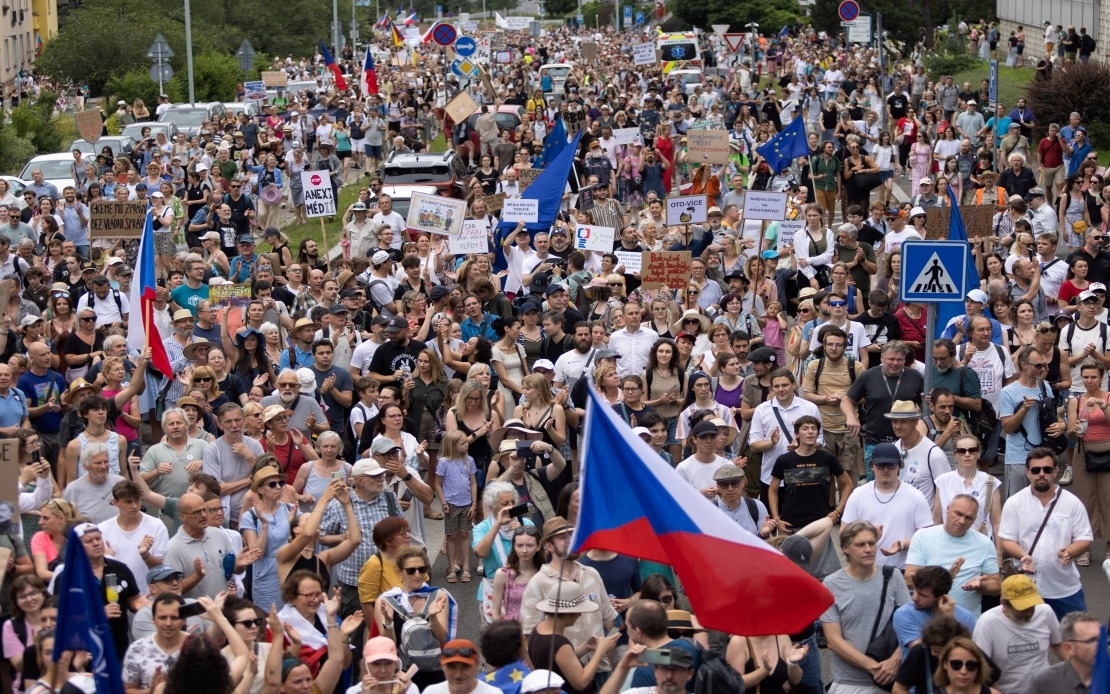
On Sunday, thousands of Czechs took to the streets outside Czech Television's Prague headquarters to voice alarm over proposed financing changes that could undermine the editorial independence of the country's public media outlets. The demonstration reflected mounting concerns that a shift away from the traditional licence fee model might open the door to greater government control over news and current affairs programming, a prospect that has galvanised civil society across the Central European nation.
The driving force behind the protest was the civic movement "A Million Moments for Democracy", which has already mobilised citizens in major Czech cities throughout May around similar themes. The scale of Sunday's gathering underscores the depth of public anxiety regarding the future direction of Czech Television and Czech Radio, institutions that have historically served as important counterbalances to executive power. The movement's messaging centred on a straightforward principle: that functional democracies depend fundamentally on the existence of robust, independent news media able to scrutinise government actions without fear of retaliation or funding restrictions.
The catalyst for the rally stems from a decision made days earlier by Prime Minister Andrej Babiš's government to eliminate the long-standing radio and television licence fees that have funded Czech public broadcasters. Instead, beginning next year, both ČT and ČRo would receive direct allocations from the national budget. The transition would also involve a reduction in overall funding levels, justified by Babiš's assertion that significant operational efficiencies could be realised at both institutions. While the Prime Minister insisted publicly that this restructuring would not lead to political interference in editorial matters, sceptics point out that budget dependence inherently creates vulnerability to pressure.
The governing coalition that implemented this decision comprises three parties: Babiš's right-wing populist ANO party, which leads the government; the far-right Freedom and Direct Democracy party; and the Motorists party. This coalition structure has been in place since December, and the media financing initiative represents one of its first major policy interventions. Critics argue that the timing and mechanics of the proposal suggest an ideological motivation to reshape public broadcasting according to preferences aligned with the coalition's political interests, rather than a genuine efficiency measure.
Culture Minister Oto Klempíř of the Motorists party has become a focal point for demonstrator anger, with rally participants explicitly demanding his resignation and a complete withdrawal of the financing proposals. From inside the television building itself, ČT staff members displayed banners thanking the protesters, a gesture that visibly demonstrated solidarity between the broadcasting workforce and the broader democratic movement opposing the changes. This alignment between employees and public protestors suggests that concerns about editorial independence resonate strongly among those working within Czech media institutions.
The severity of staff concerns became apparent when employees of both ČT and ČRo announced plans for strike action on Monday, escalating the confrontation beyond street demonstrations into direct workplace resistance. Such labour action by public broadcasters is relatively uncommon and signals the degree to which newsroom personnel view the government's plans as an existential threat to their professional autonomy. Strikes by journalists and broadcast technicians carry significant symbolic weight, as they visibly interrupt the flow of programming and draw international media attention to the underlying dispute.
The concern about political pressure through budgetary control reflects a well-documented pattern observed across Central and Eastern Europe in recent years. Several countries in the region have experienced attempts by populist governments to reshape public media narratives through various mechanisms, from funding manipulation to personnel changes to regulatory pressure. Czech Republic, despite its generally robust democratic institutions, is not immune to such pressures. The licence fee system, while imperfect, has provided a degree of insulation from annual budget fluctuations that are sensitive to political winds.
For Malaysian and other Southeast Asian observers, the Czech situation offers instructive parallels regarding the fragility of media independence even in established democracies. The transition from licence-fee funding to direct government budget allocation represents a structural vulnerability that can facilitate editorial interference, particularly when governments become hostile to critical journalism. The Czech case demonstrates that defenders of democratic institutions must remain vigilant and mobilised, as threats to media freedom often arrive through seemingly technical or administrative changes rather than dramatic censorship decrees.
The international dimension adds another layer of significance, as developments in Czech public broadcasting attract attention from press freedom advocates and democratic governance specialists worldwide. The European Union, of which Czech Republic is a member state, has increasingly focused on media independence as a prerequisite for democratic functioning, and member states can face criticism and potential consequences for actions perceived as undermining journalistic freedom. This external scrutiny may provide some constraint on how aggressively the Babiš government pursues its financing restructuring agenda, though such international pressure remains an imperfect safeguard.
Looking forward, the conflict over Czech public media financing is likely to shape political discourse throughout the remainder of the government's term. The strike action by ČT and ČRo employees may prove pivotal in determining whether public and parliamentary opinion shifts decisively against the proposals. Additionally, the organisational capacity demonstrated by "A Million Moments for Democracy" suggests that sustained civil society pressure will persist regardless of the immediate outcome of any negotiations between the government and media institutions. The coming weeks will test whether democratic pressure and institutional resistance can successfully challenge the government's determination to reshape public broadcasting financing.

