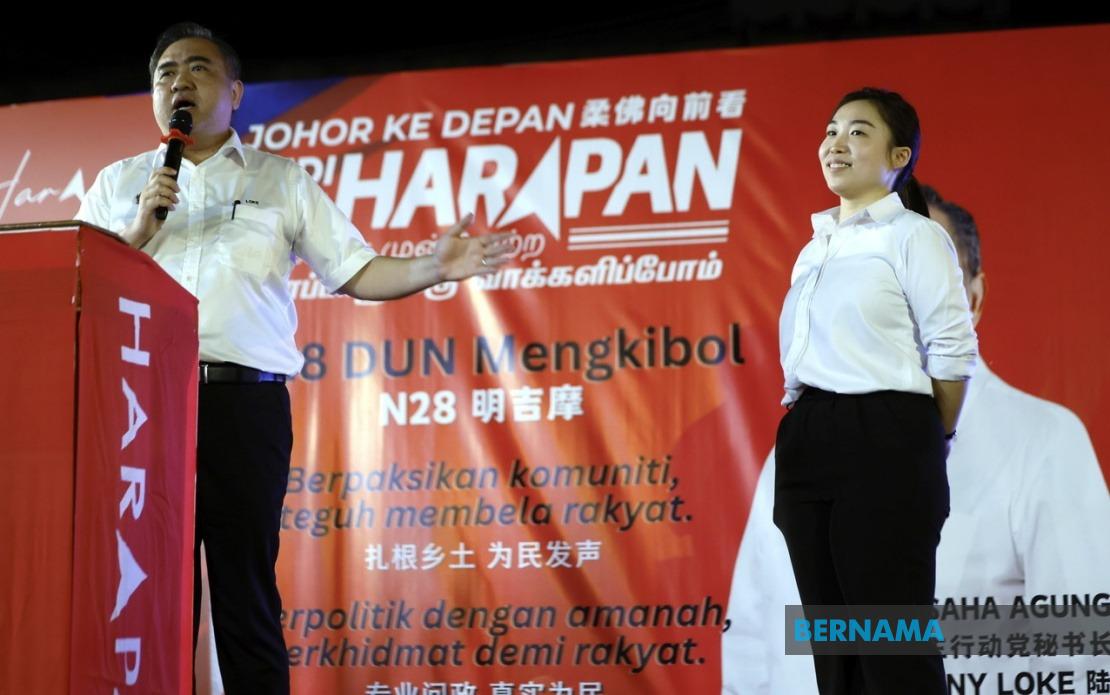
The Democratic Action Party has announced 33-year-old lawyer Chu Poh Yee as its candidate for the Mengkibol seat in the upcoming Johor state election, marking the party's push to strengthen its presence in the state with fresh faces and improved gender diversity. The announcement came during a candidate unveiling ceremony in Kluang on June 18, with party secretary-general Anthony Loke confirming the nomination to local party leadership and constituents gathered for the event.
The selection of Chu represents a transition point for the constituency, as the seat has been represented for two consecutive terms by Chew Chong Sin, whose stewardship will be redirected toward higher office. Rather than facing retirement, Chew is being repositioned by the party to contest the Labis parliamentary seat in the next national election, a move made possible after incumbent Member of Parliament Pang Hok Liong signalled his intention to step aside. This succession planning reflects how opposition parties strategically manoeuvre experienced representatives up the political ladder while simultaneously creating opportunities for emerging talent at state level.
According to Loke, the party's central leadership body unanimously endorsed Chu's candidacy, recognising her professional qualifications and community involvement as assets for the Mengkibol electorate. The lawyer has cultivated a reputation within DAP circles for providing legal support to party members and constituents seeking assistance with matters spanning advocacy and administrative procedure. Her background in managing such cases, particularly those involving vulnerable residents seeking redress or guidance, has positioned her as someone with practical understanding of the ground-level challenges faced by ordinary citizens navigating bureaucratic systems.
Loke emphasised Chu's educational attainment and linguistic capabilities as factors strengthening her candidacy, noting her fluency in multiple languages would enable her to connect effectively with Mengkibol's diverse population. Equally significant, he highlighted her existing roots within the constituency, suggesting she is neither an outsider parachuted into an unfamiliar seat nor someone requiring time to establish credibility with local voters. This locality advantage becomes particularly valuable during election campaigns when candidates must demonstrate genuine familiarity with community concerns and local personalities.
The nomination also forms part of a deliberate effort by DAP to elevate women into electoral contests, addressing long-standing critiques about gender representation in Malaysian politics. By selecting Chu for a seat currently held by the party, rather than sacrificing her candidacy on a marginal battleground, the party signals seriousness about achieving meaningful female participation rather than merely appeasing external pressure. Such strategic placement can influence wider party culture and signal to potential female candidates that nomination is achievable.
Mengkibol constitutes one of the 17 state constituencies the Democratic Action Party will contest in the Johor election, a roster comprising multiple categories of seats reflecting different strategic calculations. Ten of these are seats presently held by DAP representatives, where incumbency provides organisational advantages and voter familiarity. Four additional constituencies represent territory the party previously controlled but has since lost, and which party strategists believe can be recaptured through renewed campaigning and candidate appeal. The remaining three seats represent expansion opportunities where DAP believes emerging voter sentiment or demographic shifts might produce results.
The candidacy announcement for Mengkibol comes ahead of a staggered rollout of nominations across the party's full slate. Loke indicated that four additional candidates would be unveiled during a separate event on Saturday, specifically for the Tiram, Johor Jaya, Senai and Bukit Permai constituencies. This gradual release of candidate information stretches media attention and allows the party to create separate news cycles around different personalities and constituencies, maximising promotional opportunity. The strategy also permits sequential evaluation of candidate reception before finalising the complete list.
The remaining candidates across all 17 seats will be revealed publicly in conjunction with nomination announcements from other Pakatan Harapan coalition partners, coordinated during a ceremony scheduled for the following Monday where Prime Minister will preside. This coordinated disclosure reflects the electoral alliance structure underpinning opposition politics in Malaysia, where DAP, Amanah, PKR and other partners must synchronise their campaign launches to project unity and coordinated messaging. The involvement of the Prime Minister in these announcements underscores the significance of the Johor contest within the broader national political landscape.
For observers tracking opposition party dynamics, Chu's nomination illustrates how Malaysian political organisations navigate generational renewal while maintaining electoral competitiveness. The legal profession has historically supplied candidates across the political spectrum, with lawyers offering perceived expertise in policy matters and governance. Chu's selection thus taps into this established talent pipeline while simultaneously addressing contemporary expectations regarding female participation. Her appointment to defend rather than contest a marginal seat suggests DAP's confidence in her electability, positioning Mengkibol voters with a candidate who combines professional credentials, local knowledge and party support resources.