The use of government resources and student attendance at what was billed as an educational programme has become the latest flashpoint in Johor's heated election campaign, with opposition leaders demanding clarity on the intersection between official state functions and partisan political activity.
Johor DAP chairman Teo Nie Ching has called on Menteri Besar Datuk Onn Hafiz Ghazi to provide a full account of allegations surrounding the Johor MARA TVET Roadshow held at the Inland Revenue Board Hall in Kluang on July 4. According to Teo, who also serves as Deputy Communications Minister, the party received complaints from parents and students suggesting they faced pressure to participate in the event, with warnings that non-attendance would be marked as absenteeism.
What began as a vocational education initiative, according to these allegations, morphed into a platform for political endorsement when the Menteri Besar reportedly used the occasion to directly solicit support for the Barisan Nasional candidate, even referencing the contestant's ballot number. This transformation from educational content to campaign messaging has raised fundamental questions about the propriety of deploying government venues and compulsory student participation for partisan purposes during an active election cycle.
Teo framed the issue in personal rather than purely partisan terms, noting that the core concern transcends typical political disagreement. She emphasised that regardless of one's political allegiances, requiring young people to attend a government programme only to then pressure them into supporting a particular candidate represents a troubling use of institutional authority. The presence of documentary evidence, including the event itinerary, mandatory attendance directives, and video recordings of the alleged remarks, suggests this is not merely a he-said-she-said dispute but involves material that could be scrutinised by relevant authorities.
The timing of this controversy is particularly significant given that voters will go to the polls on July 11, with early voting having already commenced. The state election encompasses 56 seats with 172 candidates competing across the electorate, making this period critical for both coalitions. Any perception that one side has exploited government machinery for campaign advantage could influence public sentiment and reinforce broader narratives about institutional fairness that voters weigh when making electoral decisions.
Teo pointedly separated her criticism into two dimensions: what occurred during the event itself, and broader questions about resource deployment. She explicitly stated that the presence of a Menteri Besar at a government programme would normally be unremarkable and entirely appropriate. The controversy centres on whether that venue and captive audience were then weaponised for campaign purposes. More fundamentally, she questioned whether any government facility, regardless of the nature of the underlying event, should be permitted to host partisan campaign activity, particularly when attendance involves an element of compulsion.
The opposition leader also broadened her critique to encompass what she characterised as selective accountability from the Menteri Besar. Recent statements by Onn Hafiz criticising federal government policies as burdensome to the public became Teo's reference point for discussing what she views as inconsistent messaging. When policies prove popular, she suggested, the state government claims credit as if they were local initiatives; when they generate controversy, the blame is directed toward Kuala Lumpur, DAP, or PKR depending on perceived political advantage. This pattern, in her view, exemplifies a lack of intellectual honesty in political discourse.
Teo noted that responsibility for major policy implementation ultimately rests with the federal Cabinet, which must approve such initiatives before implementation. This structural reality, she implied, is sometimes obscured in state-level political messaging designed to appeal to voters' grievances while avoiding acknowledgment of the collaborative decision-making processes involved in governance. The broader point appears to be that the TVET event allegation fits within a pattern where government resources and platforms are selectively deployed for political advantage.
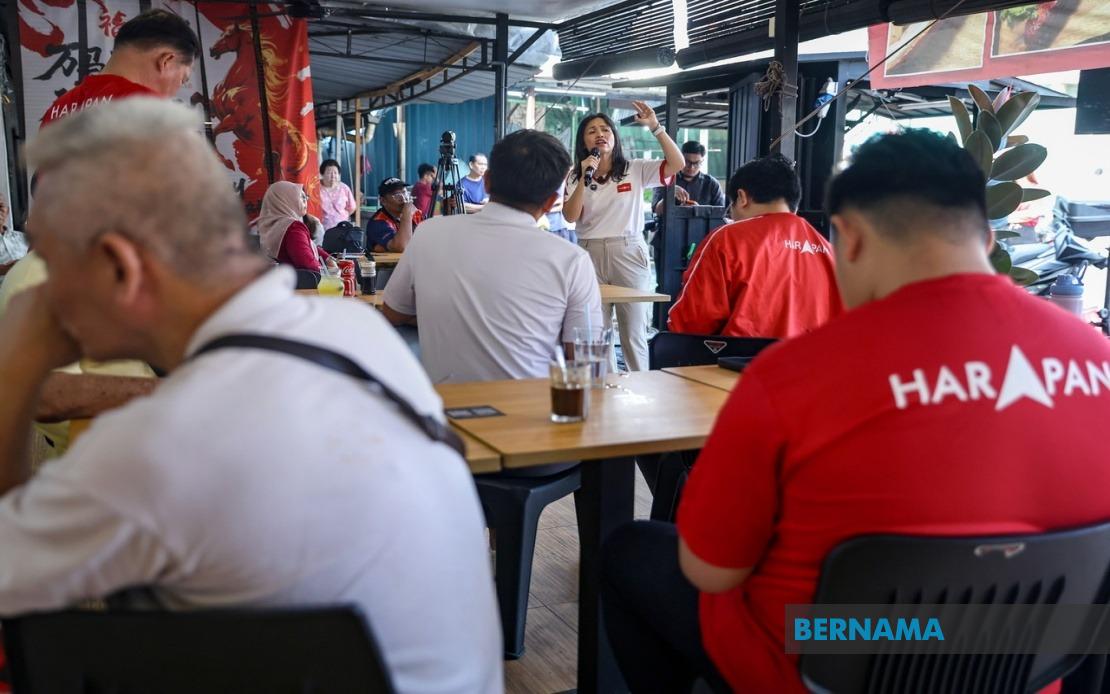
Regarding potential consequences, Teo indicated that Pakatan Harapan candidates would determine whether to lodge formal complaints with the Election Commission. This measured approach suggests the opposition is treating the matter as sufficiently serious to warrant institutional review, but is allowing the elected candidates themselves to decide on escalation rather than orchestrating a centrally coordinated response. The presence of veteran leader Tan Sri Lim Kit Siang at the forum, alongside PH's Senai seat candidate Wong Bor Yang, underscored the event's importance as an opportunity to frame election narratives.
Lim used the occasion to articulate a broader opposition vision centred on what he termed the "Malaysian Dream," emphasising unity across ethnic and religious lines, equality, democratic freedoms, shared prosperity, and human rights protection. His intervention positioned the specific TVET allegation within a larger philosophical disagreement about the type of politics that should define Malaysia and Johor specifically. The call for voters to avoid splitting their votes and instead consolidate support behind the PH coalition reflects tactical calculation ahead of the July 11 polling day.
The incident illustrates enduring tensions in Malaysian electoral politics regarding the boundaries between government functions and party interests. During active campaigns, such incidents become particularly contentious because they can swing both actual votes and broader perceptions of institutional impartiality. For voters deciding between competing coalitions, questions about who respects the integrity of government institutions and educational spaces carry weight beyond the immediate context.
For Southeast Asian observers, the Johor situation reflects common governance challenges across the region where party and state resources sometimes blur, particularly during election periods. How Malaysian institutions and the public respond to such allegations will influence whether norms around institutional integrity are reinforced or gradually eroded, with implications that extend beyond a single state election into broader patterns of political conduct.

