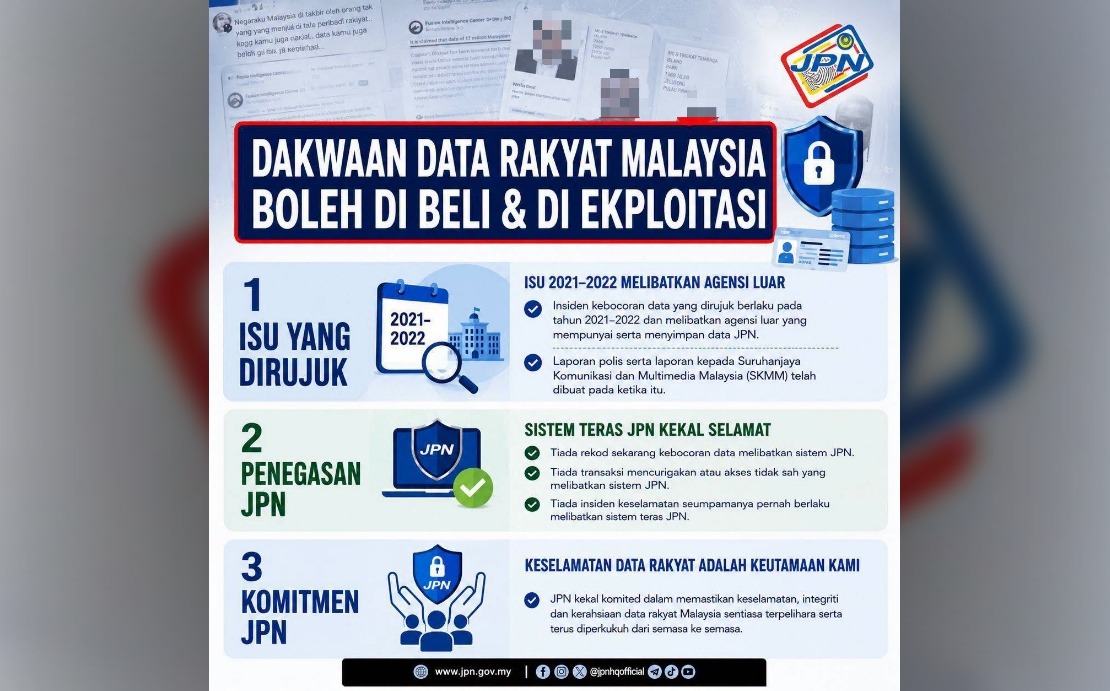
Malaysia's National Security Council (MKN) moved quickly to address public concern over a data leak circulating on social media, issuing a statement through its National Cyber Security Agency (NACSA) to clarify that the compromised information originated from cyber intrusions that occurred prior to 2022. The council stressed that the data now being redistributed online without authorization bears no connection to any presently operating digital platforms, a distinction that matters significantly for users concerned about the security of their current digital interactions and transactions.
According to NACSA's assessment, the leaked information was unlawfully extracted through targeted cyber attacks on various systems years ago, long before the incidents gained traction on social platforms recently. The timing of this redistribution—occurring years after the original compromise—suggests criminal actors are capitalizing on older breach repositories to create the impression of current system vulnerabilities. This pattern reflects a common tactic in the cybercriminal ecosystem, where aged databases are periodically re-circulated to generate panic and extract value from unsuspecting users seeking to obtain or verify their personal information.
The council's statement carried an explicit legal warning to Malaysians, emphasizing that the act of providing, disseminating, or enabling access to unlawfully obtained personal data constitutes a criminal offense under Malaysian legislation, regardless of whether the offending websites or services operate from foreign jurisdictions. This clarification is particularly important in Southeast Asia's borderless digital environment, where criminals frequently host illegal data repositories on overseas servers to evade local law enforcement. By reiterating that Malaysian law extends to the distribution of such materials, regardless of hosting location, authorities are signaling their commitment to pursuing perpetrators through international cooperation mechanisms.
Immediate containment efforts have involved coordination between multiple government agencies. NACSA, working alongside MyNIC and the Personal Data Protection Department, has engaged foreign service providers to identify and block access to the websites through which the leaked data is being offered. This multi-agency approach reflects the understanding that effective cybersecurity responses require coordination across regulatory bodies and technical specialists. The involvement of foreign service providers underscores the necessity of international partnerships in combating cyber threats that routinely transcend national boundaries.
Parallel to the remediation efforts, the Royal Malaysia Police have launched digital forensic investigations aimed at identifying perpetrators and building cases for prosecution. This law enforcement dimension is crucial because takedown notices and technical blocking measures, while important for immediate damage control, require complementary investigative work to deter future offenses through the threat of criminal consequences. The focus on forensic investigation suggests authorities are attempting to trace the chain of custody of the data and identify which individuals are actively profiting from or facilitating its distribution.
The council used the incident as a platform to advocate for stronger cybersecurity legislation, highlighting the pending Cyber Crime Bill that will soon be tabled in Parliament. The proposed legislation would introduce more comprehensive criminal provisions and enhanced penalties specifically targeting data theft, system intrusions, and identity-related offenses. These provisions would criminalize unauthorized access to computer systems and programs, as well as define identity theft involving the fraudulent use of another person's credentials as a distinct offense—a necessary evolution as identity-based crimes become increasingly sophisticated and damaging.
Complementing the legislative agenda, the Cyber Security Act 2024, which came into force in August 2024, establishes mandatory security requirements for operators of National Critical Information Infrastructure (NCII). These requirements mandate the implementation of comprehensive protection protocols, including codes of practice, systematic risk assessments, and periodic security audits. This regulatory framework represents a shift toward proactive security standards for essential service providers rather than reactive responses after breaches occur. For Malaysian citizens relying on banking, telecommunications, and government services, these mandates theoretically translate into stronger baseline protections across critical sectors.
The council also addressed concerns regarding MyDigital ID, clarifying that the platform functions as an identity verification mechanism rather than a personal data storage repository. With more than 16 million registrations to date, MyDigital ID serves as an authentication layer that connects users directly to the National Registration Department without storing personal information on the platform itself. This architectural distinction is vital because it means the leaked data predates the deployment of MyDigital ID as a system and therefore cannot have been sourced from it. The platform's rapid adoption across government agencies and private sector services—including telecommunications companies and financial institutions—indicates growing confidence in its security model among both public and private entities.
The integration of MyDigital ID across multiple service sectors creates network effects that improve overall security for digital transactions across the economy. As more organizations rely on the platform for identity verification, the incentive for criminals to compromise it increases, but so too does the concentration of security investment on a single hardened system rather than fragmented security efforts across hundreds of isolated identity verification mechanisms. For Malaysian residents conducting digital transactions, this consolidation theoretically reduces their exposure to multiple weak authentication points.
Looking forward, the council reiterated that ensuring secure digital transformation remains a top government priority, with NACSA positioned as the frontline agency for identifying and addressing emerging cybersecurity threats. The statement's emphasis on a cybersecurity-first approach to digital transformation distinguishes Malaysia's strategy from nations that prioritize speed of adoption over protective measures. This stance reflects lessons learned from regional cyber incidents and a recognition that public trust in digital systems depends fundamentally on demonstrated security capabilities and swift, transparent responses to breaches.
For Malaysian citizens, the practical implications extend beyond the immediate clarification about the data leak's age and origin. The coordinated government response, combined with legislative momentum and sector-wide compliance requirements, signals that cybersecurity governance in Malaysia is maturing from ad-hoc incident response toward systematic, multilayered protection. The public is advised to remain cautious about services purporting to offer access to unlawfully obtained information, not merely for legal reasons but because using such services perpetuates the ecosystem that funds and incentivizes cybercriminal operations. Individual vigilance against purchasing or accessing leaked data, combined with strengthened institutional safeguards, represents the most effective defense against the ongoing circulation of compromised information.

