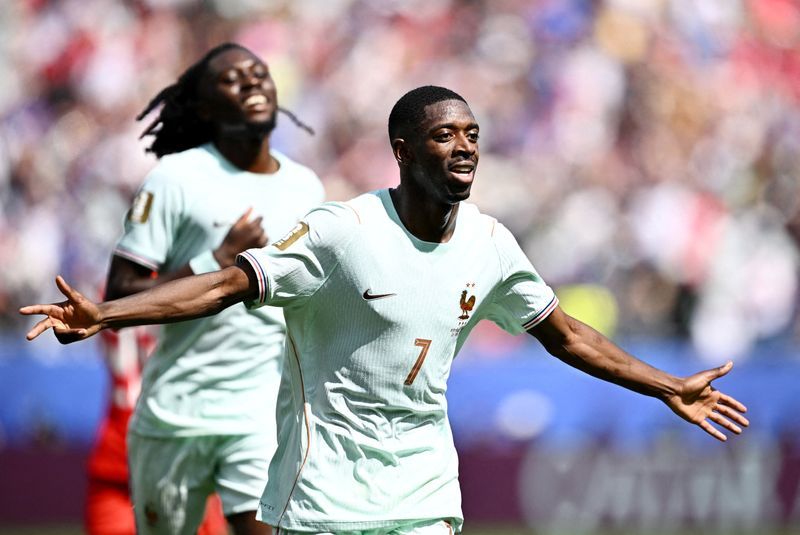
Ousmane Dembele produced a clinical finishing display on Friday evening as France steamrolled past Norway 4-1 in Foxborough, Massachusetts, securing top spot in World Cup Group I with a performance that underlined their credentials as tournament contenders. The Paris Saint-Germain winger's three-goal burst spanning just 25 minutes in the first half proved devastating, catapulting the 2018 champions and 2022 runners-up into the knockout phase with considerable attacking confidence.
Despite both sides having already secured their passage to the Round of 32 before kickoff, France's determination to finish first reflected the squad's competitive instincts and appreciation for the tournament's venue logistics. The group-topping finish carries tangible benefits, offering a more favourable travel schedule across North America's sprawling geography compared to the path available to group runners-up. For a squad operating under the emotional weight of manager Didier Deschamps' absence—he returned home to the United States to attend his mother's funeral—the victory served as a powerful tribute to their absent leader and a demonstration of collective resolve.
France's dominance was immediate and overwhelming from the opening whistle. Kylian Mbappe, potentially en route to a personal duel with Erling Haaland for the tournament's Golden Boot award, nearly broke the deadlock within twenty seconds with an angled effort that cannoned off the bar. The early intensity set the tone for what would become a one-sided affair, with the French pressing relentlessly while Norway struggled to establish any meaningful attacking rhythm.
The breakthrough arrived in the sixth minute when Mbappe executed a sweeping cross-field pass of considerable precision to Dembele, who demonstrated his technical class by cutting inside and then outside his marker before dispatching a clinical angled strike beyond goalkeeper Egil Selvik. The winger's second came fourteen minutes later, again fashioned by Mbappe's creative orchestration, as Dembele manufactured space to dispatch a dipping shot that left Selvik helpless. By the 32nd minute, Dembele completed his hat-trick with a curling low effort into the bottom corner, joining an exclusive club of France World Cup performers alongside Just Fontaine and Mbappe himself.
Dembele's achievement carried significant historical weight, representing the second-fastest hat-trick in World Cup history. Only Austria's Erich Probst eclipsed his accomplishment, notching three goals against Czechoslovakia in 1954 after 24 minutes—a record that had stood for seven decades. The blistering pace at which Dembele accumulated his treble demonstrated a clinical finishing edge that could prove decisive if France's tournament progresses as expected.
Norway's decision to deploy a heavily rotated lineup significantly influenced the contest's complexion. Coach Stale Solbakken had rested the majority of his starting eleven from the previous fixture against Senegal, most notably excluding goal-scoring sensation Erling Haaland and captain Martin Odegaard. This strategic calculation, presumably aimed at managing fitness ahead of the knockout stages, left Norway vulnerable to France's intensity and technical superiority. Thelo Aasgaard's goal shortly after Dembele's second strike provided only momentary respite, temporarily narrowing the deficit before the French winger's hat-trick confirmed France's dominance.
The second half revealed structural weaknesses in France's defensive organization, offering Norway glimpses of vulnerability despite the commanding scoreline. Jorgen Strand Larsen's soft penalty in the early stages of the second period proved inconsequential when Mike Maignan saved comfortably, preserving France's clean slate. Winger Oscar Bobb subsequently tested the French goalkeeper again as Norway briefly threatened to exploit gaps in the back line, yet the visitors lacked the sustained attacking threat necessary to mount any realistic comeback.
France's fourth goal arrived in the closing stages through substitute Desire Doue, who converted a header from Bradley Barcola's cross, adding gloss to a comprehensive performance. The late addition underscored France's offensive options and their capacity to introduce fresh attacking impetus throughout the contest. This depth of attacking talent positions the French squad as formidable opponents heading into the knockout phase, where such options could prove invaluable across multiple fixtures.
The group-topping finish carries important consequences for both teams' knockout trajectories. France will likely encounter Sweden in the Round of 16, while Norway, finishing as runners-up, faces a meeting with Ivory Coast. For the French, the prospect of facing Sweden offers a challenging but potentially manageable fixture that reflects their superior group positioning. The importance of finishing first—offering not only favourable matchups but also reduced travel distance across a geographically spread tournament—became evident as the competition structure heavily rewards group winners. For Malaysian and Southeast Asian observers, France's performance demonstrated the clinical efficiency required to advance in international tournaments, a lesson relevant to regional teams aspiring toward higher World Cup achievements.

