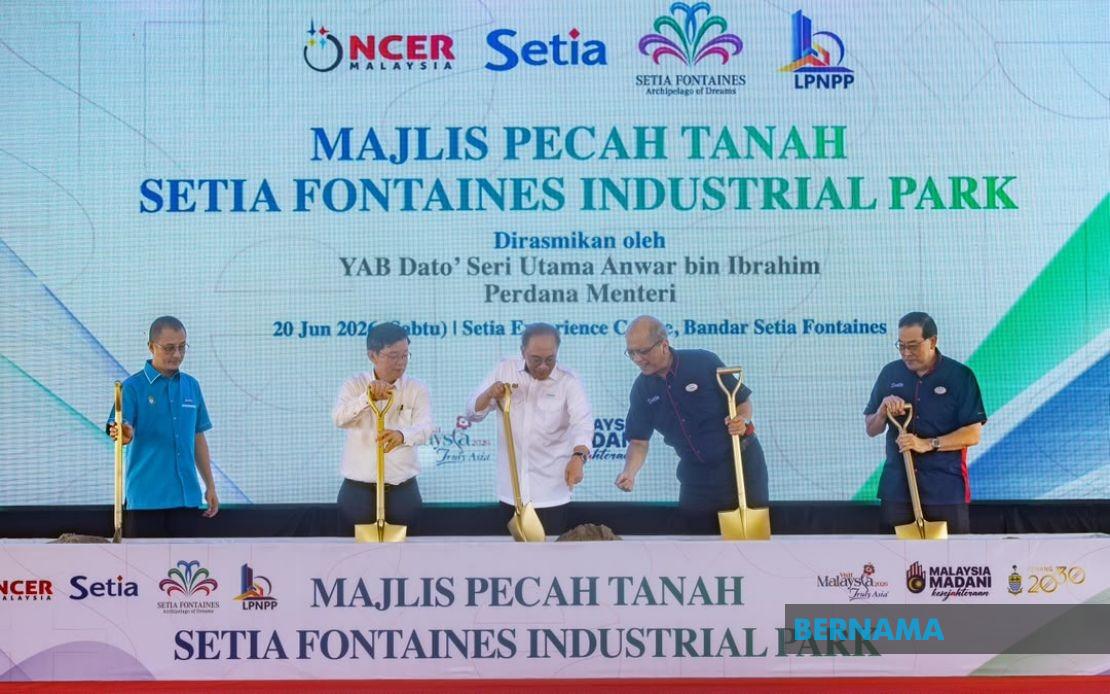
Prime Minister Datuk Seri Anwar Ibrahim has demanded that major development projects create tangible economic benefits for middle- and lower-income Malaysians, signalling growing concern within government about wealth inequality accompanying the nation's investment boom. Speaking at the groundbreaking ceremony for the Setia Fontaines Industrial Park in Kepala Batas on June 20, Anwar stressed that approvals granted to major entities such as Khazanah Nasional Berhad, Permodalan Nasional Berhad, and the Employees Provident Fund must be accompanied by concrete measures to include economically disadvantaged communities in wealth creation.
The Prime Minister's remarks reflect a fundamental tension in Malaysia's development strategy: rapid economic expansion and foreign investment influx risk benefiting a narrower segment of society unless deliberately structured otherwise. Anwar articulated this tension bluntly, warning that without intentional inclusion mechanisms, "a growing divide in our country" would emerge alongside constrained opportunities for lower-income groups. This framing positions inclusive growth not merely as a social welfare concern but as a governance imperative, suggesting that Malaysia's stability depends on distributing development gains across income strata.
Anwar's emphasis on equitable development planning appears to respond to longstanding criticisms that Malaysia's major infrastructure and industrial projects disproportionately benefit connected elites and large corporations. By explicitly naming Khazanah, PNB, and EPF—institutions managing Malaysia's sovereign wealth, national savings, and retirement funds respectively—Anwar was signalling that even state-controlled entities must now embed equity considerations into project design. This represents a notable policy shift, treating inclusive participation not as an afterthought but as a prerequisite for government endorsement.
The Setia Fontaines Industrial Park itself exemplifies the development model Anwar seeks to promote. Located in Seberang Perai, the facility is positioned to drive economic growth in a region historically overshadowed by the island's more developed areas and the state's southern corridor. This geographic focus addresses a specific inequality—uneven development between peripheral and core economic zones—that has long characterised Penang's landscape. By anchoring industrial capacity outside traditional hubs, the project implicitly acknowledges that development opportunity must extend beyond established prosperity zones.
Critically, Anwar reframed how Malaysia should measure development success. Rather than relying solely on "encouraging statistics"—a transparent reference to headline growth figures that can mask unequal distribution—he insisted that genuine progress requires "real benefits to people across all levels of society." This distinction between aggregate economic indicators and lived experience is significant for Malaysian policymakers and investors accustomed to celebrating GDP growth and foreign direct investment inflows without interrogating distributional outcomes. The articulation suggests growing frustration within government about a metrics-driven approach to development that ignores equity dimensions.
The industrial park's employment potential provides the mechanism through which Anwar envisions inclusive growth operating. He highlighted the facility's capacity to create "high-quality employment opportunities" as Malaysia transitions from labour-intensive, back-end manufacturing toward technology-intensive sectors. This transition is crucial because it determines whether job creation benefits primarily those with existing educational credentials or whether it can be structured to absorb workers from lower-income backgrounds seeking upward mobility. Without such intentionality, technological advancement risks automating away entry-level positions while reserving advanced roles for already-educated cohorts.
Skill development emerges as the critical variable in Anwar's inclusion framework. He identified a potential mismatch between job supply and worker preparedness, warning that Malaysia could create professional positions while lacking sufficient qualified candidates to fill them. This gap would render development economically inefficient and socially wasteful—creating opportunities that lower-income groups cannot access due to educational deficits. Rather than blame workers, Anwar implicitly challenged institutions and policymakers to redesign skills provision systems.
Anwar's prescription for closing this gap involves enhanced collaboration among industry, technical and vocational education providers, and universities including Universiti Sains Malaysia. This trilateral model seeks to align training with genuine employer demand rather than allowing educational institutions to operate independently of labour market realities. Critically, the emphasis on technical and vocational pathways—not solely university degrees—acknowledges that diverse routes to skilled employment must exist. For lower-income Malaysians, affordable, accessible vocational training represents a more feasible pathway to middle-class employment than traditional university education.
The technological dimension of Anwar's remarks warrants particular attention for Malaysian policymakers. He noted that "technology evolves within a year or two," implying that static educational curricula become obsolete rapidly. This observation suggests that inclusion requires continuous, adaptive learning ecosystems rather than fixed credential systems. For Malaysia, which faces global competition in technology sectors, this perpetual upskilling requirement could either entrench existing inequalities—if lower-income workers lack access to continuous training—or democratise advancement opportunities if provision becomes sufficiently accessible and affordable.
Anwar's intervention also carries implicit criticism of the development paradigm that has dominated Malaysian policy for decades. The traditional approach has treated growth as primary and distribution as secondary, assuming that expanding the economic pie automatically enlarges all slices. Anwar's emphasis suggests recognition that this "trickle-down" model has underperformed, requiring deliberate redistribution mechanisms embedded in project design. This represents a meaningful ideological shift within Malaysian governance.
For Southeast Asian observers, Anwar's stance reflects broader regional debates about inclusive growth following rapid industrialisation. Thailand, Indonesia, and Vietnam have similarly grappled with widening inequality accompanying development expansion. Malaysia's explicit policy focus on ensuring development benefits span income groups may offer a template for regional peers wrestling with equivalent tensions between growth acceleration and equity.
Looking forward, Anwar's framework creates accountability expectations for both government entities and private investors. Future development approvals will implicitly carry obligations to demonstrate inclusive opportunity mechanisms, not merely economic returns. This potentially recalibrates power dynamics between government and capital, asserting regulatory authority over how development should be structured. Whether this rhetoric translates into binding requirements or remains exhortatory remains to be seen, but the articulation itself signals that Malaysian governance increasingly prioritises equity as a development criterion rather than a secondary consideration.

