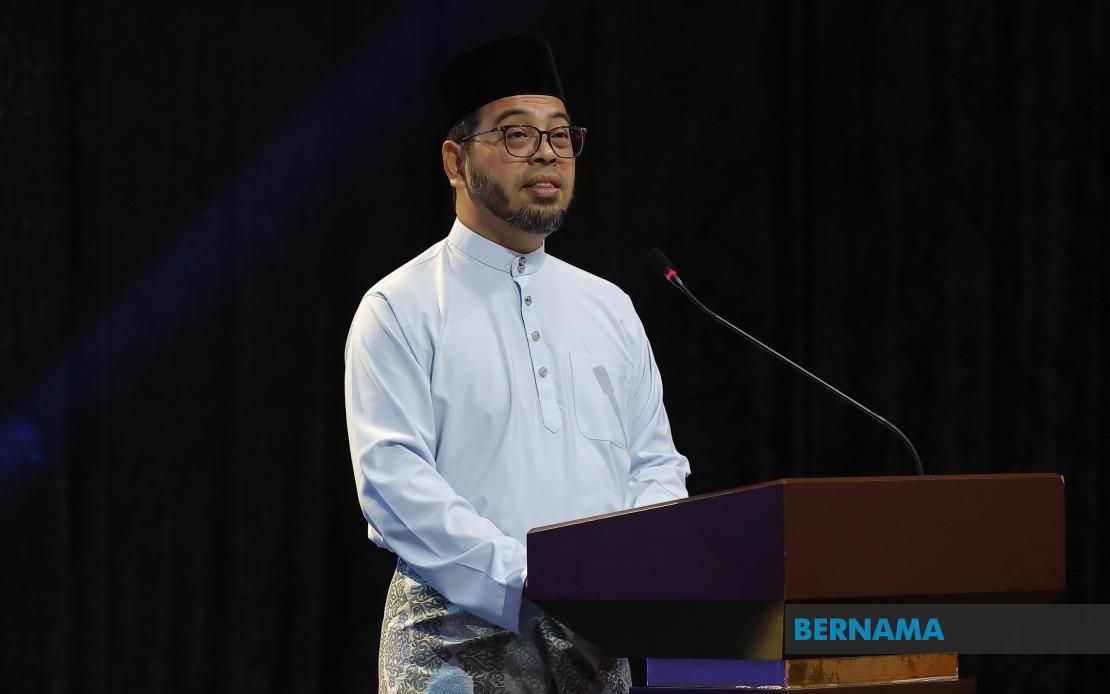
Religious Affairs Minister Dr Zulkifli Hasan has stressed that Malaysian Muslims must move beyond internal disagreements and release resentments that fragment the community, arguing that cohesion is essential for confronting the mounting complexities of an interconnected world. Speaking at the national Maal Hijrah 1448H/2026M observance held at Putra Mosque in Putrajaya, Zulkifli outlined a vision where sustained spiritual and intellectual growth within individuals translates into collective strength that safeguards the entire Muslim population from external pressures and internal fracture.
The event, which carried the theme "MADANI Dihayati, Ummah Diberkati" (MADANI Lived, the Ummah Blessed), drew prominent attendance including Sultan Nazrin Shah of Perak and Deputy Prime Minister Datuk Seri Fadillah Yusof, underscoring the high-level political endorsement for initiatives centred on religious and social cohesion. The gathering reflected an ongoing governmental emphasis on using religious occasions and platforms to reinforce messaging around national unity and shared responsibility during a period of economic and geopolitical uncertainty.
Zulkifli articulated that genuine social transformation cannot occur through policy announcements or structural reforms alone; rather, it demands that each individual undergo profound internal metamorphosis involving the cultivation of intellectual rigour, spiritual depth, and moral integrity. This framing aligns with broader Islamic teaching on personal accountability and the interconnection between individual rectification and community welfare. By positioning personal development as the foundation for collective progress, the minister sought to emphasise that Muslims bear individual responsibility for the state of their community rather than attributing fragmentation solely to leadership or institutional failures.
The minister warned that while unity generates prosperity and blessings that extend to all members of a community, division produces the opposite effect—inviting hardship and diminishing the nation's capacity to function effectively. This characterisation of unity as a generator of material and spiritual benefit reflects traditional Islamic jurisprudence while also carrying implications for Malaysia's multicultural context, where Muslim cohesion has domestic and regional resonance. The statement implicitly suggests that Malaysia's competitive standing depends partly on whether its largest religious community can overcome internal tensions that might otherwise divert energy and resources from productive endeavours.
Zulkifli emphasised that Malaysia cannot isolate itself from the turbulent global economic environment currently disrupting supply chains and creating widespread financial instability across nations. This acknowledgment of external vulnerability reinforces the argument for internal unity—framing community solidarity not as an abstract spiritual ideal but as a practical necessity for national economic resilience. As Southeast Asia remains exposed to global trade disruptions and inflationary pressures, the minister's invocation of external threats serves to justify domestic calls for putting aside factional differences in the interest of collective survival and prosperity.
The minister specifically appealed to Malaysians to continue supporting government initiatives directed at elevating the social and economic standing of Muslims and ensuring that Islamic principles remain vibrant within Malaysian society. This appeal functions on multiple levels: it reinforces governmental legitimacy by presenting state action as aligned with religious and communal interests, while simultaneously framing political support as a form of religious obligation. For Malaysian readers, the statement indicates that the government views its religious affairs portfolio as integral to broader developmental and stability agendas rather than as a separate administrative domain.
Zulkifli reframed the classical Islamic concept of hijrah (migration or exodus), traditionally understood as Prophet Muhammad's journey from Mecca to Medina, as an ongoing process of continuous personal and collective improvement. Under this contemporary interpretation, hijrah becomes a perpetual undertaking of abandoning destructive habits and cultivating virtues that cement social bonds among Muslims. This reinterpretation makes the historical concept relevant to modern circumstances, suggesting that Malaysian Muslims are engaged in their own form of hijrah by moving away from divisive behaviour and towards practices that strengthen communal ties. The reframing also subtly positions the government as facilitating this spiritual and social journey through its policies and initiatives.
The minister underscored that effective implementation of efforts to advance Islamic values depends fundamentally on the preceding establishment of communal unity. This sequencing—unity first, then value promotion—suggests a prioritisation of consensus-building over the pursuit of particular religious or ideological agendas. Such an approach may resonate with Malaysian Muslims of varying theological perspectives and socioeconomic backgrounds, as it defers questions about which specific values or practices should be elevated in favour of first establishing the procedural unity necessary to pursue any substantive agenda. This diplomatic framing reflects the complexities of religious governance in a country with diverse Muslim populations holding differing views on Islamic practice and modernisation.
Zulkifli also stressed that notwithstanding different religious convictions and personal backgrounds, all Malaysian citizens share mutual accountability for safeguarding domestic peace, institutional stability, and material prosperity. This inclusive formulation acknowledges Malaysia's non-Muslim populations while emphasising that Muslim unity serves the broader national interest rather than sectarian advantage. The statement tacitly recognises that Muslim-majority Malaysia's international standing and domestic stability depend on religious harmony and on Muslims demonstrating commitment to pluralistic values—a consideration that likely informed the minister's emphasis on transcending internal disputes rather than intensifying particular theological or political positions.
During the ceremony, Sultan Nazrin presented the National Tokoh Maal Hijrah award to IIUM Rector Prof Emeritus Datuk Dr Osman Bakar, while the International Tokoh Maal Hijrah award went to Moroccan Islamic scholar Dr Ahmad Al-Raysuni. These honour recognitions extend the messaging on unity and Islamic scholarship beyond Malaysia's borders, linking Malaysian efforts to strengthen the ummah with broader Islamic intellectual traditions represented by Al-Raysuni and institutional Islam represented by IIUM. The presentation of awards to both a Malaysian academic and an international Islamic figure reflects an attempt to position Malaysia as both contributing to and drawing from global Islamic intellectual resources.
For Malaysian observers, Zulkifli's address signals governmental priority on deploying religious messaging and platforms to advance political stability and social cohesion during a period of economic uncertainty. The emphasis on unity over doctrinal questions or institutional reforms suggests a pragmatic approach to religious affairs governance that privileges consensus and collective resilience over contested issues of theological interpretation or religious law. As Malaysia navigates regional economic competition and demographic shifts, the government's articulation of a unifying Islamic message appears calibrated to reinforce both Muslim communal bonds and broader national solidarity needed for facing external challenges.