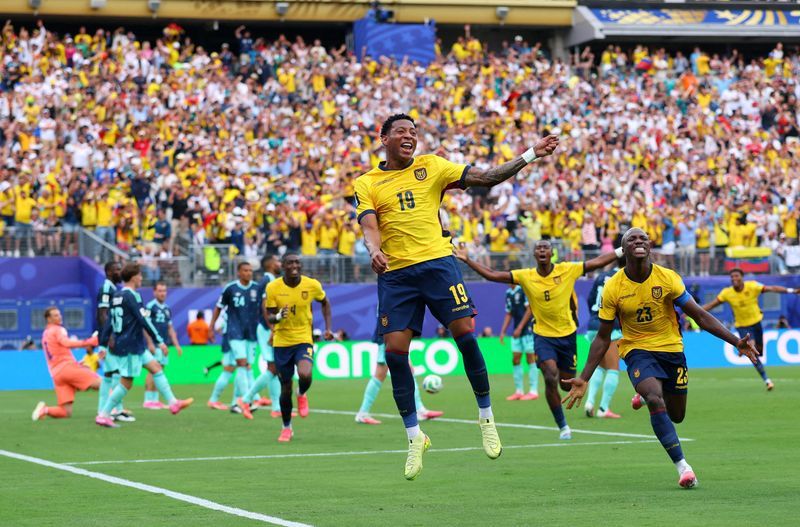
Ecuador's World Cup campaign found its salvation in a dramatic comeback victory over Germany at the Meadowlands in East Rutherford, New Jersey, on Thursday evening, rescuing their tournament aspirations with a stirring 2-1 triumph that propelled them into the knockout rounds. The South American side arrived at their decisive Group E encounter facing elimination, knowing nothing less than victory would suffice to keep their championship dreams alive. Instead of succumbing to the mounting pressure, they dismantled a German defensive structure that has been conspicuously vulnerable throughout the group stage, delivering a performance that will be remembered as one of the tournament's great upsets.
The opening minutes proved nightmarish for Ecuador when Germany, already assured of progressing as group winners, capitalised on a lightning-quick attack. Leroy Sane, who had waited 15 major tournament appearances for his breakthrough moment, latched onto a cleverly weighted pass from Florian Wirtz and finished left-footed inside the area just 120 seconds into the contest. Ecuador's coaching staff immediately registered a protest, claiming Aleksandar Pavlovic had raised his foot dangerously high and caught Pedro Vite in the head during the preceding possession, but referee Tori Penso deemed the challenge acceptable and the goal stood, leaving the yellows-dominated crowd momentarily deflated.
What emerged over the subsequent 87 minutes, however, was a masterclass in resilience and attacking intent from Gustavo Alfaro's outfit. Ecuador had arrived at this fixture burdened by a troubling statistical albatross: they had created 39 attempts without finding the net, a goalscoring drought that had haunted their previous two encounters and threatened to become the defining narrative of their tournament. That streak ended precisely nine minutes after Sane's opener when Nilson Angulo collected possession near the edge of the penalty area and executed a precise curled finish that Manuel Neuer, the German goalkeeper, appeared slow to anticipate. The goal sparked pandemonium among the sea of Ecuador supporters, instantaneously shifting the emotional tenor within the venue.
The second half unfolded with mounting controversy and escalating intensity. Referee Penso initially awarded a penalty when Kai Havertz went down following a challenge from Joel Ordonez, appearing to award Germany an opportunity to extend their advantage through what looked like a straightforward conversion opportunity. However, the intervention of video assistant refereeing proved decisive—upon review, Penso identified a foul committed by Germany in the lead-up to the incident and overturned his original decision, denying Die Mannschaft what would have been a critical second goal. This reversal fundamentally altered the match's trajectory, sustaining Ecuador's belief that an outcome favourable to them remained genuinely achievable.
For those seeking to understand the significance of Ecuador's passage from apparent elimination to knockout qualification, the context surrounding their journey proves instructive. The Andean nation began their tournament with modest expectations, arriving as underdogs against more established international powers. Their inability to convert chances in their opening matches created an atmosphere of creeping desperation, yet their players maintained the tactical discipline and composure necessary to mount a recovery when the decisive moment arrived. This capacity to reset and perform when consequences felt most severe distinguished Ecuador's tournament experience and justified the faith supporters placed in their competitive capabilities.
Gonzalo Plata authored the decisive moment of the encounter in the 78th minute, reacting with greatest alertness when substitute Kevin Rodriguez flicked on a corner at the near post. The resulting scramble and deflection left Neuer helpless as Plata stabbed the ball past the German custodian, and the Meadowlands erupted into scenes of pure jubilation. Ecuador's supporters understood the magnitude of what their players had accomplished: from potential group-stage elimination mere minutes earlier, they had secured progression and would now face stronger opposition in the knockout format, yet their tournament continuation had been assured through sheer determination and clinical finishing when opportunities materialised.
Germany's progression as group winners reflected their dominance across the three encounters despite the defensive fragility that has now become their defining characteristic across the campaign. The Germans accumulated six points and topped Group E ahead of Ivory Coast, who finished second after defeating Curaçao 2-0 elsewhere. Yet the manner of Germany's defeat to a team that seemed destined for early elimination raises pointed questions about their defensive solidity and whether their established defensive protocols can withstand the concentrated attacking intensity of stronger opponents awaiting in the knockout stages. They have now conceded in all three group matches, a concerning pattern given their historical standards.
For Southeast Asian observers and Malaysian readers with interest in international football dynamics, Ecuador's triumph underscores the tournament's inherent unpredictability and the capacity of determined underdogs to overcome substantial obstacles through collective effort and mental fortitude. The result equally demonstrates how tournament formats create scenarios where seemingly inferior sides can manufacture opportunities through pressure and persistence, turning theoretical disadvantages into competitive advantages. Ecuador's journey from apparent elimination to secured advancement provides a compelling reminder that World Cup football frequently rewards resilience and tactical flexibility over pre-tournament pedigree alone.

