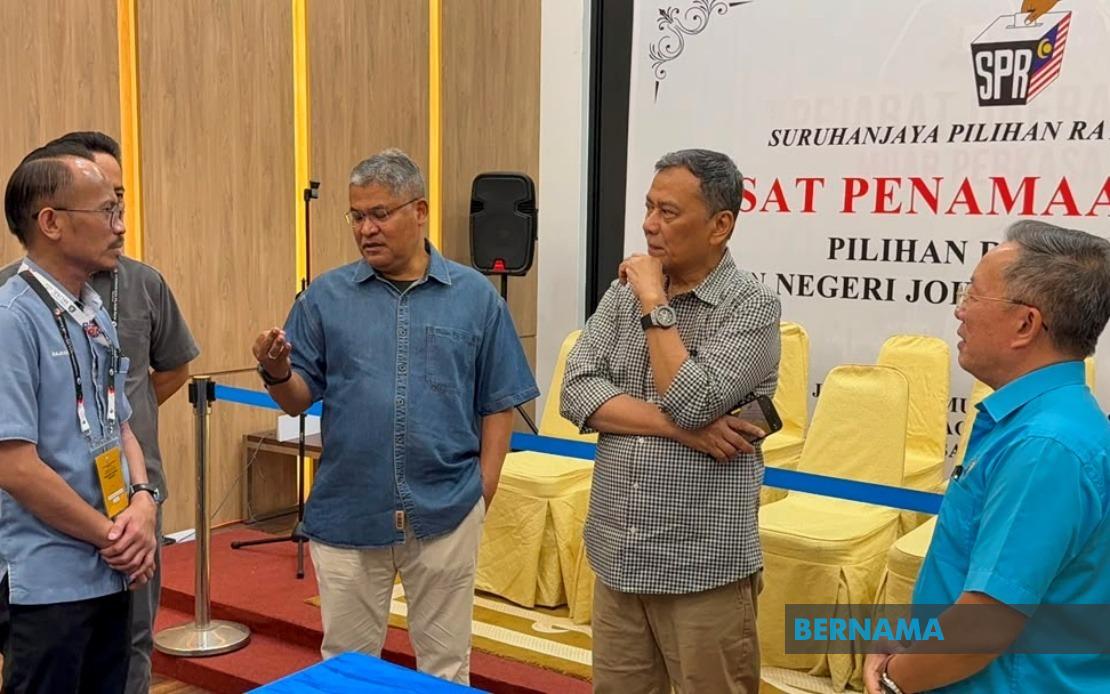
The Election Commission announced today that it has successfully completed final preparations ahead of tomorrow's nomination day for the Johor state election, with all designated polling centres reporting full operational readiness. Teams across the state conducted a final round of site inspections and coordination meetings to ensure the process proceeds without disruption when voters formally present their candidacy from 9 to 10 am across the 56 Candidate Nomination Centres distributed throughout Johor.
The Perling state constituency centre, located at Dewan Jubli Intan Hall in Johor Bahru, exemplified the level of detail given to logistical planning. Returning officer Nazatul Shima Mohamad confirmed that the physical layout of the premises had been finalised and that simulation exercises involving all participating agencies had been successfully executed. She stressed that all stakeholder organisations remained enthusiastically committed to orchestrating a seamless process, urging prospective candidates to arrive early, bring all necessary supporting documents, and present their deposit money to avoid delays.
Security and crowd management emerged as a central concern in the EC's operational design, reflecting Malaysia's experience with high-profile nomination days that often draw large gatherings of partisan supporters. The Kota Iskandar centre, situated at the main hall of Iskandar Puteri City Council in Medini, will implement a multi-layered approach to maintaining order. Returning officer Shahrulizam Abdul Rashid outlined plans for strategic road closures encircling the nomination venue, the establishment of a 50-metre exclusion zone immediately surrounding the centre, and the deployment of temporary barriers and tents to physically segregate supporters of competing political coalitions.
Coordination between the EC and law enforcement authorities formed a crucial pillar of the security architecture. Police personnel will be strategically stationed to manage the movement and behaviour of supporters gathering outside the nomination centres, preventing spontaneous clashes between rival camps. The EC has also issued a public appeal for attendees to exercise restraint and maintain civility, explicitly cautioning against provocative actions that might escalate tensions between competing party organisations. This emphasis on mutual respect reflects an underlying awareness that nomination days, while formally administrative occasions, often carry symbolic weight for political movements eager to display grassroots enthusiasm.
The 2024 Johor state election encompasses a remarkably large electorate by Malaysian standards. Commission data indicates that 2,727,926 registered voters will eventually be eligible to participate in the July 11 polling day, comprising 2,703,175 ordinary voters alongside 12,041 military personnel and their spouses and 12,710 police personnel and their families. This substantial voter base underscores the significance of Johor within Malaysia's broader political landscape and the corresponding importance of executing the electoral timeline flawlessly from its initial nomination phase through to the final ballot count.
The electoral calendar established by the Commission structures the process across multiple stages designed to allow adequate preparation time for all stakeholders. Following tomorrow's nomination day, the official announcement of candidates deemed eligible to contest will be made by individual returning officers at their respective centres. This proclamation marks a critical juncture, as it confirms the final slate of aspirants who will proceed to campaign. Early voting is scheduled for July 7, providing an opportunity for military and police personnel whose professional duties may constrain their availability on polling day, before the general election itself occurs on July 11.
The dissolution of the Johor State Legislative Assembly on June 1 set the timeline for this entire electoral exercise in motion. Under Malaysia's constitutional framework, state assemblies possess fixed terms but can be dissolved prematurely by the state ruler acting on the advice of the chief minister, triggering a fresh election cycle. The EC, as the constitutionally mandated authority responsible for administering all electoral processes in the country, subsequently announced the compressed schedule that condensed the nomination, campaign, and polling phases into a concentrated period spanning roughly six weeks.
For Malaysian political analysts and observers, the Johor election carries implications extending well beyond the state's boundaries. Johor remains one of Malaysia's most electorally consequential states, its results often signalling broader national political trends and serving as a barometer for public sentiment toward the federal government and ruling coalitions. The scale of voter participation and the composition of the elected state legislature may influence calculations within Kuala Lumpur's political circles regarding parliamentary stability and the viability of existing federal arrangements.
The EC's meticulous attention to logistical detail and inter-agency coordination reflects lessons accumulated from decades of administering Malaysian elections, including episodes where nomination days or other phases experienced disruptions, bottlenecks, or security incidents. The institution has evolved considerably in its technical capacity and procedural sophistication, deploying advanced voter management systems, trained personnel, and clearly delineated protocols to minimise friction. Tomorrow's execution will serve as a practical test of these systems and a preliminary indicator of how well the entire electoral process may function through its conclusion on July 11.

