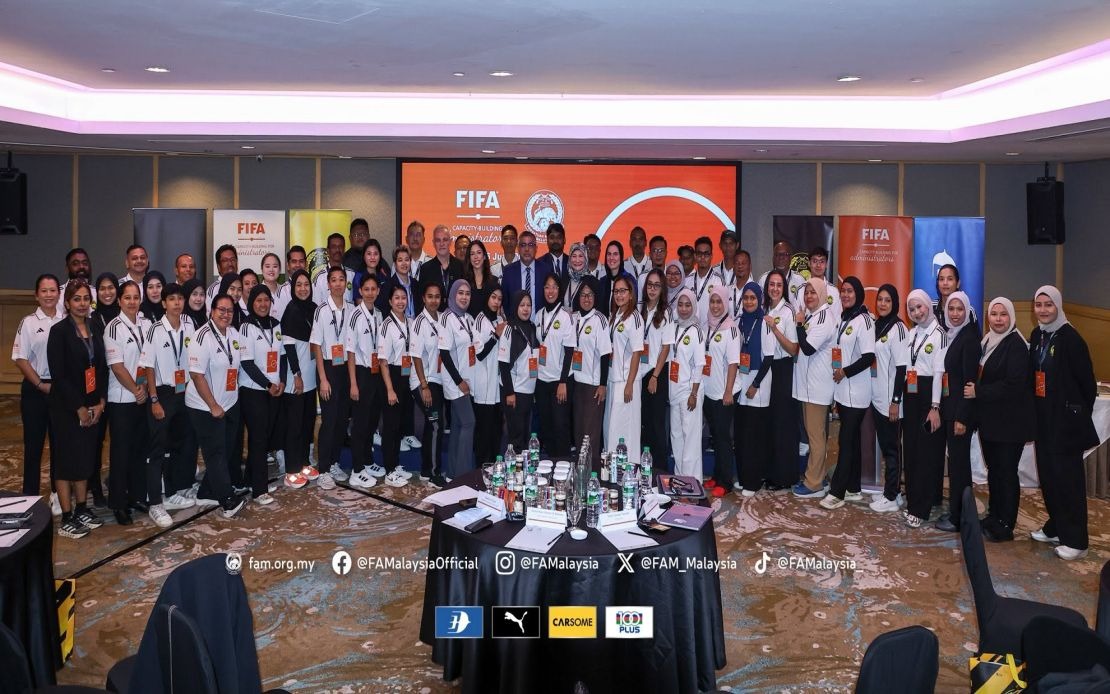
The Football Association of Malaysia has embarked on a significant institutional initiative to elevate the professional standards of women's football management across the country. Beginning in late June, FAM is orchestrating the FIFA Capacity-Building For Administrators 2026 programme, a comprehensive four-day training course designed specifically for individuals managing women's football teams and handling administrative responsibilities at various organisational levels. This move represents a deliberate strategic pivot toward recognising that a thriving women's football ecosystem depends on far more than talented players and skilled coaches on the pitch.
Leading the initiative are two internationally recognised FIFA Women's Football Development Experts: Safia Abdeldayem and Pema Choden Tshering, both of whom bring extensive experience in advancing women's football across different regions and contexts. Their involvement signals FAM's commitment to accessing world-class expertise and ensuring that participants receive instruction aligned with global best practices. The programme's curriculum spans four interconnected thematic areas that address the multifaceted nature of modern sports administration. Participants engage with modules centred on Women's Leadership, examining how to create inclusive and empowering management structures; Women's Competition, exploring the design and implementation of robust league and tournament frameworks; Club and Players' Rights, ensuring participants understand the legal and ethical obligations to their organisations and athletes; and Strategic Planning, equipping leaders with tools to envision and execute long-term institutional growth.
What distinguishes this initiative within Malaysian sports development is its explicit recognition that technical excellence on the field cannot flourish without corresponding excellence in institutional management. For too long, women's sports development in Southeast Asia has been constrained by asymmetries between player development and administrative capacity. FAM's investment in this area suggests a maturing understanding that female athletes deserve the same professional, well-organised support systems as their male counterparts. The programme ultimately seeks to empower individuals who occupy critical yet often underappreciated roles in the football value chain—team managers, administrative officers, and emerging women leaders whose decisions shape the day-to-day experience of players and influence the trajectory of clubs and national competitions.
FAM's strategic positioning of this programme reflects broader regional and international trends in women's sports governance. The Asian Football Confederation and FIFA have both intensified their focus on professionalising the administrative cadres that support women's competitions, recognising that sustainable growth requires institutional scaffolding. By inviting team managers and administrative officers from across Malaysia to participate, FAM is casting a wide net, signalling that quality management is not merely the domain of elite national teams but extends throughout the domestic football ecosystem. This inclusive approach potentially identifies and develops future leaders who may progress to higher-level administrative roles within FAM itself or within international football governance structures.
The programme's timing and scope also warrant consideration within Malaysia's broader commitment to women's sports advancement. Over recent years, Malaysian women's football has garnered greater visibility and investment, but questions persist about sustainability and institutional coherence. By systematising the training of administrators, FAM creates institutional memory and establishes common standards of practice across different clubs and regions. This professionalisation has ripple effects: when team managers understand players' rights frameworks, they create safer working environments; when administrators grasp competition structures, they can advocate more effectively for their clubs within league systems; when women leaders receive formal development, they become role models demonstrating that women's voices and decision-making authority are central to the sport's future.
The involvement of senior FAM figures—including Secretary-General Datuk Noor Azman Rahman and Women's Football Technical Director Soleen Al-Zoubi—underscores the seriousness with which the federation approaches this initiative. Equally significant is the presence of Datuk Suraya Yaacob, whose roles within both FIFA's Women's National Team Competitions Committee and the AFC's Women's Football Committee position her as a bridge between Malaysia's domestic football ambitions and continental and global governance structures. Her attendance validates the programme as part of a coherent international strategy rather than an isolated domestic experiment.
From a practical standpoint, the modules outlined address genuine pain points in Malaysian women's football administration. Women's leadership training responds to the reality that many women managers and administrators, despite their competence, have had limited exposure to formalised management education or mentoring. Understanding competition structures ensures that domestic administrators can navigate increasingly complex league systems and qualification pathways. Training on players' and clubs' rights protects vulnerable athletes from exploitation and ensures that clubs operate within ethical and legal boundaries. Strategic planning modules provide tools for long-term thinking in environments where short-term funding pressures often dominate.
For Malaysian readers and football stakeholders, this programme carries implications extending beyond administrative theory. A more professionally managed women's football ecosystem attracts better players, encourages investment from sponsors, and creates career pathways for women in sports management—fields where women remain underrepresented globally. When administrative competence rises across the board, the quality of competitions improves, match-fixing and corruption become harder to perpetrate, and the sport's integrity strengthens. These improvements, in turn, enhance women's football's appeal to audiences and broadcasters, creating a virtuous cycle of investment and growth.
The programme also reflects a recognition that FIFA's global development agenda, while international in scope, must be localised through individual federation initiatives. FAM is not simply receiving directives from Zurich; it is actively translating FIFA's capacity-building frameworks into a Malaysian context, ensuring that training content speaks to local challenges and opportunities. This localisation increases the likelihood that participants will implement lessons within their own institutional contexts rather than viewing training as a detached exercise.
Looking forward, FAM's commitment to expanding opportunities for women in football management through this and similar initiatives suggests a federation increasingly attuned to the reality that women's football's potential in Malaysia remains substantially untapped. The current player pool represents only a fraction of potential talent; many young women lack access to organised football because infrastructure and institutions are underdeveloped. By building a stronger cadre of skilled administrators and managers, FAM creates the foundation upon which expanded participation and improved competition standards can be constructed. This programme, though focused narrowly on administration, thus carries broader implications for Malaysia's sports development trajectory and its positioning within a rapidly evolving global women's football landscape.

