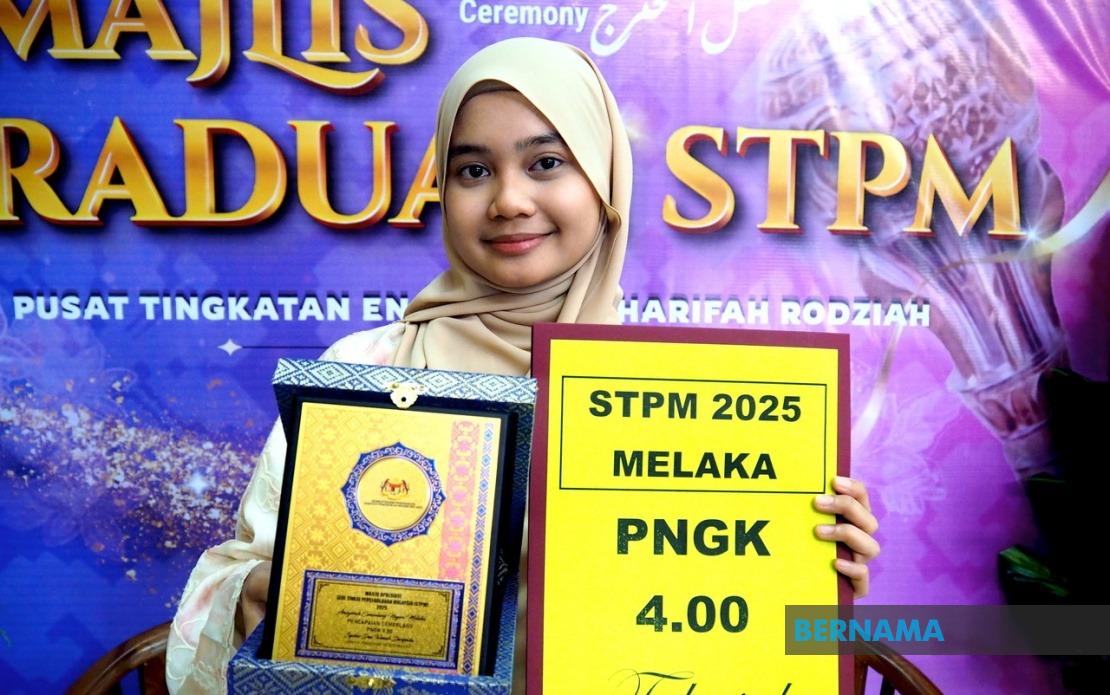
Nurfariesya Nasywa Hamedee, 21, from Sekolah Menengah Kebangsaan Agama Sharifah Rodziah in Melaka, has scored a perfect Cumulative Grade Point Average of 4.00 in the 2025 Sijil Tinggi Persekolahan Malaysia examination, an achievement rooted not in privilege but in the profound legacy of her late father's final words. The results, announced yesterday, represent a remarkable personal journey that extends far beyond academic metrics, embodying the power of familial encouragement to sustain a student through grief and uncertainty.
The story behind Nurfariesya's success reveals the fragility and resilience inherent in a young scholar's path. Her father, Hamedee Asri, died of a heart attack just one week before she was scheduled to sit for her Sijil Pelajaran Malaysia trial examinations several years ago. The loss devastated the family and shattered the teenager's confidence at a critical juncture. Confronted with the dual burden of bereavement and academic pressure, Nurfariesya seriously contemplated abandoning her education altogether, reasoning that leaving school to seek employment would provide tangible financial relief to her struggling household.
What transformed her despair into determination was her father's parting counsel, relayed through her mother Yusnita Ruslan, urging her not to squander the potential he had observed in her. This singular piece of advice transcended the moment of its delivery and became the philosophical bedrock sustaining her through years of subsequent study. Rather than serving as mere words of comfort, the instruction crystallized into a living commitment—a daily reminder that her academic pursuit honoured her father's belief in her capabilities and his hopes for her future.
The magnitude of Nurfariesya's achievement gains additional significance when considered against her own expectations. Based on her trial examination results and preliminary calculations, she had anticipated a CGPA of approximately 3.92, making the perfect 4.00 score a substantial surprise. This margin of improvement reflects not a sudden stroke of luck but disciplined effort applied over months of rigorous preparation. The student attributed her success to consistent study habits, unwavering determination, and an unshakeable faith that anchored her through periods of doubt.
During the official announcement of the 2025 Melaka State STPM results, presided over by Datuk Rosli Abdullah, the State Deputy Exco for Education, Higher Education, and Religious Affairs, Nurfariesya stood among the state's outstanding performers. She had previously demonstrated academic excellence by securing seven A grades in her SPM examination, signalling a sustained trajectory of high achievement across her secondary education. This consistency demonstrates that her STPM performance represents the culmination of years of dedicated work rather than an isolated success.
Nurfariesya's subject selection—General Studies, Arabic, Usuluddin, History, and Shariah—reflects a deliberate intellectual direction aligned with her professional aspirations. Since her school days, she has harboured a deep passion for Shariah law, viewing it as both an intellectual discipline and a meaningful avenue for service. This clarity of purpose has proven invaluable; rather than treating her subjects as hurdles to overcome, she engaged with them as components of a coherent educational pathway toward her chosen vocation. She currently interviews for admission to the Bachelor's Degree programme in Shariah law at Universiti Malaya, with aspirations to become a practising Shariah lawyer.
Nurfariesya's articulation of her success formula—diligent study, perseverance in the face of challenges, and reliance on faith—may sound conventional, yet the authenticity of her voice distinguishes it from platitudinous advice. She deliberately chose the STPM pathway over alternative post-secondary routes, recognizing it as an efficient bridge to university-level study and a gateway opening multiple institutional pathways. This strategic thinking, combined with consistent execution, exemplifies the maturity required to translate aspirational goals into measurable outcomes.
Beyond Nurfariesya's individual triumph, Melaka's education sector celebrated another exceptional performer. Ng Zhen Hong, 20, from Kolej Tingkatan Enam Tun Fatimah, earned the National-Level Best Student Award for the Science Stream in the 2025 STPM examination. Ng's achievement—securing ten A grades in his SPM examination and subsequently claiming national recognition—demonstrates that Melaka is producing scholars of calibre across disciplinary domains. With plans to pursue Chemical Engineering or Electrical Engineering at Universiti Malaya, Ng's trajectory mirrors that of many high-performing Malaysian students channelled toward technical fields critical to the nation's economic advancement.
Ng's reflection on his success emphasised the dual pillars of parental and pedagogical support, coupled with genuine enthusiasm for science subjects involving computational and problem-solving elements. He invested between one and two hours daily in revision and consciously reframed scientific challenges as motivational stimuli rather than obstacles. This psychological disposition—transforming difficulty into incentive—appears to be a shared characteristic among high achievers, suggesting that mental resilience is as crucial as raw intellectual capacity in determining academic outcomes.
The narrative of Nurfariesya's journey carries significance for Malaysian education discourse beyond the immediate celebration of excellent results. Her story illustrates how institutional structures—the availability of Islamic religious secondary schools, the STPM pathway itself, and university entry mechanisms—function as vehicles enabling students from ordinary backgrounds to pursue aspiration. Simultaneously, it underscores the irreplaceable role of family encouragement, particularly in moments when external circumstances threaten to derail a student's trajectory.
For Malaysian parents and educators, Nurfariesya's experience offers a compelling case study in the lasting impact of parental guidance imparted at critical junctures. Hamedee Asri's legacy—transmitted through his widow to his daughter at the darkest moment—demonstrates that paternal investment in a child's potential need not manifest through material advantage but can take the form of moral conviction expressed at precisely the moment when it becomes most necessary. This form of inheritance, intangible yet powerful, shaped the trajectory that culminated in academic perfection.
As Nurfariesya prepares for university study and eventual legal practice in the Shariah domain, her achievement stands as testament to the capacity of grief-stricken adolescents to channel their pain into productive endeavour when sustained by purposeful guidance. Her perfect score in STPM does not merely mark a threshold into higher education; it represents the fruition of a commitment made to a departed parent, crystallizing personal loss into meaningful educational gain.

