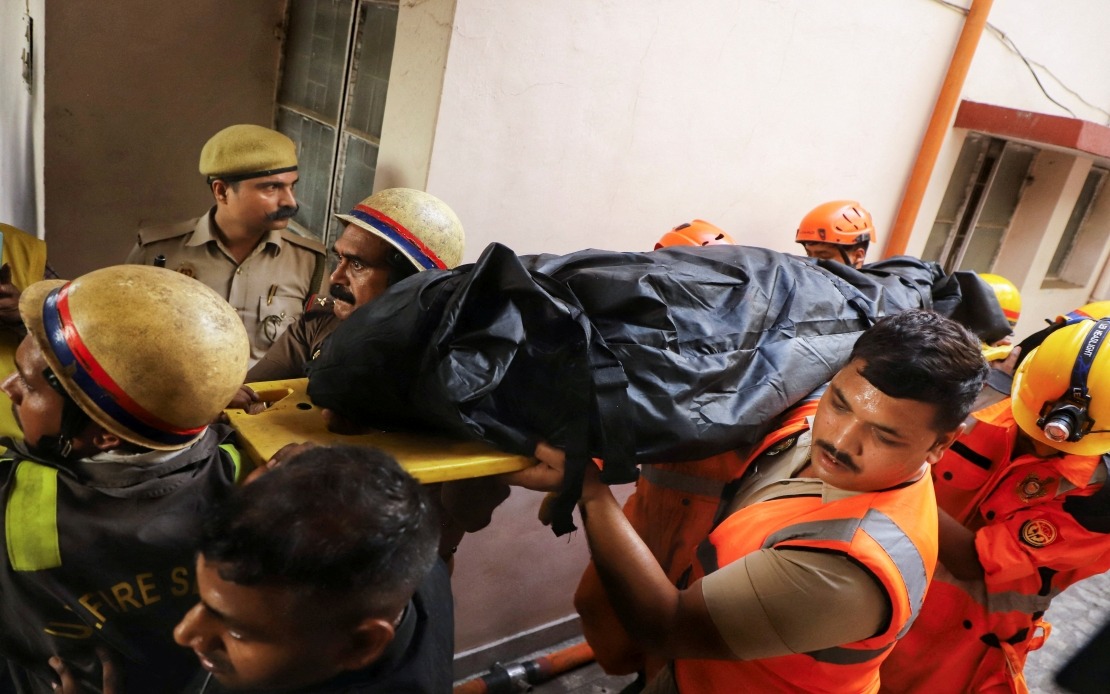
A commercial building engulfed in flames in Lucknow's Aliganj district claimed the lives of at least 15 people on Monday, predominantly young students enrolled at an animation training institute housed within the structure. The three-storey facility, which also contained retail stores, became a death trap as fire rapidly spread through its corridors, trapping occupants on upper levels and forcing some to make desperate escape attempts from windows as smoke billowed outward.
The tragedy unfolded with harrowing scenes captured by bystanders and documented on social media platforms. Witnesses reported observing individuals leaping from the smoke-inundated building while people on the ground frantically dialled emergency services, describing a period of critical minutes during which rescue coordination remained hindered by the speed at which the blaze consumed the structure. The Aliganj location, situated within Uttar Pradesh's capital city, became the centre of emergency response efforts as firefighting teams struggled against the inferno's intensity.
Medical personnel at King George's Medical University's trauma centre received over twenty victims transported from the scene. Among those admitted, fifteen individuals were pronounced deceased upon arrival, while five others remained hospitalised for treatment of injuries sustained during the incident. The rapid casualty toll reflects both the fire's intensity and the building's apparent limitations in providing safe evacuation routes for its occupants.
Uttar Pradesh Chief Minister Yogi Adityanath issued a statement expressing profound sorrow regarding the loss of life, describing the incident as "extremely tragic and heart-rending" whilst offering condolences to affected families. His remarks, delivered at a political rally in a separate city, underscored the severity with which state authorities viewed the catastrophe and acknowledged the emotional toll upon bereaved relatives.
For Malaysia and the broader Southeast Asian region, this incident carries particular resonance given the subcontinent's recurring struggle with fire safety infrastructure and enforcement. India's dense urban environments, characterised by rapidly developed commercial zones with mixed-use buildings, frequently lack adequate fire suppression systems, emergency exits, and regular safety inspections. The prevalence of informal training centres and small commercial operations operating within larger structures—common throughout South and Southeast Asia—creates vulnerability clusters where multiple businesses occupy confined spaces without proportionate safety measures.
The Lucknow tragedy represents India's second catastrophic fire event within a fortnight, following a devastating hotel fire in Delhi earlier in June that claimed at least twenty-two lives, numerous victims being international medical tourists. This clustering of incidents within a short timeframe suggests systemic deficiencies in fire safety oversight rather than isolated occurrences, pointing toward broader governance and enforcement challenges within India's building regulatory frameworks. Malaysian authorities and building code enforcers should recognise these patterns as cautionary indicators of how rapidly commercial expansion can outpace safety infrastructure development.
The concentration of fatalities among student populations raises concerns regarding the regulatory status of training establishments operating within commercial premises. Many such centres throughout India and South Asia function with minimal oversight, occupying inadequate spaces within older buildings never originally designed to accommodate training facilities. The animation training sector, in particular, has experienced explosive growth across Indian cities as the digital economy expands, yet this rapid expansion frequently occurs without corresponding improvements in occupational safety standards or building security protocols.
Investigators would likely focus upon determining whether the building possessed functional fire safety equipment, including operational fire alarms, adequate extinguishing systems, clearly marked emergency exits, and unobstructed evacuation routes. Preliminary reports suggest these fundamental protections were either absent or non-functional, a pattern disturbingly common in developing urban centres where enforcement agencies remain under-resourced relative to the pace of construction and commercial activity.
For Malaysia's business community and regulators, the Lucknow incident serves as a stark reminder of the consequences when cost-cutting measures substitute for safety compliance. Malaysian buildings codes, generally more rigorous than those implemented across substantial portions of India, nonetheless require consistent enforcement and regular inspection protocols. Mixed-use commercial buildings housing training facilities demand particular scrutiny, as occupancy patterns may shift without corresponding updates to fire safety assessments.
The tragedy will undoubtedly prompt renewed discussions within Indian policy circles regarding building safety standards, though implementation of meaningful reforms faces obstacles including bureaucratic capacity limitations, resource constraints, and political competing priorities. Meanwhile, families of the deceased in Lucknow confront not only immediate grief but prolonged struggles for justice and compensation, a pattern that has historically characterised India's response to large-scale disasters.
Regional implications extend beyond immediate regulatory concerns. As Southeast Asian economies continue urbanising and commercial sectors expand across multiple countries, the shared infrastructure vulnerabilities evident in the Indian experience warrant proactive attention. Malaysian policymakers, insurance regulators, and building safety advocates should consider whether current inspection frequencies and enforcement mechanisms adequately address emerging risks posed by evolving commercial use patterns, particularly involving informal or rapidly expanding sectors like digital skills training.
The incident also highlights the human cost of development trajectories that prioritise speed over safety. The predominantly young demographic of casualties in Lucknow—students pursuing career advancement in a growing technological field—underscores how safety failures disproportionately affect those with limited power to enforce their own protection. This vulnerability pattern extends throughout Southeast Asia, where migrant workers and young people entering new industries frequently encounter similar occupational hazards.

