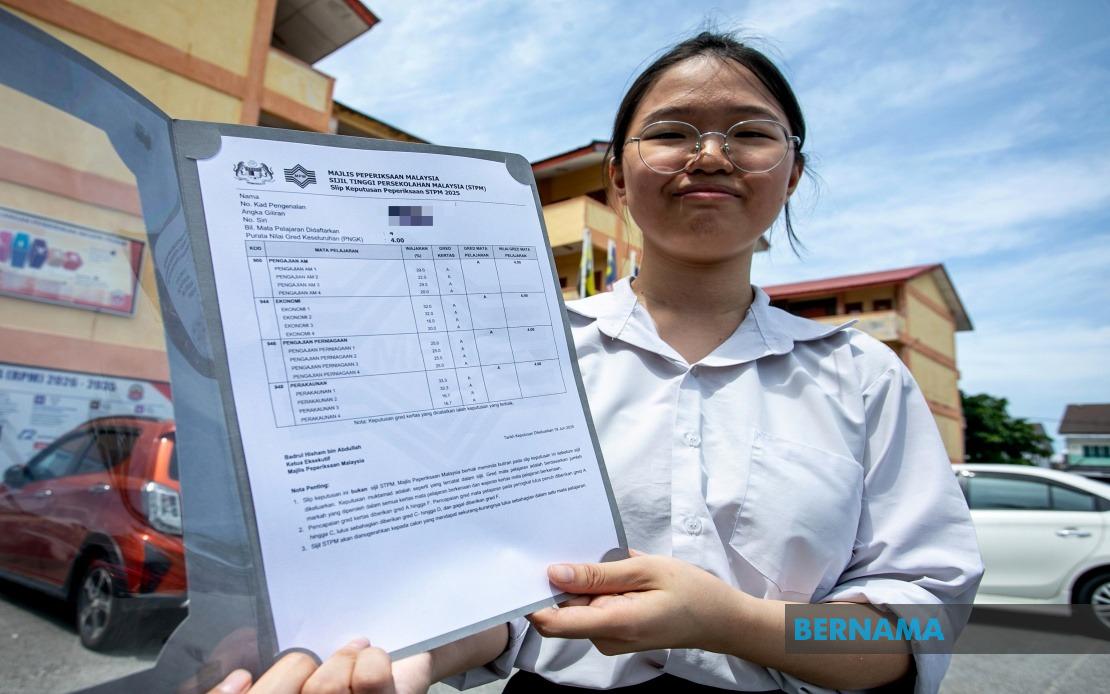
When Yong Xin Yi received her 2025 Sijil Tinggi Persekolahan Malaysia (STPM) results, the 20-year-old from SMK Jalan Tasek in Ipoh had reason to celebrate: a flawless 4As across all her subjects, with a Cumulative Grade Point Average of 4.00. Her achievement places her among an elite group of just five students from her school who attained this distinction in this examination cycle, underscoring both the rarity of such results and the exceptional commitment required to reach them.
Xin Yi's path to success was built on a foundation of unwavering discipline and strategic time management. Each day after classes concluded, she committed herself to a structured five-hour revision block between 5:00 pm and 10:00 pm, transforming her evenings into a dedicated study period. Yet the Ipoh-born student emphasizes that this evening regimen represented only part of her overall approach. Equally crucial was her attentiveness during classroom instruction, where she maintained complete focus on her teachers' explanations. This dual strategy—absorbing material thoroughly the first time through active listening, then reinforcing it systematically at home—created a reinforcing cycle that minimized confusion and maximized retention.
The importance of classroom engagement cannot be overstated in Xin Yi's methodology. She candidly explains that concentrating fully during teaching sessions fundamentally changed how she approached her evening studies. Rather than struggling to decipher unclear concepts at home, she arrived at her revision sessions with strong foundational understanding, allowing her to deepen knowledge and practice application. This philosophy reveals a sophisticated understanding that exam success is not solely determined by the hours spent studying, but rather by the quality and strategic deployment of those hours.
Beyond formal study time, Xin Yi maintained meticulous attention to homework completion. Teachers' assignments, she recognized, serve a pedagogical purpose beyond mere busywork; they function as practical applications of classroom concepts that solidify understanding. By treating homework as an integral part of the learning process rather than an obligation to discharge quickly, she ensured that each assigned task contributed meaningfully to her mastery of the material.
Among her four subjects—General Studies, Principles of Accounting, and Economics—General Studies presented the most formidable challenge. This subject demands not merely content knowledge but sophisticated writing ability, adherence to precise formatting conventions, and intimate familiarity with assessment criteria. Recognizing this vulnerability, Xin Yi deliberately allocated additional attention to General Studies relative to her other subjects, diagnosing and systematically addressing her weaknesses before they could compound during the examination period. This proactive approach to problem-solving demonstrates maturity in academic self-assessment.
The daughter of a clerk and a phone salesman, Xin Yi's achievement carries particular significance as an only child whose success represents an entire family's investment and hopes. She openly acknowledges that her parents' unwavering encouragement throughout her studies proved instrumental to her achievement. Rather than viewing her 4As narrowly as a personal accomplishment, she frames her success within a broader narrative of family aspiration and filial responsibility. Her explicit desire to leverage this academic achievement to improve her family's circumstances and honor her parents' sacrifices reveals values that extend beyond individual advancement.
Looking ahead, Xin Yi has charted a deliberate course toward tertiary education in economics at Universiti Putra Malaysia (UPM). This choice emerged from careful consideration of her personal interests and assessment of career trajectories within the economic sector. Her aspiration to become an economist reflects not an impulsive career selection but a reasoned evaluation of a field offering substantial future prospects. For Malaysian readers, her example demonstrates how STPM achievement can serve as a gateway to specialized university education and professional pathways.
Xin Yi's experience offers valuable insights for other Malaysian students navigating pre-university studies. Her success illustrates that excellence does not necessarily require superhuman ability or countless additional tuition hours, but rather strategic application of fundamental principles: consistent daily effort, quality classroom participation, methodical homework completion, and early identification of challenging areas. The transfer of her disciplined approach to a university environment will likely prove equally valuable as she pursues her economic studies.
For parents and educators in Malaysia, Xin Yi's journey underscores several important considerations. First, the critical importance of fostering classroom engagement rather than outsourcing learning entirely to private tuition; second, the value of structured home study routines that complement rather than replace school instruction; and third, the role of family emotional support as a catalyst for academic perseverance. In an educational landscape where competition for places in prestigious programs intensifies annually, Xin Yi's approach represents a sustainable model grounded in consistent effort rather than intensive cramming or expensive supplementary classes.
As she embarks on university studies at UPM, Xin Yi joins a broader cohort of high-achieving Malaysian students whose STPM success positions them for advanced academic and professional opportunities. Her decision to pursue higher education locally reflects the increasing quality and competitiveness of Malaysian universities, particularly in specialized fields like economics. Her trajectory will likely inspire other students from similar socioeconomic backgrounds to recognize that STPM excellence remains achievable through discipline and strategic planning, regardless of family circumstances.