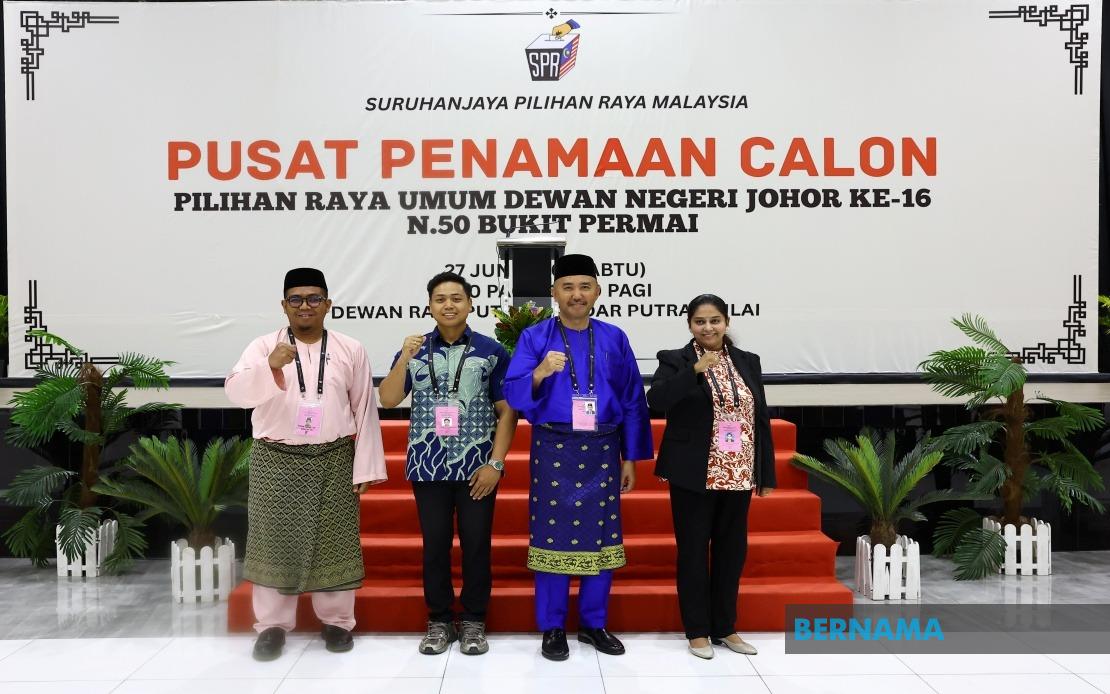
Datuk Mohd Jafni Md Shukor, the sitting state assemblyman for Bukit Permai, will mount a spirited defence of his constituency in a closely-watched four-way contest that reflects the increasingly fragmented political landscape across Johor. The Barisan Nasional representative confirmed his candidacy on June 27 after the nomination process concluded, setting the stage for a competitive electoral battle that will test his support base against a diverse array of challengers from across the political spectrum.
The contest brings together four distinct political forces competing for voter preference in this Batu Pahat-area seat. Opposing Mohd Jafni are Mohamad Shafwan Ani representing Pakatan Harapan, the federal government's primary coalition; M. Lina Manoh flying the Perikatan Nasional flag; and Muhammad Aidil Riduan Mohd Yusof contesting as the standard-bearer for the newer entrant Parti Bersama Malaysia. This configuration demonstrates the evolving nature of Malaysian electoral politics, where traditional two-front contests have increasingly given way to multi-candidate races that fragment the vote and introduce unpredictability into campaign dynamics.
The nomination proceedings took place at Dewan Raya Putra in Bandar Putra, where returning officer Afzan Azhari oversaw the formal registration of all contenders. The presence of Johor DAP chairman Teo Nie Ching, who arrived early to accompany Mohamad Shafwan, underscored Pakatan Harapan's determination to make a strong showing in the contest and retain relevance in this state assembly division. The participation of DAP's regional leadership signals the coalition's strategic focus on battleground constituencies where their vote share could determine electoral outcomes.
Mohd Jafni enters the campaign from a position of incumbency that proved advantageous in the previous electoral cycle. During the 2022 Johor state election, he secured victory with a comfortable majority of 4,755 votes in what was also contested as a four-way race. That result provided a reasonably substantial cushion, though hardly an insurmountable one in the context of heightened political volatility and shifting voter preferences that have characterised Malaysian electoral behaviour in recent years. Whether he can replicate or improve upon that performance will depend on his ability to retain incumbent support while potentially attracting undecided voters.
For Pakatan Harapan, the Bukit Permai contest represents an opportunity to demonstrate continued electoral viability in Johor, a state that has proven challenging for the federal government coalition. The inclusion of DAP leadership in campaign activities underscores the coalition's competitive ambitions, reflecting confidence that Mohamad Shafwan can translate opposition sentiment into actionable electoral support. The seat's history suggests this is precisely the type of marginal constituency where structural changes in voting patterns could prove decisive.
Perikatan Nasional's decision to field a candidate in Bukit Permai highlights how the Muhyiddin-led grouping continues attempting to establish itself as a meaningful political force at state level, even as it remains outside government at the federal level. M. Lina Manoh's candidacy gives Perikatan a platform to articulate its positioning as an alternative to both the incumbent BN and the federal ruling coalition. The presence of multiple opposition candidates, however, raises questions about whether the anti-BN vote will consolidate sufficiently to present a credible challenge to the incumbent.
The emergence of Parti Bersama Malaysia as a contestant introduces an additional layer of complexity to the electoral contest. Muhammad Aidil Riduan Mohd Yusof's participation reflects the party's efforts to broaden its political footprint beyond its existing strongholds. How significant a factor Bersama ultimately becomes in Bukit Permai remains uncertain, though its candidacy could theoretically splinter opposition support and benefit the incumbent if votes divide evenly across opposition contenders.
The electoral calendar has been established with early voting scheduled for July 7, allowing essential workers and others to cast ballots ahead of the main election day. The general polling will take place on July 11, providing a defined campaign period during which all four candidates can articulate their positions and mobilise their respective support networks. The compressed timeframe typical of Malaysian electoral campaigns means that momentum and media attention will prove particularly valuable during this pre-polling phase.
For Malaysian political analysts monitoring the Johor state election's broader trajectory, the Bukit Permai contest offers important signals about voter sentiment in a constituency that has demonstrated responsiveness to electoral shifts. The seat's competitive nature and the diversity of forces competing within it exemplify the more complex political environment that has emerged as Malaysians increasingly display willingness to split their votes across different parties at different electoral levels. The outcome will contribute meaningfully to understanding how the overall balance of power has shifted since the previous state election and which political coalitions have succeeded in consolidating or expanding their support bases among Johor voters.

