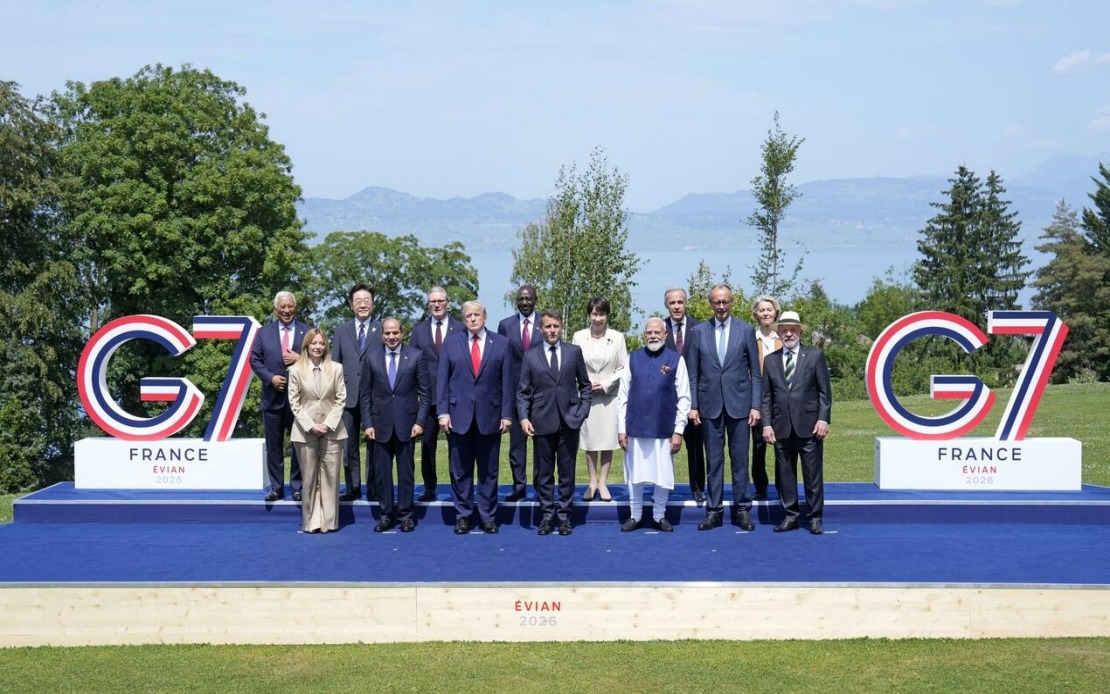
The world's seven leading industrialised economies have reaffirmed their determination to support Ukraine through sustained international pressure on Russia, even as tensions simmer within the alliance over broader strategic and economic matters. Meeting in the lakeside French resort town of Evian-les-Bains near the Swiss border, G7 leaders absorbed a direct appeal from Ukrainian President Volodymyr Zelenskyy about his nation's defence needs, then emerged with a collective position endorsing a "just and lasting peace" achieved through continued leverage against Moscow. The agreement underscores how Ukraine remains a focal point for Western solidarity, yet the summit also revealed the fault lines that increasingly divide the industrialised democracies on issues ranging from trade protectionism to military alliances and Middle Eastern conflicts.
President Donald Trump, seated at the table alongside the leaders of Britain, Canada, France, Germany, Italy, Japan and the European Union, struck a notably different note from his counterparts by suggesting that Russia ought to negotiate an exit from the conflict it initiated with its February 2022 invasion. Speaking to reporters after the Ukraine session, Trump stated bluntly that "Russia should make a deal," arguing that both Moscow and Kyiv had suffered devastating casualties and that further fighting served neither side's interests. His framing of the conflict as a negotiable dispute rather than a war of aggression represented a departure from the unambiguous European stance that any settlement must reflect Ukraine's fundamental security interests and territorial integrity.
The American president's pitch for negotiations cannot be separated from his broader efforts to reshape Washington's approach to global conflicts. Trump explicitly linked his Ukraine initiative to recent US diplomacy with Iran, where American officials have brokered a preliminary agreement to reopen the Strait of Hormuz and de-escalate the four-month conflict consuming the Middle East. By presenting these disparate crises as interconnected problems requiring his dealmaking acumen, Trump positioned himself as the essential intermediary who could bring warring parties to the negotiating table. His suggestion that the United States might soon lift temporary sanctions relief previously granted to Russia—measures introduced to stabilise global oil prices—indicated that economic pressure remains a card Washington could still deploy, potentially as an inducement to bring Moscow to serious talks.
Japanese Prime Minister Sanae Takaichi articulated the more cautious, pressure-based approach favoured by most G7 members, emphasising that the alliance must maintain unity to compel Russia toward "positive and concrete action quickly." Her comments reflected deeper anxieties among European and Asian partners about the widening security partnerships between Russia and other authoritarian powers, particularly the deepening military cooperation between Moscow and North Korea and the strengthening strategic alignment between Russia and China. For Japan and Europe, these relationships represented a destabilising realignment that threatened to create a coherent bloc opposed to the Western-led international order, making it imperative that the G7 not fracture over Ukraine and inadvertently strengthen the hand of revisionist powers.
Zelenskyy's own priorities, as articulated through social media and direct engagement with the G7 leaders, centred on strengthening Ukraine's air defence capabilities and advancing diplomatic efforts that would force Russia to terminate its military campaign. The Ukrainian president's willingness to engage simultaneously with the G7 while deepening defence partnerships with European nations outside the American sphere reflected Kyiv's pragmatic hedging strategy. Rather than relying solely on Trump's unpredictable diplomatic overtures, Ukraine has cultivated relationships with France, Germany, Poland and other European states capable of sustained military and economic support regardless of shifts in American policy priorities.
The summit's agenda extended well beyond Ukraine, encompassing the volatile situation in West Asia where the preliminary US-Iran agreement to reopen critical shipping routes requires finalisation into a comprehensive settlement. During a working lunch devoted to Middle Eastern affairs, G7 leaders and representatives from Egypt, Qatar and the United Arab Emirates engaged in detailed discussions about the consequences of the Iran conflict and the path toward regional stability. Japanese officials noted that the assembled leaders welcomed the initial American-Iranian breakthrough and committed to continued collaborative efforts toward a sustainable peace arrangement, recognising that instability in the Persian Gulf carried ramifications for the global economy.
Takaichi emphasised to her counterparts the critical importance of ensuring free and secure navigation through the Strait of Hormuz, one of the planet's most essential maritime chokepoints through which enormous quantities of petroleum transit daily. The Japanese perspective carried particular weight given Tokyo's dependence on Middle Eastern energy supplies and its vulnerability to disruptions in global oil markets. Her insistence that a comprehensive agreement between Washington and Tehran be concluded expeditiously reflected broader G7 concern that prolonged conflict or negotiating ambiguity could trigger renewed volatility in energy markets and destabilise fragile global supply chains still recovering from previous disruptions.
Beneath the surface consensus on Ukraine and Iran lay more fundamental tensions between Trump and his European counterparts regarding trade policy, NATO burden-sharing, and American unilateral initiatives such as the proposed acquisition of Greenland. These disputes highlighted the degree to which the traditional post-Cold War Western alliance has become fractious and transaction-oriented rather than ideologically cohesive. European leaders worry increasingly about the reliability of American commitments and the unpredictability of Trump's decision-making, while the American president views many longstanding international arrangements as economically disadvantageous to the United States and impediments to direct bilateral relationships.
France, which holds the G7 presidency during this summit year, extended invitations to leaders from outside the formal membership, including Brazil, Egypt, India, Qatar, South Korea and the United Arab Emirates, in recognition of the reality that solutions to global challenges require broader coalitions than the traditional rich nations' club. This expansion reflected a deliberate French strategy to adapt the G7 framework to contemporary geopolitical realities, including the rise of major emerging economies and the increasing importance of countries in the Global South to international stability. By including diverse perspectives, France sought both to enhance the legitimacy of G7 deliberations and to build consensus among countries with varying interests and capabilities.
Concerning the architecture of international development finance, the G7 issued a joint declaration acknowledging that traditional official development assistance from wealthy countries has persistently failed to meet the enormous infrastructure and social investment needs of poorer nations. The leaders committed to reforming cooperation mechanisms to create mutually beneficial partnerships that would harness private capital alongside public resources, reflecting recognition that state budgets alone cannot finance the massive long-term projects required to address poverty, inequality and climate change. This shift toward strategic partnerships framed as win-win arrangements rather than charity or obligation represented a notable reorientation of how wealthy nations conceptualise their engagement with the developing world, though sceptics worry that such framing might reduce the volume of unconditional aid flowing to the neediest countries.
For Malaysia and Southeast Asia more broadly, the G7 summit outcomes carry particular significance on multiple dimensions. The unity—or lack thereof—among the world's wealthiest democracies affects regional stability, trade patterns, security architecture and the trajectory of conflicts that could expand beyond their immediate geographical boundaries. The Strait of Hormuz closure risk concerns any nation dependent on Middle Eastern energy, while decisions by the United States and Europe regarding sanctions on Russia carry implications for global supply chains and economic growth. Additionally, the G7's investment priorities and development finance mechanisms influence the availability and terms of capital for projects across Southeast Asia, making these distant deliberations highly consequential for the region.