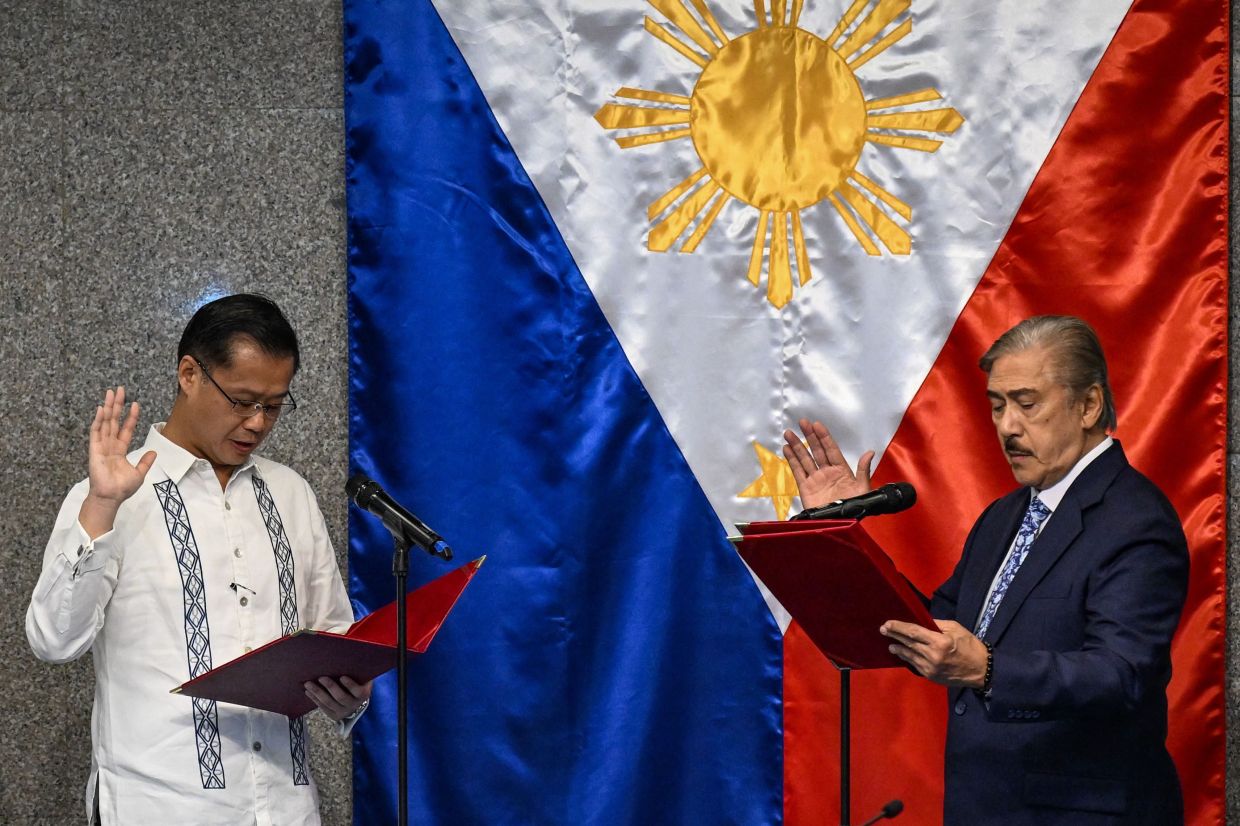
The Philippine Senate has installed Senator Sherwin Gatchalian as its new president following a special session on Wednesday, June 17, resolving a leadership contest that exposed fractures within the chamber's political dynamics. The election marked the conclusion of a week-long standoff triggered by competing interpretations of procedural requirements and political muscle-flexing among the upper house's divided factions. Gatchalian's victory became possible only after a critical shift in voting calculations, illustrating how the Senate's composition and alliance patterns continue to shape institutional outcomes in Manila's volatile political landscape.
The special session drew 13 senators—precisely the minimum threshold required to conduct business and elect a new president—who unanimously backed Gatchalian for the position. His path to the presidency had seemed unclear just days earlier, when rival camps disputed whether the Senate possessed sufficient members to legitimately conduct such proceedings. The arithmetic remained contested until key figures recalibrated their positions, ultimately tilting the balance decisively in Gatchalian's favour. His election concludes a turbulent transition period during which the Senate's leadership structure remained in flux and institutional authority itself became temporarily contested.
Gatchalian brings substantial political experience to the role, having previously served as Mayor of Valenzuela City, one of Metro Manila's prominent municipalities, and as a House Representative. These positions provided him with demonstrated administrative credentials and familiarity with legislative processes at multiple governmental levels. His background as a local executive suggests practical experience managing constituencies and navigating the complex political terrain characteristic of the capital region, skills potentially applicable to coordinating a fractious Senate chamber where consensus often proves elusive.
The leadership succession originated when Alan Peter Cayetano assumed the Senate presidency on May 11, following the regular electoral cycle. However, his tenure proved remarkably brief. On June 3, twelve senators moved to elect Gatchalian as Senate president pro tempore—a position typically reserved for scenarios when the president is unavailable—while simultaneously declaring that Cayetano had vacated his office. This procedural maneuver suggested that opponents of Cayetano's leadership had orchestrated a coordinated challenge to his authority, questioning both his legitimacy and the faction's numerical strength.
Cayetano immediately contested the assertion that he had relinquished his position, asserting that he remained the duly constituted Senate president. He additionally invoked what he characterized as a procedural requirement: any election or removal of Senate officers required the attendance and participation of at least thirteen senators. This claim proved pivotal, as it introduced a mathematical threshold that neither competing faction could unilaterally satisfy without forging additional alliances. The dispute thus hinged not merely on political preference but on competing legal interpretations of Senate standing orders—a contest that could determine whose interpretation would prevail institutionally.
The critical turning point arrived when Senator Joel Villanueva, who had previously aligned with Cayetano's camp, abruptly shifted his support to Gatchalian's bloc. Villanueva's defection proved decisive, as it simultaneously bolstered Gatchalian's faction while undermining Cayetano's numerical position. By Tuesday, June 16, Cayetano had evidently concluded that the political mathematics had fundamentally altered following his conversation with Villanueva. Recognizing that he could no longer command sufficient Senate votes to maintain his position, Cayetano indicated his willingness to step down voluntarily rather than face a formal removal vote—a graceful exit that preserved his standing while acknowledging electoral reality.
The Senate's current composition has been disrupted by significant absences and legal complications affecting its full membership. The chamber nominally comprises 24 members, yet only 22 senators remain actively sitting. Senator Jinggoy Estrada, a prominent and veteran legislator, surrendered to police custody earlier in June following long-standing graft allegations. Subsequently, the Sandiganbayan—the specialized anti-graft court handling corruption cases involving public officials—ordered his suspension from office for ninety days, effectively preventing him from participating in Senate proceedings during a critical period of institutional transition.
Complicating the Senate's roster further is the absence of Senator Ronald Dela Rosa, whose whereabouts remain unknown as he faces International Criminal Court arrest warrants. Dela Rosa's status as a fugitive from international justice proceedings has rendered him effectively unable to participate in Senate business, reducing available members and reshaping the political calculus around majority formation. These absences, combined with the leadership transition, have left the Philippine Senate operating with reduced capacity during a period when legislative work typically accelerates heading toward mid-year recess.
The leadership contest carries implications beyond mere institutional hierarchy. Control of the Senate presidency determines agenda-setting authority, committee assignments, and influence over the chamber's legislative priorities. These powers prove particularly consequential in the Philippine context, where the Senate serves as the apex of legislative authority and often acts as a check against executive overreach. The struggle between Cayetano and Gatchalian reflected deeper divisions within the Senate regarding policy direction and political alignment, conflicts that will likely resurface as Gatchalian assumes responsibility for managing competing factions and advancing his own legislative agenda.
Gatchalian's election also signals shifting coalition dynamics within Philippine Congress, where alliances frequently reorganize based on personal relationships, regional interests, and calculations regarding future electoral viability. The Senate's fractious nature—with 24 independently elected members answering primarily to provincial constituencies rather than national party structures—makes leadership particularly challenging. Gatchalian must now navigate these competing interests while maintaining sufficient consensus to pass legislation and preserve institutional functionality throughout his presidency.
For Malaysian observers and Southeast Asian political analysts, the Philippine Senate presidency transition illustrates broader patterns affecting regional democracies. Institutional instability, leadership volatility, and the difficulty of maintaining stable legislative coalitions characterize several Southeast Asian parliaments, where personality-driven politics frequently overwhelm institutional norms. The Philippine Senate's struggles reflect tensions inherent in presidential systems with powerful independent legislatures, particularly in societies with weak party discipline and politically autonomous regional bases.