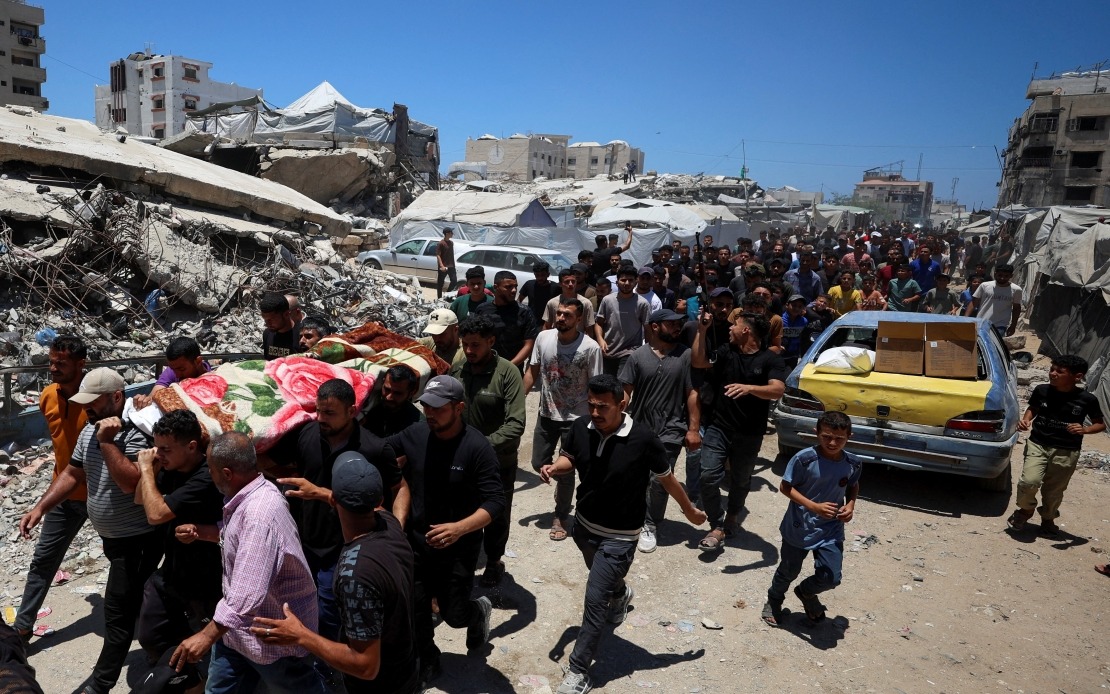
The humanitarian catastrophe in Gaza has deepened substantially even after a ceasefire agreement took effect, with Palestinian officials reporting that Israeli military operations have claimed 1,021 additional lives, according to data released by the Palestinian Prime Minister's Office this week. The figure pushes the overall death toll since the conflict began in October 2023 to 73,032, underlining the massive human cost of the ongoing confrontation and the precarious situation that persists despite the nominal ceasefire arrangement.
Conditions across the Gaza Strip show no signs of meaningful improvement, with the Palestinian Government Communication Centre warning that the humanitarian landscape continues to deteriorate rapidly. Residents face acute shortages of clean water, forcing the vast majority to depend on whatever humanitarian assistance reaches the enclave. Beyond water, restrictions on aid delivery compound the crisis, meaning that even the limited resources available struggle to meet the enormous needs of a population under sustained stress.
The destruction of civilian housing has been catastrophic. Nearly one million Palestinians now live in temporary tent accommodation following the widespread devastation of the built environment. Israeli military operations have destroyed or damaged 76.6 per cent of Gaza's total housing stock, representing an unprecedented blow to civilian infrastructure. The persistence of restrictions on humanitarian movements means that reconstruction efforts remain virtually impossible, trapping residents in a cycle of displacement and deprivation.
Recent military activities in the enclave have extended across multiple populated centres. Documented attacks involving aircraft and unmanned drones have targeted areas including Nuseirat, Al-Mawasi, Khan Younis, and Gaza City over the past week alone, each incident adding to the casualty count and further deteriorating conditions on the ground. Children represent a particularly vulnerable segment of the population, with UNICEF documenting 265 Palestinian child deaths and more than 400 injuries since the ceasefire was announced, a grim reminder of the conflict's indiscriminate character.
International humanitarian organisations have expressed alarm at the persistence of access barriers. Oxfam representatives brought the matter directly before the United Nations Security Council, detailing how Israeli restrictions continue to obstruct the movement of humanitarian convoys and prevent the delivery of life-saving medical supplies and food assistance. This obstruction occurs despite international law obligations regarding the protection of civilians and the provision of humanitarian aid in conflict zones.
The dispute extends beyond Gaza's borders into occupied Palestinian territories. Israeli authorities have assumed control over planning and construction powers relating to the Ibrahimi Mosque in Hebron, a move that Palestinian officials argue violates the 1997 Hebron Agreement framework that had regulated such arrangements. The United Nations Human Rights Office has simultaneously documented a marked increase in forced displacement of Palestinians across the West Bank and East Jerusalem, driven by settler violence, military demolitions, movement restrictions, and forced evictions that continue unabated.
Agricultural destruction represents another dimension of the crisis affecting Palestinian livelihoods. The Palestinian Ministry of Agriculture has documented the destruction of 7,258 trees through attacks by Israeli settlers and occupation forces, including 1,270 olive trees that form a critical part of Palestinian agricultural heritage and economic survival. These incidents have generated estimated losses of US$5.17 million. Additionally, arson attacks have targeted mosques in the villages of Jiljilya and Mazra' al-Nubani, indicating a pattern of attacks on religious and civilian infrastructure.
Refugee camps in the northern West Bank have experienced particular severity in military operations. Since January 2025, Israeli military actions in Jenin, Tulkarem, and Nour Shams refugee camps have displaced more than 33,000 Palestinians, adding to the region's already massive displacement crisis. Concurrently, detention facilities housing Palestinian prisoners have come under scrutiny from international monitors, with serious concerns raised about deteriorating conditions, severe overcrowding, and the spread of infectious diseases within these facilities.
Despite the catastrophic circumstances, Palestinian education authorities have managed to complete preparations for the General Secondary Education Examination scheduled for this year. Approximately 91,000 students will sit for the examinations, with around 37,000 of these sitting in Gaza. Remarkably, Gaza-based students will take their examinations electronically for the third consecutive year, a testament to educational resilience under extraordinary duress even as the conflict continues to ravage the enclave's social fabric and institutional capacity.
For Malaysian and Southeast Asian observers, the Gaza situation reflects broader regional instability and the humanitarian costs of protracted conflict. The scale of civilian casualties and displacement, combined with systematic barriers to aid delivery, raises urgent questions about international accountability mechanisms and the effectiveness of ceasefire arrangements that fail to halt military operations. The education statistic, while remarkable, also underscores how conflict normalises improvisation and disruption of childhood development across an entire generation of Palestinians.

