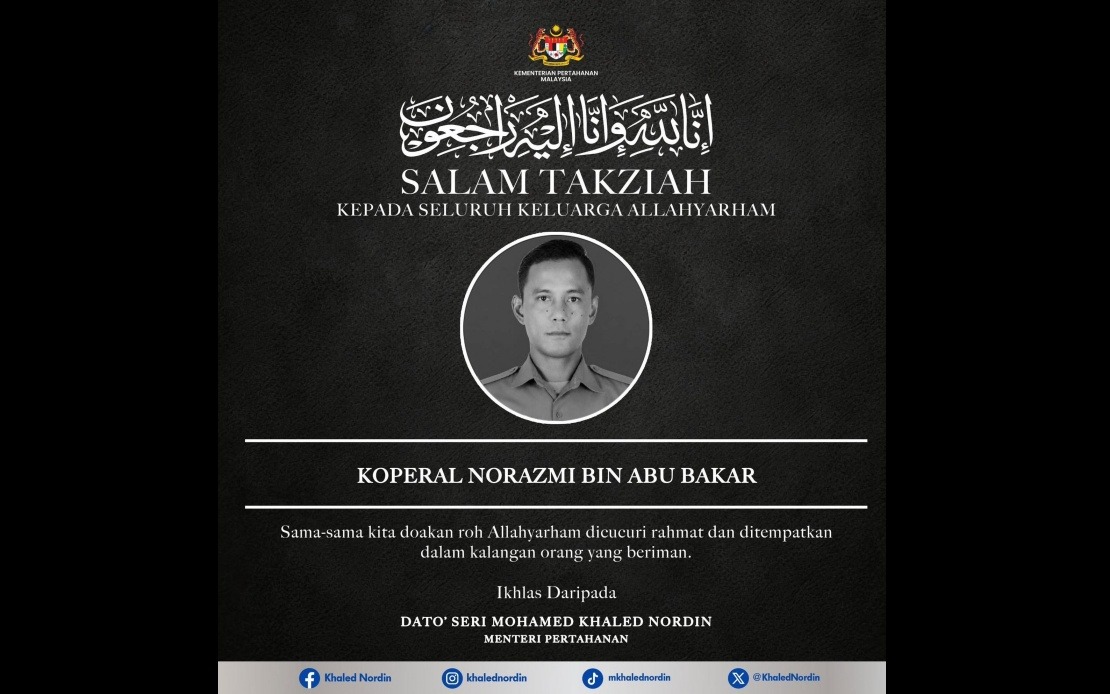
The Malaysian government and Defence Ministry have conveyed their sympathies to the families of Corporal Norazmi Abu Bakar and Private Siti Khadijah Sungip, who tragically lost their lives in a blast during a grenade-throwing training exercise on June 16. Both servicemembers sustained critical injuries in the incident at Hobart Camp firing range in Gurun, Kedah, and died while being transported to Sultan Abdul Halim Hospital in Sungai Petani. The accident occurred at 10.57 am, cutting short the lives of two dedicated military personnel and leaving their families to grapple with an unexpected loss.
Defence Minister Datuk Seri Mohamed Khaled Nordin released a statement expressing profound sorrow over the deaths of the two soldiers. The minister emphasised that both the Defence Ministry and the government stand united in grief with the bereaved families during this difficult period. Through his message, Nordin sought to convey a sense of national solidarity and compassion, acknowledging the sacrifice these servicemembers made while serving their country. The minister's words underscored the deep bonds that connect Malaysia's defence establishment to those who dedicate their lives to protecting the nation's security.
The Defence Ministry and government have called for spiritual strength for the grieving families, invoking prayers for the departed souls. In his social media post, Minister Nordin referenced Islamic traditions, asking for divine mercy upon Corporal Norazmi and Private Siti Khadijah, forgiveness of their sins, and their acceptance among Allah's faithful servants. This spiritual dimension of the condolence reflects Malaysia's predominantly Muslim context and the importance of religious observance in the nation's official responses to tragedy. The gesture also demonstrates how governmental expressions of sympathy are tailored to the cultural and spiritual values held by Malaysian society.
The Malaysian Army has formally confirmed the identities of both fallen servicemembers. Corporal Norazmi Abu Bakar served with the 6th Battalion, Royal Malay Regiment, a unit with a storied history within Malaysia's armed forces. Private Siti Khadijah Sungip was attached to the 1st Squadron, Royal Army Engineers Regiment, indicating her involvement in specialist engineering and tactical operations. The presence of female personnel in combat-related roles, as exemplified by Private Siti Khadijah's position, reflects the increasingly inclusive nature of Malaysia's armed forces and the expanding opportunities for women to contribute to national defence.
The incident occurred during routine military training at Hobart Camp firing range, a designated facility in Gurun, Kedah used for various weapons and tactical exercises. Grenade-throwing drills are standard components of military training programmes worldwide, designed to ensure personnel can effectively deploy such weapons in operational scenarios. Despite extensive safety protocols and professional oversight typically accompanying such exercises, accidents can still occur, often due to unforeseen mechanical failures, human error, or unpredictable circumstances. This tragic event underscores the inherent risks that military personnel face even during training operations, where the margin for error can be unforgiving.
Army Chief General Tan Sri Azhan Md Othman has initiated a comprehensive investigation to establish the precise cause of the explosion. Such inquiries following military accidents are crucial for identifying contributing factors, whether technical malfunctions in equipment, procedural lapses, or other variables. The investigation's findings will be vital not only for understanding how this particular tragedy occurred but also for implementing corrective measures and preventing similar incidents in the future. Military establishments worldwide view post-accident investigations as essential learning opportunities that strengthen safety culture and operational protocols.
The deaths of these two personnel represent a sobering reminder of the dangers inherent in military service, even in peacetime training environments. Malaysia's armed forces maintain robust training programmes to keep personnel combat-ready and operationally effective, but such intensive preparation inevitably carries risks. The loss of Corporal Norazmi and Private Siti Khadijah will resonate throughout their respective units and across the broader defence establishment, affecting colleagues, commanding officers, and the broader military community. Such tragedies often prompt reflection within military circles about safety standards and the precious nature of each service member's life.
For Malaysia, this incident highlights the ongoing commitment required to maintain defence capabilities while safeguarding the lives of those in uniform. The nation's military personnel volunteer or are conscripted into service with the understanding that their roles involve certain hazards, yet accidents during training are particularly poignant because they occur outside combat contexts where such risks might be more anticipated. The support extended by government and military leadership to the families of the fallen represents both a recognition of the sacrifice these individuals made and an acknowledgment of the broader military community's shared grief.
As investigations proceed and the families begin their mourning process, Malaysia's defence establishment will likely review training protocols and safety measures to ensure similar incidents are minimised in future operations. The memory of Corporal Norazmi Abu Bakar and Private Siti Khadijah Sungip will serve as a poignant testament to the dedication of those who serve in the armed forces and the costs associated with maintaining national security. Their loss underscores the importance of continued vigilance, rigorous safety standards, and unwavering support for military families who bear the ultimate sacrifice on behalf of the nation.