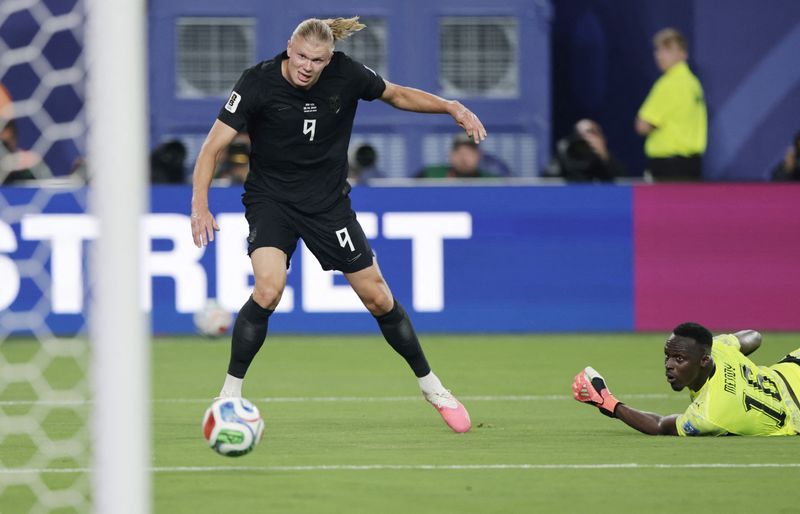
Norway advanced to the World Cup knockout stage for the first time in 28 years after overcoming Senegal 3-2 in a dramatic encounter at East Rutherford, New Jersey, on Monday evening. Erling Haaland proved decisive once again, adding two goals to his tally at this tournament and becoming one of the competition's standout performers alongside his earlier exploits in the group phase.
Senegal arrived at the match as Africa's most compelling contender for World Cup glory, yet the team's defensive frailties ultimately proved fatal against a clinical Norwegian side. The West African outfit had begun positively, keeping their opponents at bay during the opening stages and restricting Haaland's influence on proceedings. However, as halftime approached, Senegal's backline disintegrated under sustained pressure. Marcus Pedersen, brought into the fray as a replacement for the injured Julian Ryerson, capitalised on a miscue from captain Kalidou Koulibaly to fire Norway ahead, with goalkeeper Edouard Mendy unable to make the save.
The second period proved far more comfortable for Norway's attacking ambitions. Martin Odegaard, having squandered an earlier opportunity, orchestrated a well-executed move that freed Haaland to unleash a thunderous finish into the top corner. Ten minutes later, Haaland struck again, meeting a cross at the near post with a well-placed volley that settled off the crossbar. The Norwegian forward's four-goal haul across his first two matches at this tournament places him among the tournament's leading marksmen and suggests his nation's attacking prowess could trouble even the strongest defensive units in the competition's later stages.
Despite Senegal's litany of defensive miscalculations, the team demonstrated resilience through Ismaila Sarr, who pulled two goals back to make the scoreline respectable. One of these came deep into stoppage time, hinting at the attacking quality the African representatives possessed, even as their hopes of advancing from the group stage evaporated. The result effectively consigns Senegal to chasing a place among the best third-ranked teams, a scenario that leaves their World Cup ambitions hanging by a thread.
The victory propels Norway to the top of Group I standings, though they must contend with France on Friday to determine who will claim the group crown. France's emphatic 3-0 dismantling of Iraq ensured that Group I has become the first pool to produce two confirmed qualifiers for the tournament's final 32. This positioning highlights the competitive gulf between established football powerhouses and emerging nations, even as Norway's fairy-tale return to the World Cup stage after nearly three decades continues to capture imaginations.
Weather conditions at East Rutherford presented a significant challenge throughout the evening, with heavy rain and thunderstorms sweeping across the northeastern United States in the hours leading up to kickoff. These atmospheric disturbances triggered shelter-in-place advisories and disrupted travel patterns across the region, contributing to more challenging conditions than either side would have ideally preferred. In neighbouring Philadelphia, where Group I's other fixture took place, proceedings were temporarily suspended as the elements proved particularly disruptive.
The Norwegian contingent demonstrated unwavering support despite the meteorological adversity, with thousands of supporters braving the elements clad in ponchos to witness their nation's historic advancement. Their visible presence in the stadium proved instrumental in creating an intimidating atmosphere, with the overwhelming sea of red jerseys lending the venue an unmistakably Scandinavian character. The travelling support has become a hallmark of Norway's participation, with their distinctive "Viking row" tradition — performed on the pitch following the final whistle — adding cultural colour to proceedings.
In stark contrast, Senegalese supporters were notably sparse in the crowd, a situation attributable to stringent visa restrictions that have prevented most West African nationals from entering the United States for the tournament. This imbalance in travelling support fundamentally altered the match environment, granting Norway a pronounced home advantage despite playing technically away from their native soil. Such logistical barriers underscore the systemic challenges affecting African nations' participation in major tournaments, particularly when held in North America.
Haaland's continued brilliance suggests Norway possess genuine attacking capabilities that could trouble established contenders in the knockout phase. The Manchester City forward's trajectory through the tournament indicates he has already proven himself among the competition's elite performers, and his partnership with Odegaard provides Ståle Solbakken's team with a creative axis that warrants respect. Friday's encounter against France will prove the ultimate litmus test of whether Norway's fairy-tale return to the World Cup stage represents merely a pleasant interlude or the beginning of something more substantial.

