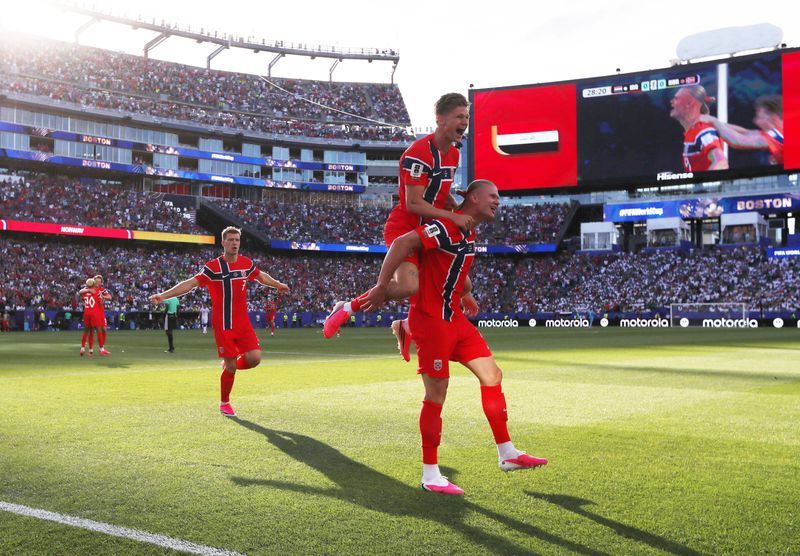
Erling Haaland made an emphatic statement on football's grandest stage, netting twice in Norway's commanding 4-1 victory over Iraq on Tuesday to announce his arrival at the World Cup with the kind of clinical finishing that has defined his meteoric rise through European football's elite competitions.
The 23-year-old striker's first-half brace extends a remarkable record of breaking through at the highest levels. He has now scored on his competitive debut across the German Bundesliga, England's Premier League, the UEFA Champions League, and now the World Cup finals—a feat that underscores his exceptional adaptability and hunger for goals regardless of the stage or opposition. Few observers questioned whether Haaland would deliver when the stakes reached their zenith, and his performance vindicated the confidence placed in him by Norway's coaching staff and supporters.
While the final scoreline appeared comfortable, the contest revealed vulnerabilities in Norway's approach. Despite controlling possession and territory for significant stretches, the Scandinavian side produced a surprisingly uneven performance marked by wayward passing and loose moments that gifted Iraq opportunities to remain competitive. The fact that Iraq managed to breach Norway's defence for an Aymen Hussein equaliser illustrated that coach Stale Solbakken's team cannot rely solely on individual brilliance if they intend to progress from the group stage.
Haaland's first goal showcased the positioning and instinct that have made him such a coveted asset. A perfectly weighted cross from David Moller Wolfe found the striker in space, and he finished with the predatory awareness of a forward who has drilled this scenario countless times. His second goal demonstrated an entirely different dimension of his game—pressing intensity. When Haaland applied pressure to Iraq's backline, the defensive unit cracked, producing a weak return pass. The striker's quick reaction to block the goalkeeper's clearance attempt and deflect the ball into the net highlighted his engagement beyond waiting for chances to arrive.
Norwegian Prime Minister Jonas Gahr Stoere had emphasised before the match that while individuals score goals, teams win competitions. This sentiment appears central to Solbakken's tactical philosophy: creating a functional structure that maximises Haaland's scoring opportunities rather than building elaborate team patterns. The strategy succeeded against Iraq, though captain Martin Odegaard, typically the creative fulcrum in midfield, made surprisingly little impact on proceedings, suggesting the orchestration of play remains a work in progress.
The three-point haul propels Norway to the summit of their group on goal difference, ahead of France, who overcome Senegal 3-1 earlier the same day. However, Haaland himself acknowledged that his team's overall performance fell short of what will be required in forthcoming fixtures. The striker's warning carries weight—in tournament football, early complacency punishes teams severely, and Norway's defensive lapses and midfield disconnects offer opponents blueprints for disruption.
This victory represents a watershed moment for Norwegian football. The nation had endured 28 years of World Cup absence since their last appearance in 1998, when a young squad captured global imagination through their attacking verve. The intervening decades witnessed qualified campaigns that ultimately fell short in the qualifying rounds, testing the patience of a football-mad nation. Tuesday's win at least provides immediate gratification and genuine hope that this generation possesses sufficient quality to make a substantive impact.
For Haaland personally, the occasion carried particular resonance. His father, Alfie Haaland, represented Norway at international level, establishing a family connection to the Norwegian national team. The younger Haaland carries the aspirations of an entire nation, a burden that would suffocate many athletes. Yet his demeanour throughout—quiet, focused, determined—suggests he welcomes rather than resents the responsibility. When asked about the performance, he grinned broadly, expressing hope that supporters back in Norway were celebrating the return to the World Cup stage after such a prolonged absence.
The implications for Southeast Asian observers merit consideration. Norway's combination of a star individual player and relative structural weakness reflects patterns visible across international football, where elite talent often compensates for systemic deficiencies. Malaysian observers and analysts can derive insight from how coaching systems either maximise or constrain their biggest talents, a relevant consideration as national teams contemplate development philosophies.
With the group stage advancing and France awaiting in subsequent fixtures, Norway faces a decisive period. Haaland's brilliance provides a foundation, but the team's functioning as a collective unit will determine whether this World Cup return becomes a footnote or the beginning of something more enduring. The striker's double provides immediate vindication of his credentials, yet also poses a question: can the supporting cast rise to match his standards when opposition inevitably tightens their defensive approach?