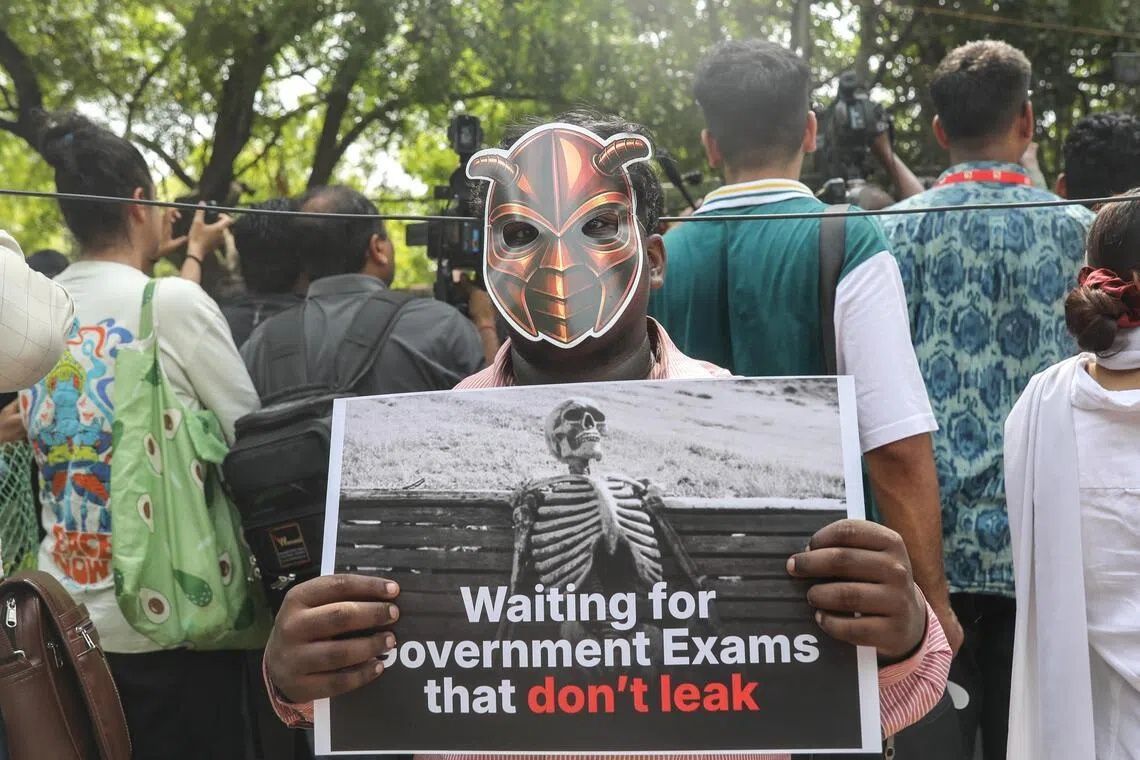
India's education system faces a credibility crisis as 2.2 million aspiring medical students prepare for a critical retest on Sunday following the cancellation of their previous examination due to a major question paper leak. The incident has ignited one of the most significant youth-driven protests in recent Indian memory, with students and parents demanding the removal of Education Minister Dharmendra Pradhan and questioning the competence of the institutions tasked with administering the country's most consequential entrance examinations.
The National Eligibility cum Entrance Test, commonly known as NEET, serves as the sole gateway to India's estimated 100,000 undergraduate medical college seats. The sheer scarcity of available positions relative to the millions of candidates creates an extraordinarily competitive landscape where even marginal score differences determine life trajectories for young Indians. This pressure has transformed the examination into a high-stakes affair that extends far beyond academic assessment, driving a booming coaching industry worth billions of rupees and simultaneously creating lucrative opportunities for criminal syndicates specialising in exam fraud.
Authorities have responded to the security breach by implementing what officials describe as a comprehensive "multi-layered security framework" designed to prevent any recurrence of the leak. The National Testing Agency has announced the deployment of more than 200,000 officials, including uniformed police and plainclothes security personnel, stationed across examination centres nationwide. This represents an extraordinary mobilisation of state resources, reflecting the political sensitivity surrounding the examination and the government's determination to restore institutional credibility after the previous failure.
Technological safeguards now form a critical component of the security architecture. Biometric authentication systems will verify the identity of every candidate, while artificial intelligence-powered camera surveillance will monitor examination halls in real-time to detect suspicious behaviour. Perhaps most innovatively, GPS tracking has been implemented on all question papers to prevent their diversion before the examination begins. These measures represent a significant escalation in surveillance and control, raising questions about privacy implications even as they address legitimate fraud prevention concerns.
The government has also taken the controversial step of temporarily restricting access to the Telegram messaging application, citing its use by examination fraud networks to rapidly distribute leaked questions to candidates willing to pay substantial fees. However, Telegram's chief Pavel Durov publicly disputed the effectiveness of this measure, arguing that attempting to suppress communication channels merely redirects criminal activity rather than addressing the root problem. His critique highlights a fundamental challenge facing Indian authorities: the corruption appears to stem from insiders within the examination system itself, making technological fixes insufficient without systemic institutional reform.
Investigations by India's Central Bureau of Investigation have resulted in the arrest of an individual identified as a chemistry lecturer allegedly serving as the kingpin orchestrating the leak. His involvement suggests that the problem runs deeper than opportunistic fraud, potentially indicating organised criminal networks with institutional connections capable of extracting sensitive examination materials weeks before administration. The sophisticated coordination required to distribute leaked papers to paying candidates and ensure they reach test centres on examination day points to a well-developed underground economy built around entrance examination fraud.
The broader context of examination malfeasance extends beyond the medical entrance test. A separate controversy involving the online marking system for high school examinations taken by nearly two million students has compounded public frustration with India's educational administration. Reports of incorrect grade assignments and instances where results were delivered to wrong candidates have undermined confidence in the technological systems and human oversight meant to ensure examination integrity. These overlapping failures suggest systemic vulnerabilities rather than isolated incidents.
Public dissatisfaction has crystallised around calls for Education Minister Pradhan's resignation, with student protests gaining momentum throughout May and June. The anger has even spawned an unconventional political response: a satirical political party called the "Cockroach People's Party" has accumulated millions of social media followers since May, channelling youth frustration with the examination establishment through humorous but pointed criticism. While ostensibly comedic, the movement's rapid growth indicates genuine, widespread disillusionment with institutional competence and government accountability.
For Malaysian and regional observers, India's examination crisis offers instructive lessons about the vulnerabilities inherent in high-stakes centralised testing systems serving hundreds of millions of candidates. Southeast Asian nations operating analogous entrance examination structures should examine whether they face similar insider corruption risks or systemic weaknesses in quality assurance. The incident also demonstrates how educational disputes can rapidly politicise youth populations and challenge government authority, particularly when institutional failures directly impact life opportunities.
The retest scheduled for June 21 at 2 p.m. local time represents both a practical reset and a broader test of whether technological measures and enhanced security can restore public trust in Indian examination administration. Success requires not merely preventing paper leaks in this single examination but demonstrating systemic reforms addressing the deeper institutional rot that enabled the original fraud. Failure could further energise student activism and deepen the credibility crisis affecting India's educational gatekeeping institutions.
India's examination crisis ultimately reflects tensions inherent in operating merit-based entrance tests at continental scale with limited educational capacity. As long as positions remain drastically scarce relative to qualified aspirants, the economic incentives for fraud will persist regardless of surveillance technology deployed. Resolving the examination integrity crisis may ultimately require expanding educational capacity or reconsidering the centrality of single examinations in determining educational access, structural reforms far more challenging than deploying additional officials and biometric systems.

