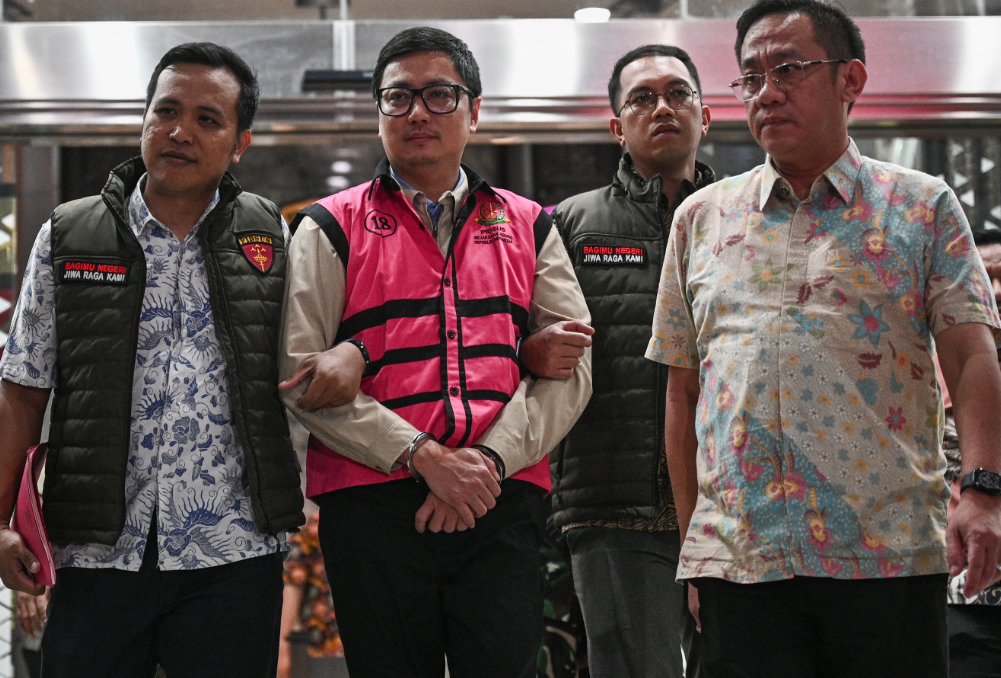
Indonesia's anti-corruption authorities have escalated their investigation into a major scandal undermining the government's flagship free meals initiative, with the Attorney General's Office announcing fresh arrests that signal the breadth of alleged malfeasance extending across both public agencies and private contractors. The investigation, which had initially focused on three former leaders of the National Nutrition Agency, now encompasses a widening network of suspects including logistics operators and businessmen accused of profiting from budget manipulation.
On Friday, investigators arrested Andri Mulyono, commissioner of logistics company PT Yasa Artha Trimanunggal, on suspicion of inflating procurement costs within the multitrillion-rupiah programme designed to distribute nutritious meals to schoolchildren and pregnant women across Indonesia. Authorities allege that Mulyono systematically marked up prices on more than 21,000 electric motorcycles destined for meal distribution kitchens nationwide, engineering the final bill to precisely match the National Nutrition Agency's allocated budget ceiling of Rp 1.03 trillion, equivalent to approximately US$58.2 million. This pricing manipulation, investigators contend, allowed Mulyono to extract illicit profits while obscuring the underlying irregularities through careful calculation.
The electric motorcycle procurement has emerged as a particularly contentious element of the scandal, drawing public ridicule since April when critics questioned its relevance to the core mission of combating malnutrition. The timing and necessity of purchasing thousands of motorcycles struck observers as divorced from pressing nutritional imperatives, fuelling broader scepticism about programme management. Finance Minister Purbaya Yudhi Sadewa subsequently acknowledged internal communication failures within his ministry that resulted in portions of the proposal gaining approval despite questionable justification, announcing that no additional motorcycle purchases would proceed in 2026.
A second businessman, Asep Yusuf Somantri, was arrested the previous week on allegations of leveraging his relationship with Sony Sonjaya, a former deputy head of the National Nutrition Agency, to improperly interfere with partner verification procedures. Prosecutors allege Somantri exploited his privileged access to manipulate kitchen registration systems and push through applications beyond the official registration deadline, effectively circumventing established safeguards designed to ensure transparent vetting of participating institutions. This form of insider assistance appears to have enabled Somantri to secure advantageous positions within the programme's operational framework.
The roster of five arrested suspects now includes the three top officials from the National Nutrition Agency who were apprehended on June 3, immediately following President Prabowo Subianto's summary dismissal of them from their positions. Former head Dadan Hindayana and deputy heads Sony Sonjaya and Lodewyk Pusung faced criminal charges within 24 hours of losing their administrative authority, reflecting the government's apparent determination to demonstrate decisive action in response to escalating public outrage. The rapid succession of arrests and terminations underscores the severity of the alleged breaches and the political pressure mounting on the administration.
Investigators have signalled their intention to expand the probe substantially further, with Sony Sonjaya's legal team having submitted an application requesting justice collaborator status in exchange for identifying an estimated 20 additional individuals implicated in the corruption network. While authorities have not disclosed details regarding these additional names, the suggestion of a broader conspiracy involving at least 25 people across multiple organisations indicates that the investigation has uncovered systemic problems rather than isolated misconduct by individual actors. Senior investigator Syarief Sulaeman Nahdi of the Office of Assistant Attorney General for Special Crimes confirmed that questioning would resume once the collaboration application undergoes formal review.
The free meals programme itself, launched in early 2025 with the stated objective of serving more than 80 million schoolchildren and pregnant women, has become mired in multiple crises beyond the corruption allegations. At least 33,000 documented cases of mass food poisoning have been reported since the initiative's rollout, raising fundamental questions about food safety protocols and quality control mechanisms. These health incidents, combined with mounting evidence of financial impropriety, have severely undermined public confidence in the scheme and transformed it from a popular social initiative into a focal point for criticism of government competence.
Public dissatisfaction crystallised on Friday when student-led protesters gathered for a demonstration labelled #MenujuIndonesiaBangkrut, literally meaning Indonesia heading for bankruptcy, explicitly calling for the programme's complete suspension. Demonstrators characterised the free meals initiative as emblematic of misplaced government priorities, particularly given Indonesia's deteriorating macroeconomic conditions and the weakening value of the rupiah against major currencies. The protests represent a significant shift in narrative, transforming what the government positioned as a compassionate poverty-alleviation measure into a symbol of fiscal irresponsibility and bureaucratic dysfunction.
Government officials have responded defensively to the mounting criticism, with Muhammad Qodari, head of the Government Communications Agency, issuing a statement on Saturday rejecting calls to terminate the programme. Qodari acknowledged that implementation challenges inevitably accompany large-scale initiatives, employing a colloquial and somewhat dismissive rhetorical flourish in asserting that operational problems are unavoidable in any active programme. His remarks attempted to reframe the scandals as routine teething troubles rather than systemic failures, arguing that identification and correction of problems represent normal governance processes rather than grounds for abandonment of policy objectives.
The government's decision to maintain the free meals programme despite mounting public opposition reflects competing priorities within the administration. While acknowledging operational difficulties, officials have repeatedly invoked the programme's contribution to reducing stunting and malnutrition rates as justification for continuation, emphasising long-term public health benefits over short-term political discomfort. This positioning suggests the Prabowo administration views the initiative as sufficiently aligned with its development agenda to warrant persistence despite reputational damage and scandal management challenges.
The corruption investigation carries significant implications for Indonesian governance and Southeast Asian perceptions of institutional accountability. The speed with which authorities apprehended and charged suspects indicates functional anti-corruption mechanisms, yet the scale of alleged misconduct also raises troubling questions about oversight and internal controls within major government programmes. For Malaysia and other regional states observing Indonesia's handling of the crisis, the investigation provides a case study in both the vulnerabilities of large-scale social programmes to exploitation and the importance of robust procurement verification and financial monitoring systems.
As the probe expands and additional suspects potentially emerge, the free meals programme faces an uncertain trajectory. The investigation's outcome will significantly influence public perception of government integrity and the feasibility of implementing ambitious social welfare initiatives in Southeast Asia more broadly. Beyond immediate accountability measures, the scandal underscores the importance of transparent implementation frameworks, independent oversight mechanisms, and responsive systems for addressing citizen concerns in large programmes serving vulnerable populations.

%22%2F%3E%3C%2Fpattern%3E%3C%2Fdefs%3E%3Crect%20width%3D%22100%25%22%20height%3D%22100%25%22%20fill%3D%22url(%23ph4qqbzg)%22%2F%3E%3Crect%20width%3D%22100%25%22%20height%3D%22100%25%22%20fill%3D%22url(%23ph4qqbzp)%22%2F%3E%3Ctext%20x%3D%2250%25%22%20y%3D%2250%25%22%20text-anchor%3D%22middle%22%20dominant-baseline%3D%22central%22%20fill%3D%22rgba(255%2C255%2C255%2C0.95)%22%20font-family%3D%22Georgia%2C%20'Times%20New%20Roman'%2C%20serif%22%20font-weight%3D%22700%22%20font-size%3D%22151%22%20letter-spacing%3D%22-0.02em%22%3ESoutheast%3C%2Ftext%3E%3C%2Fsvg%3E)
%22%2F%3E%3C%2Fpattern%3E%3C%2Fdefs%3E%3Crect%20width%3D%22100%25%22%20height%3D%22100%25%22%20fill%3D%22url(%23ph5491bg)%22%2F%3E%3Crect%20width%3D%22100%25%22%20height%3D%22100%25%22%20fill%3D%22url(%23ph5491bp)%22%2F%3E%3Ctext%20x%3D%2250%25%22%20y%3D%2250%25%22%20text-anchor%3D%22middle%22%20dominant-baseline%3D%22central%22%20fill%3D%22rgba(255%2C255%2C255%2C0.95)%22%20font-family%3D%22Georgia%2C%20'Times%20New%20Roman'%2C%20serif%22%20font-weight%3D%22700%22%20font-size%3D%22136%22%20letter-spacing%3D%22-0.02em%22%3EBangladesh%3C%2Ftext%3E%3C%2Fsvg%3E)