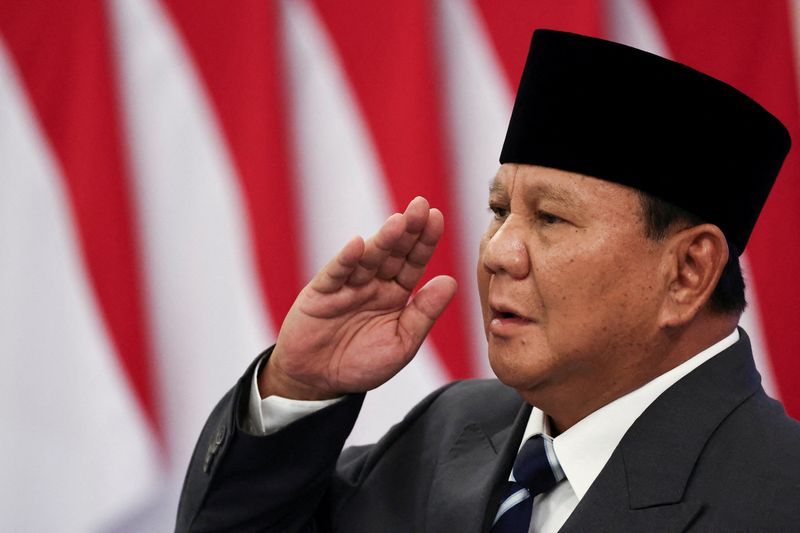
Indonesia is moving to weave artificial intelligence throughout its government operations, with an ambitious roadmap that touches some of the nation's most visible public services. A presidential regulation draft, which has not previously been reported, outlines plans to embed AI capabilities across key programmes including the government's centrepiece $15 billion free-meals scheme. The initiative represents President Prabowo Subianto's attempt to position Indonesia as a serious player in the global AI race, with policymakers projecting that such integration could expand the country's gross domestic product by 12 percent—equivalent to $366 billion—by 2030.
The regulatory framework, awaiting presidential signature, establishes implementation targets spanning 2026 to 2029, directing ministries and regional authorities to adopt AI systems in priority government initiatives. According to Wahyudi Djafar, a technology analyst who contributed to drafting the regulation and serves on the government's AI task force, major international technology firms including Meta Platforms, IBM, and Microsoft shaped the document's direction. The involvement of these multinational corporations underscores the intersection between Indonesia's development ambitions and the strategic interests of global tech leaders seeking to deepen their footprint in Southeast Asian markets. Microsoft itself has already signalled its confidence in Indonesia's potential, pledging $1.7 billion over several years to expand cloud infrastructure and AI services across the archipelago.
Indonesia's strategic push arrives at a moment when regional competitors are consolidating advantages in the AI sector. Singapore and Malaysia have already positioned themselves as regional technology development hubs, successfully attracting billions of dollars in investment from global technology enterprises constructing essential infrastructure for cloud and AI service delivery. By contrast, Indonesia's progress in AI capabilities has lagged behind these neighbours, creating both urgency and motivation for the current government to accelerate adoption. The new regulation can therefore be understood as an attempt to bridge a growing technological gap and prevent further divergence in regional competitiveness.
The free-meals programme, a flagship initiative that has consumed substantial public resources, appears set for significant technological overhaul. Under the proposed AI framework, the system would leverage machine learning to design region-appropriate menus tailored to local preferences and nutritional needs, continuously monitor kitchen sanitation standards through automated surveillance, forecast food consumption patterns to optimise supply chains, and flag operational anomalies that might indicate mismanagement or corruption. Additionally, the integration would connect health monitoring data with the feeding programme, enabling early warning systems for potential disease outbreaks or nutritional emergencies affecting participating children.
These technological interventions address genuine governance challenges that have plagued the programme since its inception. The initiative collapsed into crisis last year when tens of thousands of schoolchildren experienced foodborne illness, exposing serious deficiencies in food safety protocols and emergency response mechanisms. Investigations subsequently revealed irregularities in kitchen construction and setup, alongside persistent opacity regarding programme administration and resource allocation. Earlier this month, the initiative's leadership faced dramatic upheaval when its head was dismissed and arrested, further eroding public confidence. By introducing AI-driven oversight mechanisms, the government hopes to restore credibility whilst simultaneously addressing Indonesia's chronically constrained fiscal position—every efficiency gain theoretically redirects scarce budget allocations toward other pressing needs.
Yet implementation sceptics question whether technological solutions can remedy deeper structural deficiencies. Derwin Suhartono, an artificial intelligence professor at Bina Nusantara University in Jakarta, expressed concern that Indonesia lacks foundational prerequisites for meaningful AI deployment. Beyond the free-meals sector, the nation confronts acute shortages of computational infrastructure, including semiconductor and chip manufacturing capacity, alongside a workforce demonstrably underprepared in AI competencies and applications. Suhartono warned that without addressing these underlying constraints, Indonesia risks remaining locked into a subordinate position as a consumer of foreign-manufactured AI products rather than emerging as an indigenous developer or innovator. He further cautioned that whilst strategic roadmaps can appear impressive on paper, actual execution remains uncertain—characterising current government communications as predominantly rhetorical absent concrete operational follow-through.
Beyond the free-meals programme, the regulatory framework extends AI integration into Indonesia's public health infrastructure. The government intends to deploy machine learning algorithms to analyse results from its free health screening initiatives and tuberculosis testing campaigns. These applications could theoretically identify disease patterns, predict outbreak risk in vulnerable populations, and optimise resource allocation for prevention and treatment interventions. The underlying logic mirrors other sectors: automating data analysis whilst improving public service delivery and reducing operational expenditure through efficiency gains.
The regulation acknowledges legitimate governance concerns accompanying AI adoption, particularly regarding potential misuse and security vulnerabilities. Companion regulations stipulate that government agencies must systematically report risks associated with artificial intelligence deployment, encompassing biometric data misuse, intellectual property violations, and synthetic media manipulation (deepfakes). This risk framework suggests policymakers appreciate that unchecked AI integration without adequate safeguards could inadvertently create new vulnerabilities—a recognition that distinguishes the approach from purely techno-optimist enthusiasm.
Supporting the AI adoption agenda, the government simultaneously proposes establishing a dedicated sovereign AI fund, primarily managed through Danantara Indonesia, the nation's newly created wealth vehicle. The fund framework would provide fiscal incentives targeting AI researchers and specialists, attempting to attract and retain talent in a competitive global market. These financial mechanisms address the recognised skills deficit, though sceptics question whether financial incentives alone can overcome Indonesia's educational infrastructure limitations or compete with compensation packages from established technology hubs in Singapore, San Francisco, or Shanghai.
The regulatory initiative builds upon a white paper issued previously, representing incremental rather than revolutionary policy development. The timing of presidential signature remains unclear, with Prabowo's office declining immediate comment. This uncertainty itself reflects broader questions about the regulation's priority within an administration managing multiple urgent governance challenges, from fiscal consolidation to infrastructure development to anti-corruption efforts.
Indonesia's AI ambitions must be understood within the context of a nation simultaneously seeking to modernise governance, restore institutional credibility, and compete regionally for technology investment and talent. The proposed regulatory framework represents a genuine attempt to leverage emerging technologies addressing real policy problems—food safety, health service delivery, administrative efficiency. However, the substantial gap between well-intentioned regulation and effective implementation, combined with acknowledged infrastructure and skills constraints, suggests that Indonesia's AI journey will prove considerably more complicated than technological roadmaps suggest. Success will ultimately depend less on regulatory frameworks than on sustained investment in human capital, computational infrastructure, and genuine institutional reform.

