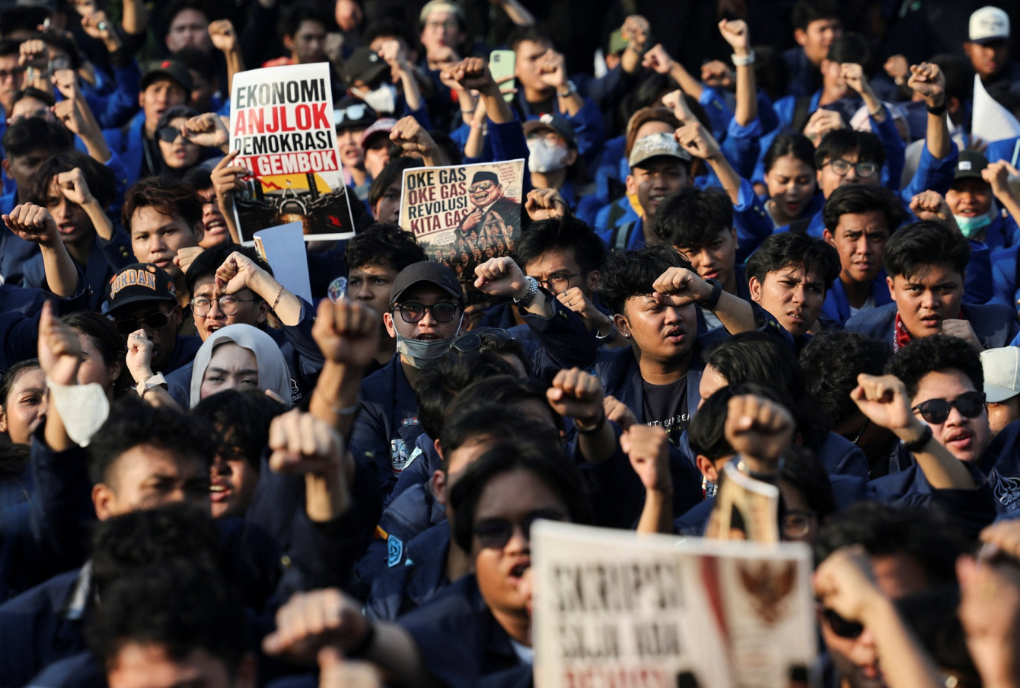
Indonesia's ambitious free meal programme, a centrepiece of President Prabowo Subianto's development agenda, has become a flashpoint for national debate as competing protests emerge across the archipelago, exposing deep divisions over how the government should balance social welfare with fiscal discipline. The controversy surrounding the scheme—allocated at least Rp 335 trillion this year to feed approximately 83 million beneficiaries including schoolchildren and pregnant women—reflects broader anxieties about governance, transparency, and economic priorities in Southeast Asia's largest economy.
Student activists have organised a string of demonstrations demanding immediate action on multiple fronts. In Bali, university students gathered outside the provincial legislative council building in Denpasar on Monday, articulating concerns that the programme's enormous budget allocation sits awkwardly alongside wider government austerity measures. Their grievances extend beyond fiscal management to encompass food safety incidents and implementation shortcomings. The protesters formally requested that both the government and Indonesia's Supreme Audit Agency (BPK) undertake exhaustive scrutiny of the free meal initiative, signalling a fundamental loss of confidence in current oversight mechanisms.
The student movement has proven most visible and organised in the capital. Thousands of activists affiliated with the Indonesian Islamic Student Movement (PMII) gathered at the House of Representatives (DPR) complex in Central Jakarta on Monday, demanding a complete leadership restructuring of the National Nutrition Agency (BGN), which administers the programme. This pressure follows the recent detention of three senior BGN officials on corruption allegations—a development that crystallised student concerns about whether funds are reaching intended beneficiaries. The Jakarta protests, which also encompassed calls for improved teacher compensation and economic strengthening, represented the latest in a series of demonstrations at the same location, with over 1,000 students convening just days earlier to denounce perceived fiscal waste.
Leading universities including Trisakti, Mercu Buana, and Esa Unggul coordinated the capital's demonstrations, alongside the Islamic Students Association (HMI), indicating that opposition to the programme's current structure has mobilised across mainstream student organisations. Protesters explicitly demanded that President Prabowo curtail what they characterised as profligate government expenditure and suspend several high-cost flagship initiatives, with the free meals scheme occupying prime position in their criticism. Comparable student-led activism occurred in Batam, Riau Islands, where demonstrators called for a thorough evaluation and threatened suspension if the programme cannot demonstrate measurable effectiveness and proper targeting. Muryadi Agus Priawan, coordinating the Batam Student Movement Alliance, framed student activism as essential democratic accountability, emphasising that protesters serve as watchdogs ensuring policymakers remain answerable to public interest rather than bureaucratic inertia.
Yet the narrative of unambiguous opposition obscures a more complex political economy. Hundreds of kitchen workers employed under the free meal scheme staged counter-demonstrations in Batam over the weekend, defending the programme's continuation and warning that efficiency measures would devastate their livelihoods. The government's decision to reduce meal distribution from six to five days weekly and suspend operations during school holidays directly threatens the income of approximately 1,500 daily-wage kitchen workers in Batam alone. Coordinator Langga Husein pointed out that the proposed cuts would also compromise nutritional support for pregnant women, lactating mothers, and toddlers who require year-round dietary assistance regardless of school calendars. This perspective reveals how austerity measures, however justified by fiscal hawks, impose tangible hardship on vulnerable working populations with limited alternative income sources.
Agriculturally dependent regions have emerged as unexpected strongholds of programme support. Residents in Bandar Lampung, Lampung, rallied publicly on Monday to advocate for the scheme's expansion rather than retrenchment. Field coordinator Maradoni articulated an economic argument rooted in local agricultural reality: the free meal programme absorbs substantial volumes of domestically produced commodities including corn, rice, cassava, and seasonal fruits and vegetables, thereby stabilising farm-gate prices and supporting rural incomes. For smallholder farmers who comprise much of Indonesia's agricultural base, the programme functions as a crucial demand stabiliser and price support mechanism. This agricultural constituency's mobilisation suggests that opposition to the scheme concentrates among fiscal conservatives and urban elites concerned with macroeconomic management, whilst benefits-dependent populations and rural producers constitute a substantial pro-continuation coalition.
Similar pro-programme demonstrations have materialised in Jakarta, West Nusa Tenggara, and East Java, indicating geographically dispersed constituencies whose economic welfare depends on the scheme's continuation. The spatial distribution of competing protests reflects Indonesia's persistent urban-rural divide, with student and bureaucratic critiques emanating primarily from metropolitan centres and institutions of higher learning, whilst worker and agricultural interests mobilise in provincial towns and rural districts. This geographic bifurcation poses genuine governance challenges for policymakers attempting to navigate legitimacy across diverse constituencies.
The Prabowo administration has adopted a pragmatic middle path, declining student demands for suspension whilst implementing efficiency measures and budget reductions. Government Communications Agency head Muhammad Qodari has publicly insisted that the programme will continue, rejecting suspension arguments and advocating instead for systematic improvement of existing structures. In parallel, National Nutrition Agency Deputy Head Agustina Arumsari announced that the budget has been trimmed to Rp 228.4 trillion—a substantial reduction from the initial allocation—and flagged operational efficiencies including suspension during the late June through mid-July school break. Additionally, the government plans to halt distribution in 76 schools situated in relatively affluent urban areas deemed capable of meeting nutritional needs through private resources, targeting benefits more narrowly toward disadvantaged populations.
These modifications reveal the administration's attempt to preserve the programme's social legitimacy whilst addressing legitimate concerns about cost and targeted effectiveness. The decision to suspend operations during school holidays, however, creates precisely the nutritional coverage gap that worker and agricultural defenders worry will most harm vulnerable populations. Similarly, excluding affluent school communities, while fiscally sensible, invites accusations of means-testing that may undermine the universal programme's symbolic and political appeal. The government finds itself navigating a narrow path between fiscal sustainability and developmental ambition, between macroeconomic prudence and the concrete wellbeing of populations relying on state-provided nutrition.
For Malaysia and the broader Southeast Asian region, Indonesia's free meal programme controversy offers instructive lessons about the tension between large-scale social protection schemes and fiscal constraint in middle-income developing economies. The programme's Rp 335 trillion initial allocation represents approximately two percent of Indonesia's annual government spending—a substantial commitment that competes directly with infrastructure, debt service, and defence expenditures in a country with limited fiscal space. Neighbouring countries considering comparable universal nutrition schemes must grapple with similar trade-offs between aspirational social policy and realistic budget constraints. The corruption allegations surrounding the BGN, meanwhile, highlight the institutional challenges facing large-scale government programmes in contexts where transparency and accountability mechanisms remain contested.
Indonesia's President Prabowo launched the initiative in January following his election campaign promises to prioritise child nutrition and stunting reduction—objectives supported across the political spectrum. The programme targets approximately 83 million beneficiaries, making it among the world's largest nutrition interventions. However, its scale amplifies implementation risks and provides ample opportunity for inefficiency or misappropriation, as the corruption investigation has demonstrated. The student protests should be understood partly as expressions of frustration with weak implementation oversight and governance accountability rather than blanket opposition to nutrition support itself.
Looking forward, the intensifying protest dynamics suggest that the Prabowo administration faces growing pressure to demonstrate tangible results and transparent administration of the free meal scheme. The efficiency measures already announced—budget reduction, suspension during school holidays, exclusion of affluent schools—may prove insufficient to satisfy fiscal critics whilst simultaneously disappointing beneficiaries and workers anticipating continued full-scale operations. The programme's political viability ultimately depends on whether the government can improve accountability, reduce corruption, and communicate convincingly that allocated resources genuinely reach intended recipients. As Malaysia and other regional economies consider their own social protection expansion, Indonesia's experience underscores that universal programmes' success hinges not merely on adequate funding, but on institutional capacity, transparent administration, and political commitment to effective implementation.

