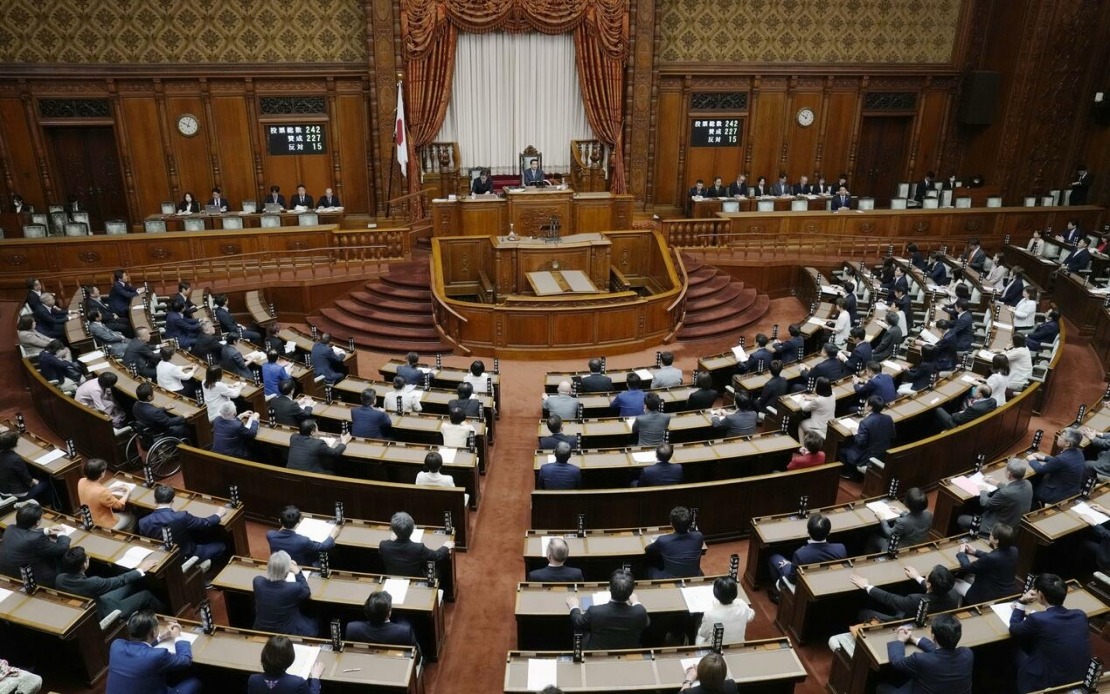
Japan's parliament has enacted sweeping reforms to its defence infrastructure, passing legislation on Friday that fundamentally restructures the nation's Air Self-Defence Force by incorporating explicit space operations into its organisational framework and official title. The measures represent a strategic pivot toward emerging security domains as the country confronts mounting geopolitical pressures in its surrounding waters and airspace. Implementation of the reorganisation will commence during the fiscal year ending March 2027, signalling Tokyo's methodical approach to this transformation despite the urgency driving these changes.
At the heart of the restructuring lies the establishment of a dedicated space operations group, to be commanded by a lieutenant general tasked with enhancing Japan's surveillance and awareness capabilities across the space domain. This organisational innovation directly addresses vulnerabilities in satellite reconnaissance and orbital monitoring—areas increasingly critical for early warning systems and strategic intelligence gathering. The creation of this unit acknowledges that modern military readiness depends fundamentally on secure space-based infrastructure, from communications networks to positioning systems that guide weapons platforms and coordinate multinational operations.
Defence Minister Shinjiro Koizumi underscored the civilian dimension of space security during his announcement, noting that contemporary Japanese society relies extensively on orbital infrastructure for basic services. Satellite navigation systems embedded in smartphones, weather forecasting networks, and agricultural monitoring systems all depend on uninterrupted access to space assets. Koizumi's framing deliberately connects military space capabilities to civilian prosperity, a rhetorical choice that emphasises how space security transcends traditional defence categories and touches all societal functions. This messaging approach helps build public consensus for defence spending at a time when Japan faces fiscal constraints and generational debates about military spending.
The legislation simultaneously authorises the appointment of a second senior vice defence minister, effectively doubling the nation's high-level civilian defence leadership capacity. This institutional expansion reflects practical lessons learned from recent crises, particularly the devastating earthquakes and typhoons that regularly strike Japan. By creating redundancy in senior defence decision-making, the government positions itself to manage multiple simultaneous contingencies—natural disasters, military crises, or hybrid scenarios combining both. The additional vice minister also facilitates expanded defence diplomacy with Washington and other security partners, providing dedicated capacity for the intricate negotiations required to coordinate allied military cooperation in an increasingly multipolar Asia-Pacific.
Japan's defence recruitment crisis forms the underlying rationale for several provisions within the legislation. The Self-Defence Forces confront demographic headwinds and cultural shifts that make military service less attractive to younger Japanese, who face competing career opportunities in a technologically advanced economy. By restructuring post-retirement benefits and adjusting compensation frameworks, Tokyo attempts to make SDF careers more economically competitive. These modifications matter especially since mandatory retirement ages for military personnel typically occur years before standard civil service retirement thresholds, meaning former officers face extended periods without steady income—a calculus that deters qualified candidates from enlisting.
The southwestern island dimension of Japan's strategic calculus receives explicit institutional reinforcement through the legislation's upgrade of the Ground Self-Defence Force's 15th Brigade, stationed in Naha, Okinawa Prefecture. This unit becomes Japan's newest full division, expanding its command structure, deployment capabilities, and personnel complement. Okinawa's geographic position places it at the frontier of China's expanding maritime reach into the Pacific, making the island prefecture an acute point of potential military friction. China's assertive construction and militarisation of outposts throughout the East China Sea and South China Sea, combined with increased naval operations near Japanese territory, prompted Tokyo to strengthen ground defences in these remote but strategically vital islands.
For Malaysian and broader Southeast Asian observers, Japan's space defence initiative carries meaningful implications for regional stability. Japan functions as a crucial security anchor in the western Pacific and as a key interlocutor with the United States concerning Asian security architecture. Japanese advances in space-based surveillance and reconnaissance capabilities inevitably reshape the military information environment throughout Asia-Pacific waters, including zones that directly concern Malaysian maritime interests. Malaysian planners monitoring developments in the South China Sea must account for enhanced Japanese surveillance capabilities that could contribute to regional transparency or become integrated into broader US-led surveillance architectures.
The timing of Japan's reorganisation also reflects broader patterns of military modernisation among US allies responding to Chinese military advancement. South Korea, Taiwan, Australia, and other American partners have similarly accelerated space-focused defence initiatives. Japan's formalisation of space operations as a core defence function thus participates in a coordinated alliance response to power shifts in the Indo-Pacific. This coordinated approach carries implications for how maritime disputes, including those affecting Malaysia, might be monitored, documented, or escalated through alliance networks.
Defence Minister Koizumi's stated commitment to building institutional frameworks for effective Self-Defence Force operations points toward sustained budgetary increases and technological investments extending far beyond this single legislative package. Japan faces a multi-year modernisation agenda encompassing hypersonic weapons development, advanced fighter aircraft acquisition, and expanded amphibious capabilities. The space legislation functions as a foundational stone within this broader strategic reconstruction, establishing the organisational prerequisites for integrating space capabilities across all domains of Japanese military operations.
The appointment of an additional senior vice defence minister, expected during the coming summer months, will signal whether Tokyo intends merely symbolic bureaucratic adjustments or genuine expansions in defence decision-making capacity. Observers should monitor whether this position attracts experienced defence professionals and whether it produces tangible changes in allied coordination or crisis response procedures. The cumulative effect of these reforms—space reorganisation, leadership expansion, recruitment incentives, and southwestern island fortification—sketches an emerging Japanese military posture increasingly confident in technological sophistication while consciously attempting to sustain personnel levels amid demographic decline. This balancing act will define Japanese defence effectiveness throughout the coming decade.

