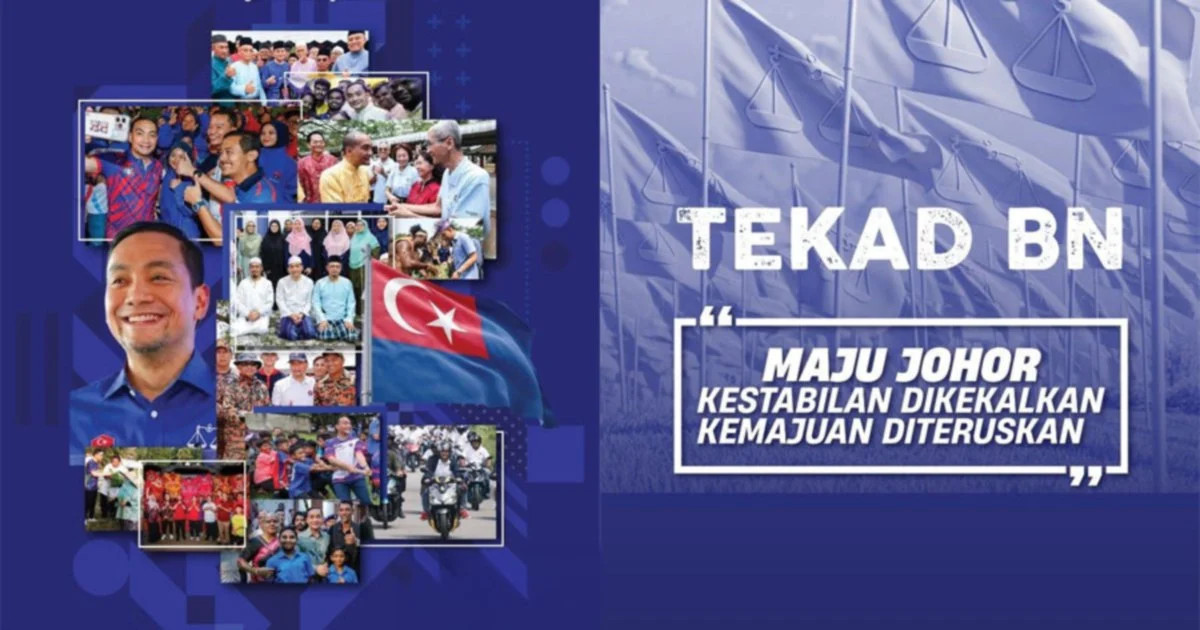
Barisan Nasional launched its election platform for Johor on Wednesday in Johor Baru, presenting a comprehensive 63-point manifesto designed to address voter concerns while emphasising continuity in governance. The coalition's blueprint rests on six foundational pillars that party leaders say will protect the state's hard-won stability whilst accelerating its development agenda across multiple sectors.
Job creation stands as the manifesto's most prominent economic target. The 200,000 employment positions the coalition pledges to generate represent a significant response to unemployment concerns that have featured prominently in public discourse across the southern region. These positions are expected to span both traditional and emerging industries, reflecting efforts to diversify Johor's economy beyond its traditional reliance on manufacturing and services. The pledges suggest BN aims to position itself as the coalition most capable of delivering tangible economic benefits to ordinary Johoreans, particularly younger voters entering the job market.
The six-pillar framework reveals the coalition's understanding of voter priorities across different demographics. Rather than concentrating solely on large infrastructure projects, the manifesto appears designed to address concerns ranging from education and healthcare to agricultural modernisation and urban development. This multi-sectoral approach suggests BN strategists believe victory requires appealing simultaneously to urban professionals, rural communities, and traditional strongholds that have historically supported the coalition.
Johor's political significance within the Malaysian federation cannot be overstated. As the nation's second-largest state by population and a crucial economic engine, the result will carry implications beyond state boundaries. A strong BN performance in Johor would strengthen the coalition's national position, whilst any setback would signal shifting voter sentiment that opposition parties would surely highlight. The state's political complexion has shifted considerably in recent years, making the manifesto launch a critical moment in the campaign narrative.
The emphasis on stability appears calculated to respond to opposition criticism that change is necessary. By framing their pledges within existing structures and partnerships, BN seems intent on positioning itself as the safe, predictable choice for voters concerned about disruption to services and business continuity. This defensive posture may reflect internal awareness that voter sentiment has become more volatile and harder to predict compared with previous electoral cycles.
The manifesto's construction around six pillars suggests BN has undertaken significant research into voter concerns. Whether these pillars address housing affordability, which remains a pressing issue for younger Johoreans, or whether they prioritise industrial development that might benefit corporate partners requires examination of the detailed pledges. The breadth of the commitment hints that party strategists identified several areas where the opposition coalition perceived vulnerability and attempted to pre-empt criticism.
Job creation promises carry particular weight in the current economic climate. With cost-of-living pressures affecting Malaysian households broadly, and Johor experiencing its own labour market dynamics influenced by cross-border employment patterns with Singapore, the 200,000-job target addresses immediate household concerns. However, the quality and sustainability of these positions will likely become a central debate point, with opposition parties questioning whether pledges translate into meaningful, permanent employment or temporary arrangements masking structural economic challenges.
The timing of the manifesto release reflects careful campaign choreography. Launching the platform before opposition coalitions reveal their own proposals allows BN to set initial terms of debate, frame campaign narratives, and force competitors into reactive positions. However, the strategy also creates expectations that the coalition must now meet through concrete action should voters return them to power.
Regional observers will likely scrutinise how the manifesto addresses Johor's unique geopolitical position as Malaysia's southernmost state with deep economic ties to Singapore. Whether the pledges adequately account for cross-border trade implications, foreign investment concerns, or regional development opportunities will influence how different voter segments assess BN's capability to manage Johor's affairs.
The coalition's reliance on six foundational pillars rather than scattered individual pledges suggests sophisticated campaign messaging designed to create coherent narratives voters can readily understand and remember. This structural approach differs from simply listing policy ideas and may prove more effective in conveying a comprehensive vision of governance to an electorate increasingly bombarded with competing political messages.
For Southeast Asian observers tracking Malaysian political developments, the Johor election represents another test of whether traditional coalitions can adapt messaging to contemporary voter expectations. The manifesto's content and reception will offer insights into whether Malaysian voters prioritise economic performance and stability above other considerations, or whether demands for accountability, transparency, and systemic reform have fundamentally altered electoral calculus.

