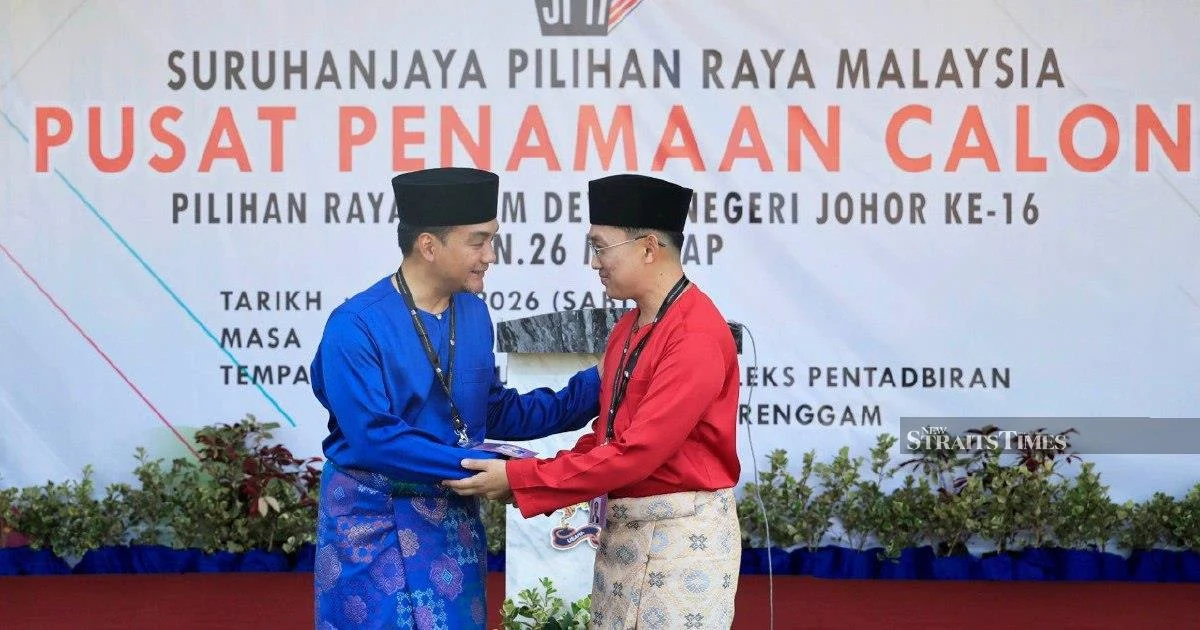
The race for Johor's top political position is shaping up to be more unpredictable than its incumbent leadership might suggest. Speaking in Simpang Renggam, caretaker Menteri Besar Datuk Onn Hafiz Ghazi expressed a measured perspective on his electoral prospects, emphasising that political contests invariably contain elements of surprise regardless of past performance or current polling indicators. His comments come as Johor prepares for its July 11 election, where he seeks validation for a second term leading the state.
Onn Hafiz's cautious posturing reveals a strategic calculation that extends beyond mere political modesty. In Malaysian electoral politics, particularly at the state level, the distance between polling day projections and actual results has widened considerably in recent election cycles. The Menteri Besar's acknowledgment that "anything can happen" reflects both historical awareness of electoral volatility and the practical necessity of keeping his coalition mobilised until voting concludes. This rhetorical approach serves a dual purpose: it tempers expectations that might breed complacency within his own political machinery while simultaneously suggesting to voters that every vote carries genuine weight.
The Machap constituency, which forms the electoral battleground for Onn Hafiz's personal seat, carries symbolic importance beyond its individual representative role. As the Menteri Besar's own constituency, its outcome will largely determine whether his administration receives a fresh mandate and whether state governance continuity prevails. Political analysts across the region often treat a chief executive's own constituency as a barometer for broader sentiment, making this particular contest exceptionally significant for reading Johor's political mood heading into the second half of 2024.
Johor's political landscape has undergone substantial reconfiguration in recent years, with coalition alignments, leadership transitions, and demographic shifts all contributing to an environment where traditional assumptions about electoral advantage carry diminishing predictive power. The state has experienced intense inter-coalition competition, particularly between Barisan Nasional and Perikatan Nasional formations, with both blocs commanding substantial voter bases. This structural competition means that even strong incumbent positions offer no guarantees, as voter sentiment can shift rapidly in response to campaign messaging, local grievances, or broader national political developments.
For Onn Hafiz specifically, his path to the Menteri Besar's office and his tenure thus far have been marked by both achievement and controversy. His administration has pursued various developmental initiatives while navigating the complex terrain of managing a state with significant economic importance to Malaysia's broader economy. The July 11 election represents an opportunity for voters to assess whether his government's performance warrants continuation or whether alternative leadership deserves consideration. His cautious rhetoric acknowledges that such assessments cannot be taken for granted.
The Malaysian electoral system, despite its familiar mechanics, continues to produce outcomes that defy simple prediction models. Factors including voter turnout patterns, last-minute campaign momentum, fence-sitter decision-making, and local issues that dominate final weeks of campaigning all create genuine uncertainty. Onn Hafiz's experience as a politician presumably makes him acutely aware of these dynamics, explaining his apparent reluctance to project overconfidence despite holding the considerable advantages that incumbency typically provides.
Regional observers watching Johor's election will assess not merely which coalition controls the state government, but what the results suggest about Malaysian electoral behaviour more broadly. As a major economic hub and traditionally influential state in national politics, Johor's political direction carries implications extending beyond its borders. The state's voters are making judgments not only about local governance but about the broader trajectory of Malaysian politics, and their choices will reverberate through national political calculations.
Onn Hafiz's measured approach to campaigning appears designed to sustain voter attention and participation rather than suggesting actual vulnerability in his position. However, the principle he articulates—that electoral contests remain fundamentally unpredictable—reflects a truth that experienced politicians understand: voter decisions emerge from complex calculations that resist neat categorisation, and campaigns can shift perceptions in unexpected directions. His insistence on remaining vigilant rather than complacent represents sound electoral strategy regardless of actual competitive circumstances.
As the Johor campaign intensifies toward July 11, Onn Hafiz's refrain will likely persist as a central theme of his messaging. Whether interpreted as genuine caution or strategic positioning, his acknowledgment that outcomes remain uncertain serves to motivate his supporters while warning against the organisational slack that defeated governments often point to as contributing factors. The election itself will ultimately determine whether his electoral predictions prove accurate or whether voter decisions surprise observers once again.

