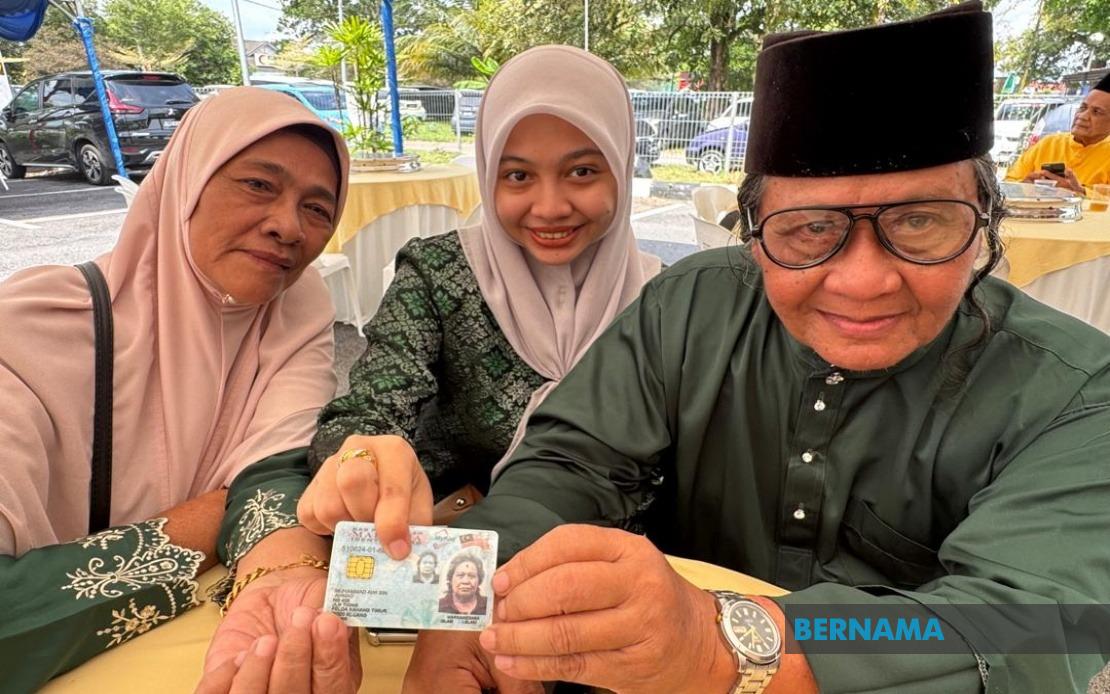
A milestone moment arrived for Muhammad Awi Ahmad on his 75th birthday when he finally received official ownership of his 4.2-hectare plantation and family residence in Felda Kahang Timur, after pursuing the title through three separate applications spanning nearly four decades. His achievement symbolizes the culmination of a broader effort by the Johor state government under Menteri Besar Datuk Onn Hafiz Ghazi to resolve a longstanding administrative impasse that has haunted the state's agricultural settler communities since the inception of the Federal Land Development Authority schemes decades ago.
Muhammad Awi's journey illustrates the frustration many early Felda participants encountered. His initial applications in 1990 and 2000 were rejected, leaving him and thousands of others in legal limbo despite having actively farmed their allocated plots and paid their obligations. The subsequent approval of his third application within approximately one year suggests a significant acceleration in processing efficiency, indicating that administrative bottlenecks rather than legal complications were responsible for the extended delays.
The Johor Felda Settlers Land Title Handover Ceremony, held at Dewan Dato' Onn within the Rumah Komuniti Parlimen Sembrong complex in Kluang, recognized 210 successful applicants from three districts: Kluang, Kota Tinggi, and Mersing. The gathering brought together families whose circumstances varied widely but whose central concern remained identical—transforming decades of productive labour into recognized, transferable property rights. This distribution across multiple districts underscores the scale of the backlog and the systematic nature of the resolution process now underway.
The implications extend profoundly beyond the immediate recipients. Norliyani, Muhammad Awi's 25-year-old daughter, articulated a generational anxiety that animates the second and third cohorts of settler families. Unlike their parents, who typically maintained connections to villages of origin and could theoretically retreat to ancestral lands if Felda schemes failed, younger settlers have roots only in the agricultural communities their parents established. For them, securing clear ownership documentation represents not merely an asset transfer but an existential requirement—ensuring that family heritage and accumulated wealth remain within the family rather than reverting to the state or passing to unrelated third parties.
Mohd Farhan Mohamad's experience adds another dimension to the narrative. His 43-year tenure on Felda Pasak in Kota Tinggi, initiated through an application lodged in 2006, stretched across 18 years before approval materialized. The fact that his father, Mohamad Masek, had cultivated the land since the 1980s—potentially three decades before receiving formal title—demonstrates that the problem affected settlers across multiple waves of the Felda programme. Farhan's candid admission that he did not anticipate approval, even after submitting a fresh application the previous year, suggests deep-rooted skepticism about bureaucratic responsiveness within these communities.
The statistical completion rate warrants careful interpretation. With 27,639 out of 27,642 Felda settlers in Johor having received titles—representing 99.9 percent—the state has achieved near-universal resolution of applications received. This remarkable figure indicates that the remaining obstacles, if any exist, are trivial edge cases rather than systemic failures. However, it also raises questions about why the process consumed so many decades when contemporary throughput appears capable of resolving cases within months to a couple of years. Administrative restructuring, political prioritization, or resource reallocation must account for the shift in processing velocity.
The broader Felda context provides essential background for Malaysian and regional readers. The Federal Land Development Authority, established in the 1950s as a flagship poverty-alleviation and rural development instrument, allocated land to settlers under long-term occupancy arrangements rather than immediate freehold ownership. This structure served multiple purposes: controlling land speculation, ensuring continued agricultural productivity, and maintaining settler focus on farming rather than real estate investment. However, the unintended consequence was generations of settlers whose legally-recognized rights remained ambiguous, complicating inheritance, loan applications, and long-term family planning.
Johor's resolution effort, while incomplete on a national scale, represents an important precedent. Other states where Felda schemes operate—including Pahang, Terengganu, Perak, and Kepuang—presumably contain analogous backlogs. If the Johor model proves effective and administratively sustainable, it could provide a template for nationwide implementation, potentially affecting tens of thousands of settler families and resolving a governance issue that has festered across multiple election cycles and ministerial tenures.
The ceremony's symbolic importance should not be underestimated. Public recognition of settler achievements, the physical handover of documentation, and the presence of state leadership all communicate that the government takes seriously its obligations to communities that functioned as essential components of post-independence development policy. For settlers who have endured uncertainty and frustration, the ceremony validates decades of labor and reaffirms their integration into the formal property rights system that underpins modern economic participation.
Looking forward, the completion of title distribution creates new opportunities and obligations. Settlers now possess collateral for agricultural loans, inheritance clarity for family succession planning, and the psychological security of unambiguous ownership. Agricultural authorities can potentially develop more sophisticated engagement strategies with settler communities, knowing that property security is no longer a destabilizing variable. Insurance, cooperative financing, and value-chain participation become more feasible when settlers can pledge their land as security.
For policymakers across Southeast Asia, the Johor experience underscores an enduring challenge in land development schemes: the gap between initial allocation and final formalization of rights. Countries throughout the region have launched comparable agricultural settlement programmes, and many face similar title documentation backlogs. The Johor effort, extending across nearly four decades before systematic resolution commenced, suggests that such issues require deliberate intervention rather than assuming they resolve through routine administrative processes.
The human dimension remains paramount. Muhammad Awi's birthday gift, Norliyani's advocacy for generational security, and Farhan's relief that his father's decades of stewardship finally receive official acknowledgment—these individual narratives aggregate into a collective testimony about the profound importance of property formalization in rural communities. As Malaysia continues developing its agricultural sector and exploring land-based economic strategies, ensuring that settlers possess clear, incontestable titles represents not merely bureaucratic tidiness but a foundation for sustainable prosperity and social cohesion.

